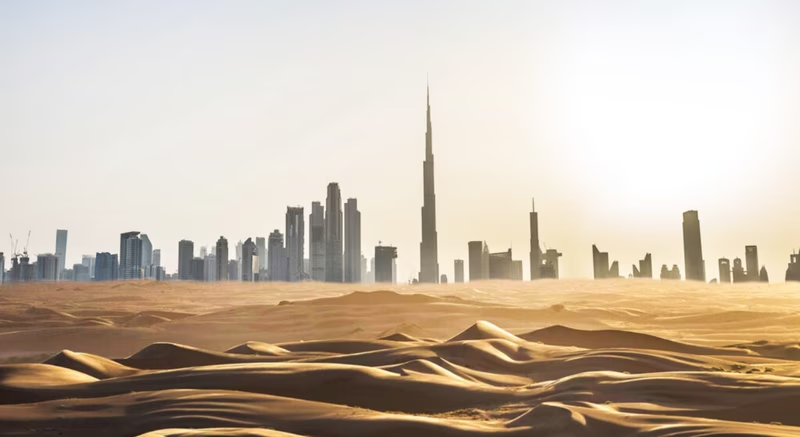
Imagine this: a country covered in endless dunes, home to some of the planet’s largest deserts, yet forced to ship sand halfway across the globe to build its cities. That’s the striking reality for **Saudi Arabia and the UAE**, which regularly **import sand from Australia**—and even from Europe and Southeast Asia—to fuel their architectural ambitions .
From the record-shattering **Burj Khalifa** to the futuristic **NEOM megacity**, these nations rely on foreign sand because the very sand beneath their feet is virtually useless for modern construction. It’s a paradox that exposes a little-known but critical global issue: the **world is running out of usable sand**—and the consequences are far-reaching .
Table of Contents
- Why Saudi Arabia Imports Sand from Australia
- The Science Behind Sand: Why Desert Grains Fail in Concrete
- The Hidden Global Sand Crisis: Demand vs. Supply
- Environmental Damage from Sand Mining
- Sustainable Alternatives: The Future of Construction
- Conclusion: Building the Future Without Destroying the Planet
- Sources
Saudi Arabia Imports Sand from Australia: The Paradox Explained
At first glance, it seems absurd. Saudi Arabia’s Rub’ al Khali—the Empty Quarter—is one of the largest continuous sand deserts on Earth, spanning over 650,000 square kilometers . So why spend millions importing sand from quarries in Western Australia?
The answer lies in **grain structure**. Construction-grade concrete requires sand with **rough, angular grains** that can lock together with cement and gravel to form a strong, stable matrix. Desert sand, shaped by millennia of wind erosion, is **too smooth and rounded**—like tiny ball bearings. When mixed into concrete, it lacks cohesion, resulting in weak, crumbly structures unsuitable for skyscrapers or infrastructure .
As a result, Gulf nations source what’s known as “industrial sand” from riverbeds, quarries, and marine deposits—places where water erosion creates the jagged texture needed for high-strength concrete. Australia, with its vast mineral reserves and strict mining regulations, has become a key supplier .
The Science Behind Sand: Why Desert Grains Fail in Concrete
Not all sand is created equal. Geologists classify sand by origin and morphology:
- Desert Sand: Wind-polished, spherical grains. Poor binding ability. Unusable for concrete.
- River Sand: Water-tumbled, angular and irregular. Excellent for construction. Highly sought after.
- Marine Sand: Similar angularity, but often contains salt that corrodes steel rebar—requiring costly washing.
- Manufactured Sand (M-sand): Crushed rock, engineered for consistency. Growing in popularity.
Concrete is more than just a mixture—it’s a science. The **interlocking geometry** of sand particles determines compressive strength. Desert sand simply can’t provide that. As one civil engineer put it: “You can’t build Burj Khalifa on beach balls.”
The Hidden Global Sand Crisis: Demand vs. Supply
This isn’t just a Gulf problem—it’s a planetary emergency. Sand is the **second-most consumed natural resource on Earth after water**, with over **50 billion tons** used annually in construction, glass, and electronics .
According to the United Nations Environment Programme (UNEP), we’re using sand **twice as fast as it’s naturally replenished**. Key hotspots of shortage include India, China, and the Middle East—regions undergoing rapid urbanization .
The demand is only accelerating. Saudi Arabia’s **NEOM project alone** is expected to consume hundreds of millions of tons of sand over the next two decades. Without alternatives, the pressure on global sand reserves will only intensify.
Environmental Damage from Sand Mining
Extracting river and marine sand isn’t harmless. Unregulated dredging has already caused:
- Riverbed degradation in India and Indonesia, leading to bridge collapses and water table drops.
- Coastal erosion** in Southeast Asia, as beaches vanish faster than they can regenerate.
- Loss of aquatic habitats**, disrupting fish breeding grounds and marine biodiversity.
- Illegal sand mafias** in countries like Cambodia and Myanmar, linked to corruption and violence .
Even “legal” imports carry an ecological footprint—shipping sand across oceans adds to carbon emissions. The irony? Mega-projects marketed as “sustainable” (like NEOM’s The Line) may be built on environmentally destructive foundations.
Sustainable Alternatives: The Future of Construction
Thankfully, innovation is catching up. Researchers and engineers are exploring viable substitutes:
- Recycled Concrete Aggregate (RCA): Crushed old concrete reused in new builds.
- Manufactured Sand (M-sand): Produced by crushing granite or basalt—already widely used in India.
- Desert Sand Composites: Experimental binders that allow desert sand to be used (e.g., UAE’s “Sand Concrete” project).
- Bamboo, Hempcrete, and 3D-Printed Structures: Low-sand or sand-free building methods.
For authoritative insights, the UNEP’s 2022 report on sand sustainability outlines a global framework for responsible resource management .
Conclusion: Building the Future Without Destroying the Planet
The fact that **Saudi Arabia imports sand from Australia** is more than a curious anomaly—it’s a warning sign. It reveals a fragile global supply chain, unsustainable consumption patterns, and the urgent need for innovation in construction. As nations race to build smarter, greener cities, the solution won’t come from digging deeper—but from thinking differently. The future of urban development depends not on how much sand we can mine, but on how creatively we can replace it.
Sources
- Times of India: Why Saudi Arabia and the UAE import sand from Australia despite their endless deserts
- UNEP: Sand and Sustainability: Finding New Solutions for Environmental Governance
- NASA Earth Observatory: The Global Sand Shortage
- World Atlas: Rub’ al Khali Desert Facts