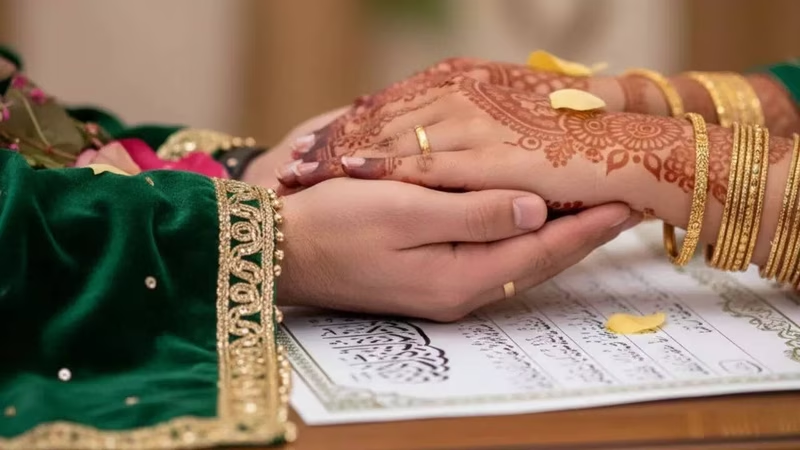
In a move that has sparked both support and debate across Uttar Pradesh, a local Muslim community panchayat in **Kosi Kalan** has issued a sweeping directive: **nikah ceremonies can no longer be held at hotels, banquet halls, or guest houses**. The order, aimed at curbing “unnecessary extravagance,” also bans DJ music, fireworks, and the traditional ‘salami’ ritual—imposing an **Rs 11,000 fine** for repeat violations .
Under the new rules, all nikahs must now be solemnized exclusively in **mosques**, reflecting a growing push within certain conservative religious circles to return to simpler, more austere wedding practices aligned with Islamic principles. This decision by the Kosi Kalan panchayat is not just administrative—it’s a cultural statement with deep social implications .
Table of Contents
- UP Panchayat Bans Nikah at Hotels: What’s Prohibited?
- Why the Ban? Promoting Austerity and Equality
- Community Reaction: Support, Concern, and Criticism
- Legal Standing: Can a Panchayat Enforce Religious Rules?
- Similar Austerity Measures in Other Indian Communities
- Conclusion: Tradition vs. Modernity in Wedding Culture
- Sources
UP Panchayat Bans Nikah at Hotels: What’s Prohibited?
The Kosi Kalan panchayat’s resolution is remarkably specific. Effective immediately, the following are **strictly forbidden** at all nikah ceremonies within its jurisdiction :
- Venue**: Nikahs cannot be held in hotels, private banquet halls, or guest houses. Only mosques are permitted.
- Entertainment**: DJ music, live bands, and loudspeakers for non-religious content are banned.
- Fireworks**: No firecrackers or celebratory pyrotechnics allowed.
- ‘Salami’ ritual**: The practice of giving cash gifts to the groom’s family during the ceremony is prohibited.
- Penalty**: First-time violators receive a warning; repeat offenders face a fine of **Rs 11,000**.
The panchayat argues these restrictions are not about control—but about **reviving the spiritual essence of nikah**, which, in Islamic tradition, is meant to be a simple, solemn contract, not a lavish social spectacle .
Why the Ban? Promoting Austerity and Equality
Behind this decision lies a growing concern among religious elders about the **financial burden** of modern weddings. In many communities, families go into debt to host elaborate nikahs—featuring multi-course meals, designer outfits, and expensive entertainment—just to keep up with social expectations .
“Nikah is a religious obligation, not a fashion show,” said a senior member of the panchayat, speaking anonymously to local media. “We want to protect poor families from shame and debt.”
The ban on ‘salami’—where the bride’s family gives cash to the groom’s relatives—is particularly significant. Critics long viewed it as a form of **dowry in disguise**, contradicting Islamic teachings that prohibit financial demands on the bride’s side . By outlawing it, the panchayat aims to restore gender equity in marital customs.
Community Reaction: Support, Concern, and Criticism
Reactions in Kosi Kalan have been mixed. Many low-income families have welcomed the move, calling it a “relief from social pressure.” Young couples, however, express frustration—especially those who see hotel venues as more convenient, private, or hygienic than crowded local mosques .
Others worry about **enforcement**. “Who decides what’s ‘too loud’? Can they really fine someone for playing a wedding song?” asked a local shopkeeper. Meanwhile, women’s rights activists caution that while austerity is noble, such bans must not infringe on personal freedoms or become tools for moral policing .
Legal Standing: Can a Panchayat Enforce Religious Rules?
This is where things get legally complex. While **Muslim personal law** allows community bodies to offer religious guidance, panchayats in India **do not have statutory authority to impose fines or criminal penalties** for religious or social behavior .
According to the Ministry of Panchayati Raj, local panchayats can pass resolutions on civic matters—like sanitation or land use—but **cannot enforce religious codes** or levy fines outside the framework of municipal law .
That means the Rs 11,000 penalty is likely **symbolic or community-based**, not legally enforceable in a court of law. Still, social pressure in tight-knit communities can be a powerful deterrent—sometimes more effective than legal sanctions.
Similar Austerity Measures in Other Indian Communities
Kosi Kalan isn’t alone. Across India, religious and caste-based panchayats have introduced austerity rules:
- In **Rajasthan**, several Hindu panchayats have capped wedding guest lists at 200 people.
- In **Karnataka**, a Jain community banned gold jewelry at weddings to promote simplicity.
- In **Bihar**, Muslim imams have issued fatwas against dowry and excessive spending .
Even the **All India Muslim Personal Law Board** has repeatedly urged followers to keep nikahs simple, citing Quranic principles that emphasize modesty over showmanship . For deeper context on Islamic wedding ethics, the Islamic Relief UK’s guide on wedding practices offers a balanced perspective .
Conclusion: Tradition vs. Modernity in Wedding Culture
The **UP panchayat bans nikah at hotels** is more than a local ordinance—it’s a microcosm of a global struggle between tradition and modernity, faith and fashion, community norms and individual choice. While the intent—to protect families from financial ruin and uphold religious values—is commendable, the execution raises questions about autonomy and enforceability.
As India navigates the complexities of cultural identity in the 21st century, the debate in Kosi Kalan may well echo in towns and cities across the nation. One thing is certain: the conversation about what a wedding should be—**a celebration of love or a display of status**—is far from over.
Sources
- Times of India: Muslim panchayat bans nikah at hotels, halls, DJ music, fireworks in UP town
- Ministry of Panchayati Raj, Government of India: Official Portal
- All India Muslim Personal Law Board: Statements on Social Reforms
- Islamic Relief UK: Islamic Guidance on Weddings