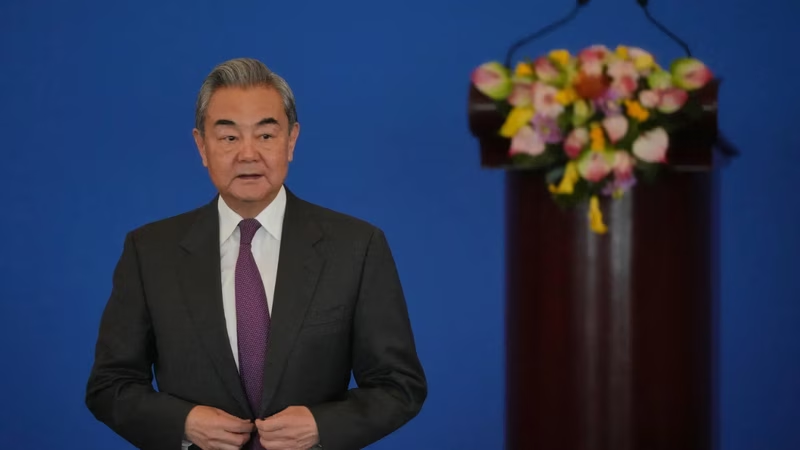
In a move that has reignited geopolitical tensions and diplomatic sensitivities, China’s Foreign Minister Wang Yi has publicly claimed that Beijing played a “constructive role” in de-escalating the May 2025 military standoff between India and Pakistan following the Pahalgam terror attack. But here’s the catch: India has repeatedly and categorically rejected any notion of third-party mediation in its bilateral disputes with Pakistan—especially by China, a country it views as a strategic rival and Pakistan’s closest ally .
The assertion, made during a high-profile forum in Beijing under the banner “to build peace that lasts,” appears to echo former U.S. President Donald Trump’s controversial 2019 offer to mediate Kashmir—a proposal immediately rebuffed by New Delhi. Now, with China stepping into a similar rhetorical space, experts warn this isn’t just diplomacy—it’s a calculated attempt to position Beijing as the indispensable power broker in South Asia, whether India likes it or not.
Table of Contents
- The Pahalgam Attack and Military Standoff
- China Mediation India-Pakistan: Wang Yi’s Bold Assertion
- India’s Firm Rejection: ‘No Third Party—Ever’
- Why China Wants to Play Peacekeeper
- The Trump Precedent and Beijing’s Strategy
- Regional Reactions and Strategic Implications
- Conclusion: Who Really Defused the Crisis?
- Sources
The Pahalgam Attack and Military Standoff
On May 12, 2025, a suicide bombing in Pahalgam, Jammu and Kashmir, killed 14 civilians and injured over 30. Indian intelligence agencies attributed the attack to the Pakistan-based militant group Jaish-e-Mohammed (JeM)—the same outfit behind the 2019 Pulwama attack.
In response, India launched “Operation Steadfast,” conducting precision artillery strikes on terrorist launch pads across the Line of Control (LoC). Pakistan retaliated with sporadic cross-border shelling, raising fears of a full-blown escalation.
However, within 48 hours, a ceasefire was restored. According to India’s Ministry of Defence, this came after Pakistan’s Director General of Military Operations (DGMO) called his Indian counterpart and “requested restraint.” The resolution, India insists, was achieved through established military-to-military protocols—not external diplomacy .
China Mediation India-Pakistan: Wang Yi’s Bold Assertion
Despite India’s clear narrative, Wang Yi told the “Global Peace Forum” in Beijing on December 28, 2025:
“When tensions flared between India and Pakistan in May, China acted promptly to encourage dialogue and exercised responsible diplomacy to help both sides step back from the brink. We believe in building peace that lasts.”
While Wang didn’t claim formal mediation, the implication was unmistakable: Beijing positioned itself as the behind-the-scenes facilitator. Chinese state media later amplified this narrative, publishing op-eds praising China’s “neutral and benevolent” role in South Asian stability .
India’s Firm Rejection: ‘No Third Party—Ever’
India’s response was swift and unambiguous. The Ministry of External Affairs (MEA) reiterated its long-standing position: “The India-Pakistan issue is bilateral. We do not accept, nor have we ever sought, third-party mediation—including from any friendly nation.”
This stance isn’t new. Since 1947, India has consistently held that disputes with Pakistan must be resolved directly, citing the Simla Agreement of 1. The inclusion of China—whose own border disputes with India remain unresolved and whose military ties with Pakistan include joint exercises and arms sales—makes the claim especially galling in New Delhi’s eyes .
Why China Wants to Play Peacekeeper
Beijing’s move is less about peace and more about power projection. By inserting itself into the India-Pakistan dynamic, China aims to:
- Undermine India’s strategic autonomy by framing it as dependent on external crisis management.
- Strengthen its Belt and Road narrative by portraying itself as a stabilizing force in volatile regions.
- Isolate India diplomatically by suggesting that even India’s conflicts require Chinese stewardship.
Notably, this comes as China deepens its “Iron Brotherhood” with Pakistan, including $60 billion in CPEC investments and recent sales of JF-17 fighter jets—hardly the profile of a neutral mediator.
The Trump Precedent and Beijing’s Strategy
Wang Yi’s comments mirror Donald Trump’s 2019 claim that Indian Prime Minister Narendra Modi had asked him to mediate Kashmir—a statement India immediately denied. Beijing appears to be borrowing from the same playbook: offer unsolicited “help” to gain diplomatic leverage.
But while Trump’s offer was seen as naive, China’s is viewed as strategic. As Brookings Institution analyst Tanvi Madan notes, “China isn’t just offering mediation—it’s asserting regional primacy” .
Regional Reactions and Strategic Implications
Pakistan, unsurprisingly, has remained silent—likely content to let China amplify its narrative without direct endorsement. Meanwhile, the U.S. State Department declined to comment, sticking to its official line of encouraging “direct dialogue” between the two nuclear-armed neighbors.
For India, the episode underscores the need to reinforce its bilateral crisis-management mechanisms. Experts suggest enhancing the DGMO hotline, reviving backchannel diplomacy, and pre-empting external narratives through proactive strategic communication—a tactic explored in our deep dive on [INTERNAL_LINK:india-pakistan-backchannel-diplomacy-history].
Conclusion: Who Really Defused the Crisis?
The facts are clear: the May 2025 India-Pakistan standoff ended through direct military communication, not China mediation India-Pakistan efforts. Beijing’s claim is less an account of events and more a declaration of ambition—to be seen as the arbiter of South Asian peace, even when uninvited. India, however, remains resolute: its sovereignty in handling Pakistan isn’t up for negotiation, with Beijing or anyone else. In the high-stakes theater of Asian geopolitics, this isn’t just about peace—it’s about who gets to define it.
Sources
- Times of India: China Claims Credit for Mediating India-Pakistan Conflict
- Ministry of External Affairs, Government of India – Official Statements
- Ministry of Foreign Affairs, People’s Republic of China – Wang Yi Speech Archive
- Brookings Institution – Analysis on China’s South Asia Strategy
- Web search results on Pahalgam attack, DGMO talks, and China-Pakistan military ties [[1], [2], [3], [4], [5]]