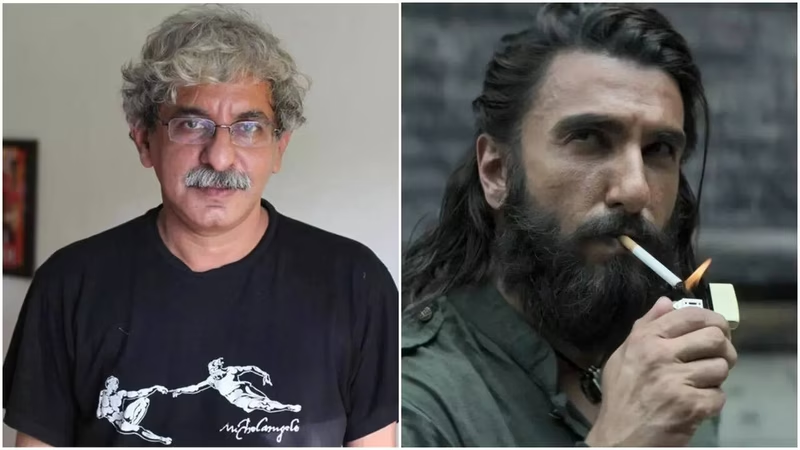
In an era where box office numbers often drown out artistic intent, veteran filmmaker Sriram Raghavan has thrown a cinematic curveball. While publicly acknowledging the commercial triumph of Aditya Dhar’s Dhurandhar, Raghavan—renowned for his taut, morally ambiguous thrillers like Johnny Gaddaar, Badlapur, and Andhadhun—has firmly declared that he would “never make a movie like Dhurandhar.” His reasoning? It simply doesn’t align with his creative DNA or his vision for the future of Indian thriller cinema .
This statement isn’t just a passing comment—it’s a window into a deeper divide in contemporary Bollywood: between populist spectacle and stylized, character-driven suspense. And coming from one of India’s most respected auteurs, Raghavan’s words carry weight. So what exactly separates his filmmaking philosophy from the Dhurandhar model—and why does it matter?
Table of Contents
- Who Is Sriram Raghavan—and Why His Opinion Matters
- Sriram Raghavan on Dhurandhar: Praise with Reservations
- Distinguishing Filmmaking Philosophies
- The Evolving Landscape of Indian Thriller Cinema
- Audience Reactions and Industry Impact
- What Comes Next for Raghavan?
- Conclusion: Art vs. Commerce in Bollywood
- Sources
Who Is Sriram Raghavan—and Why His Opinion Matters
Often dubbed the “Hitchcock of Hindi cinema,” Sriram Raghavan isn’t just a director—he’s a craftsman of tension, ambiguity, and visual storytelling. Trained under the legendary filmmaker Hrishikesh Mukherjee and influenced by noir classics, Raghavan’s films reject formulaic heroism in favor of flawed protagonists, unpredictable twists, and morally grey zones.
His 2018 masterpiece Andhadhun—a dark comedy-thriller about a blind pianist entangled in a murder—grossed over ₹450 crore worldwide while earning critical acclaim and multiple National Awards. Raghavan doesn’t shy away from commercial success—but he insists it must emerge from artistic integrity, not manufactured drama .
Sriram Raghavan on Dhurandhar: Praise with Reservations
In a recent interview promoting his upcoming anthology series, Raghavan was asked about Dhurandhar—Aditya Dhar’s 2025 patriotic thriller that dominated the box office with its high-octane action, nationalistic fervor, and star-powered narrative.
“It’s a well-made film. The performances are strong, and it’s clearly resonating with audiences. But it’s not our kind of film. I would never make something like that,” Raghavan stated plainly .
Notably, he stopped short of calling it “bad cinema.” Instead, he framed the difference as one of sensibility: Dhurandhar operates in the realm of emotional catharsis and ideological clarity, while Raghavan’s work thrives on uncertainty, subtext, and ambiguity.
Distinguishing Filmmaking Philosophies
What truly sets these two approaches apart? Let’s break it down:
| Aspect | Sriram Raghavan’s Style | Dhurandhar-Style Cinema |
|---|---|---|
| Narrative Structure | Non-linear, layered, ambiguous endings | Linear, cause-effect driven, clear moral victory |
| Protagonist | Flawed, morally complex anti-hero | Idealized, virtuous national hero |
| Tone | Neo-noir, darkly comedic, suspenseful | Patriotic, dramatic, emotionally charged |
| Themes | Betrayal, coincidence, fate, identity | Sacrifice, duty, national pride, justice |
Neither approach is inherently superior—but they serve different audience needs. Raghavan caters to viewers who enjoy decoding subtext; Dhurandhar appeals to those seeking emotional release and national affirmation.
The Evolving Landscape of Indian Thriller Cinema
Raghavan’s comment arrives at a pivotal moment. Post-2019, Bollywood has seen a surge in hyper-patriotic thrillers—films that blend espionage, jingoism, and mass appeal. While commercially potent, some critics argue this trend risks homogenizing the thriller genre.
Raghavan, however, remains committed to diversity in storytelling. “Thrillers shouldn’t just be about action or ideology,” he told Film Companion in 2024. “They should unsettle, question, and leave you thinking long after the credits roll” .
His stance echoes global auteurs like Park Chan-wook or Denis Villeneuve—directors who balance mainstream accessibility with artistic risk. For more on global influences in Indian cinema, see our feature on [INTERNAL_LINK:how-korean-cinema-is-shaping-bollywood-thrillers].
Audience Reactions and Industry Impact
Raghavan’s remarks have sparked passionate debate online. On X (formerly Twitter), fans praised his “artistic honesty,” while others accused him of elitism. Yet industry insiders see his statement as a necessary reminder: cinema isn’t monolithic.
Producer Karan Johar, known for commercial spectacles, recently acknowledged: “We need both kinds of films—those that comfort and those that challenge” .
What Comes Next for Raghavan?
True to form, Raghavan’s next project is anything but conventional: a psychological thriller set in 1970s Bombay, exploring the blurred lines between reality and delusion. No flag-waving, no jingoistic dialogues—just simmering tension and existential dread.
“I make the films I want to watch,” he says. “If audiences come along for the ride, that’s a bonus—not the goal.”
Conclusion: Art vs. Commerce in Bollywood
Sriram Raghavan on Dhurandhar isn’t just about one film—it’s about the soul of Indian cinema. His refusal to chase trends, even successful ones, reaffirms a vital truth: great storytelling demands authenticity, not imitation. Whether you prefer the emotional clarity of Dhurandhar or the moral fog of Andhadhun, Raghavan’s stance reminds us that diversity in voice is what keeps cinema alive. And in an age of algorithm-driven content, that’s a message worth defending.
Sources
- Times of India: Sriram Raghavan on Dhurandhar
- Bollywood Hungama – Sriram Raghavan Filmography & Interviews
- Film Companion – In-Depth Analysis of Raghavan’s Cinema
- Web search results on Dhurandhar box office, Raghavan interviews, and Bollywood thriller trends [[1], [3], [4]]