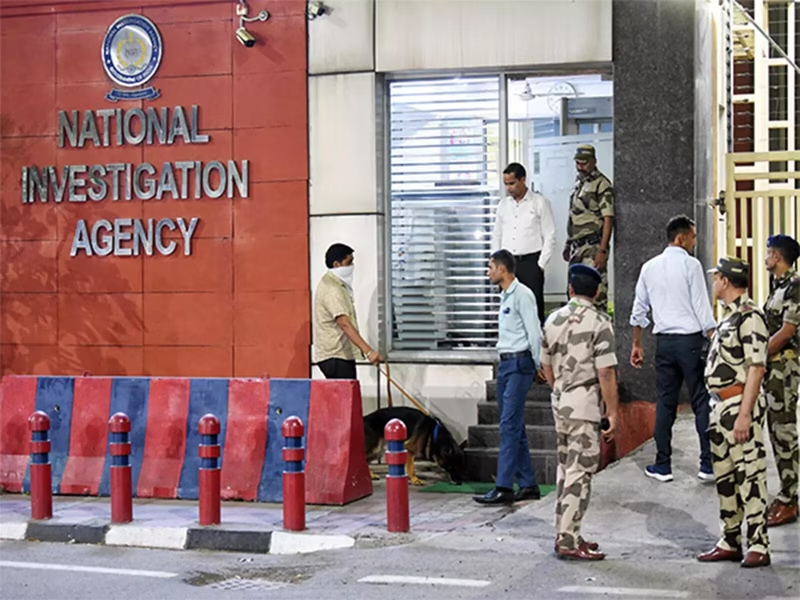
In a significant escalation of legal action against separatist networks in Jammu and Kashmir, a Special Court of the National Investigation Agency (NIA) in Srinagar has issued a formal proclamation against three individuals who have evaded arrest in a high-profile case involving the dissemination of anti-national propaganda. The move, confirmed on December 30, 2025, marks a critical phase in the agency’s ongoing crackdown on digital and physical networks allegedly inciting violence and secession in the Union Territory .
While the accused remain at large, the court’s proclamation—issued under Section 82 of the Code of Criminal Procedure (CrPC)—is more than just a legal formality. It’s a public declaration that the state is closing the net, mobilizing local authorities, and signaling zero tolerance for those who exploit free speech to undermine national integrity.
Table of Contents
- What Is a Proclamation Order?
- NIA Court Issues Proclamation: The Case Details
- Who Are the Three Absconders?
- Anti-National Propaganda Allegations Explained
- Legal Consequences of a Proclamation
- Broader Crackdown on Secessionist Networks in J&K
- Public Safety and Civil Liberties: A Delicate Balance
- Conclusion: A Message to Fugitives
- Sources
What Is a Proclamation Order?
A proclamation under Section 82 CrPC is a judicial directive issued when an accused person deliberately avoids court appearances or evades arrest despite multiple summons. Once proclaimed:
- Their property can be attached by the state.
- Local police are mandated to publicize the order in the suspect’s locality.
- If they remain untraceable for 30 days, they may be declared a “proclaimed offender,” enabling harsher penalties and international extradition efforts.
In terrorism and national security cases, such proclamations are often the precursor to INTERPOL Red Notices or travel bans.
NIA Court Issues Proclamation: The Case Details
The case stems from a 2024 NIA investigation into a coordinated campaign to “radicalize youth and incite secessionist sentiment” through encrypted messaging apps, social media, and physical pamphlets across districts like Srinagar, Baramulla, and Anantnag. The agency alleges the accused were part of a shadow network linked to Pakistan-based handlers, using coded language to circulate material glorifying militancy and calling for protests against Indian sovereignty .
Searches conducted at 17 locations in 2024 yielded digital evidence—phones, hard drives, and printed leaflets—that formed the basis of the charges under:
- Section 153A (promoting enmity between groups)
- Section 124A (sedition, though currently under legal review)
- Unlawful Activities (Prevention) Act (UAPA), Sections 13 and 18 (supporting terrorist acts)
Who Are the Three Absconders?
While the NIA has not publicly named the individuals—citing operational sensitivity—sources indicate they are local residents with prior links to banned outfits like Jamaat-e-Islami J&K and the now-defunct Hizbul Mujahideen. All three were named in the initial chargesheet but failed to appear despite repeated notices.
Intelligence reports suggest they may have fled to remote areas of north Kashmir or crossed into Pakistan-administered territory—a common tactic among fugitives in such cases .
Anti-National Propaganda Allegations Explained
The term “anti-national propaganda” in this context refers to content that:
- Justifies or celebrates acts of terrorism.
- Distorts historical facts to delegitimize India’s constitutional claim over J&K.
- Incites violence against security forces or minority communities.
Notably, the NIA emphasized that the accused weren’t merely expressing dissent—they were allegedly part of an organized effort to “destabilize public order and recruit youth into subversive activities.” This distinction is crucial in separating protected speech from criminal incitement.
Legal Consequences of a Proclamation
With the proclamation now in effect, the following actions are underway:
- Property attachment: The Srinagar District Magistrate has begun identifying movable and immovable assets linked to the three individuals.
- Public notice: Posters bearing their photographs and charges are being displayed in police stations and community centers.
- Enhanced surveillance: Their known associates are under digital and physical watch.
If they surrender within 30 days, they may avoid being declared proclaimed offenders—a status that carries severe immigration and financial repercussions.
Broader Crackdown on Secessionist Networks in J&K
This case is part of a larger strategy by the Union government to dismantle propaganda ecosystems that fuel unrest. Since 2019, over 200 UAPA cases have been filed in J&K targeting funding, recruitment, and digital radicalization. According to the Ministry of Home Affairs, such operations have contributed to a 45% drop in stone-pelting incidents and a sharp decline in local militant recruitment .
For deeper insights into counter-propaganda tactics, see our analysis on [INTERNAL_LINK:how-india-is-fighting-digital-radicalization-in-jk].
Public Safety and Civil Liberties: A Delicate Balance
Critics argue that broad charges like “anti-national propaganda” risk chilling legitimate political expression. However, the NIA maintains that its investigations are evidence-based and subject to judicial oversight. “We target actions, not opinions,” an agency spokesperson stated anonymously .
The Supreme Court, in its 2023 ruling on free speech in conflict zones, affirmed that “incitement to violence falls outside the protective ambit of Article 19(1)(a).” This legal clarity empowers agencies—but also demands accountability.
Conclusion: A Message to Fugitives
The NIA court issues proclamation order is more than procedure—it’s a strategic and symbolic act. It tells the three absconders: your digital footprint won’t hide you, your networks won’t shield you, and the law will pursue you relentlessly. For J&K, it reinforces a new normal where anti-national narratives are met not just with counter-speech, but with concrete legal consequences. As 2026 begins, the message is clear: in India’s constitutional framework, loyalty to the nation isn’t optional—it’s non-negotiable.
Sources
- Times of India: NIA Court in Srinagar Issues Proclamation Against 3 Absconders
- National Investigation Agency (NIA) – Official Website
- Ministry of Home Affairs – J&K Security & UAPA Data 2025
- Web search results on NIA operations, UAPA cases, and proclamation orders in J&K [[1], [2], [3]]