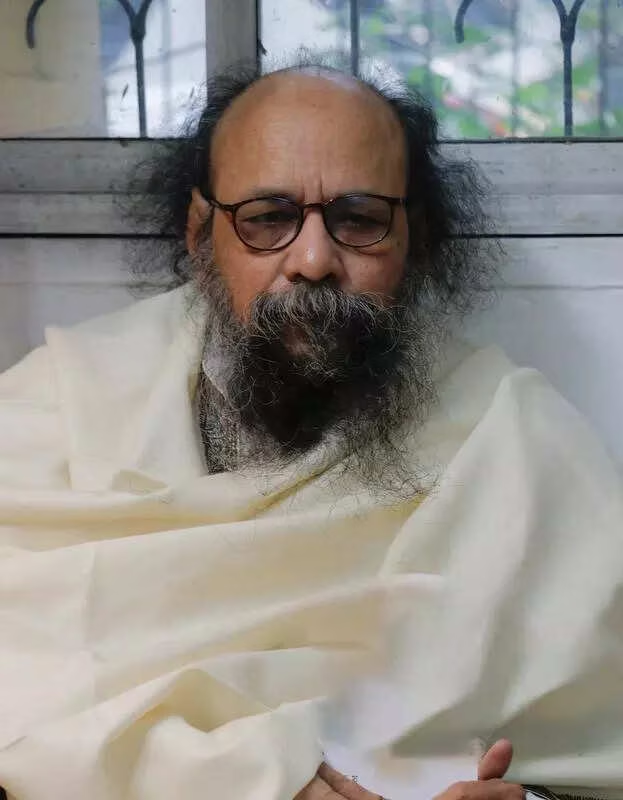
A literary giant of modern Bengali poetry now finds himself entangled in a bureaucratic controversy that threatens his most basic democratic right: the vote. **Joy Goswami**, the 72-year-old Sahitya Akademi award-winning poet, has been flagged as an **‘unmapped voter’** in West Bengal and summoned for a hearing by the Election Commission (EC) on January 2, 2026. The summons comes as Goswami is still recovering from recent major surgeries—sparking outrage from civil society, literary circles, and opposition parties who see this as part of a broader pattern of voter suppression and political targeting in the state.
His daughter, speaking publicly, decried what she called a “pervasive politics of fear” and questioned why an ailing cultural icon would be subjected to such scrutiny. With elections looming, the case of **Bengal unmapped voters** like Goswami has ignited a fierce debate about electoral integrity, bureaucratic overreach, and the weaponization of voter verification processes.
Table of Contents
- Who Is Joy Goswami? A Literary Legend Under Scrutiny
- What Are ‘Bengal Unmapped Voters’?
- The EC Hearing and Family Allegations
- Political Reactions and Civil Society Response
- How Voter Mapping Works in India
- Are Intellectuals Being Targeted in Bengal?
- Conclusion: Democracy or Bureaucratic Harassment?
- Sources
Who Is Joy Goswami? A Literary Legend Under Scrutiny
Often hailed as one of the most influential Bengali poets since the 1980s, Joy Goswami has published over 40 poetry collections and received the **Sahitya Akademi Award** in 2000 for his seminal work *”Dhobor Ghaash.”* His verses explore existential angst, urban decay, and spiritual yearning, earning him a near-mythical status in Bengali literary circles.
Now 72, Goswami has faced serious health challenges in recent months, undergoing multiple surgeries and requiring prolonged rest. Despite his frail condition, he remains on the voter rolls—yet the EC’s “unmapped” label has cast doubt on his eligibility, forcing him to justify his own existence as a citizen.
What Are ‘Bengal Unmapped Voters’?
The term **‘unmapped voter’** refers to individuals whose names appear on electoral rolls but whose residential details couldn’t be verified during the EC’s recent **Special Summary Revision (SIR)** process. As part of a nationwide initiative to clean up voter lists using geotagging and door-to-door verification, officials mark voters as “unmapped” if no one was found at the registered address or if documentation appears inconsistent.
While the goal is to eliminate duplicate or fictitious entries, critics argue the process is prone to error—especially for elderly, bedridden, or mobile citizens. In West Bengal, over **1.2 million voters** were initially flagged as unmapped during the 2025 SIR, triggering widespread anxiety .
The EC Hearing and Family Allegations
Goswami’s daughter has publicly stated that her father’s address is correct and that he has voted from the same location for decades. She alleges that despite repeated attempts to clarify, the local Booth Level Officer (BLO) failed to properly verify his residence during the SIR.
“They didn’t even knock properly,” she told reporters. “Now, a man who can barely walk is being asked to appear before officials to prove he lives where he’s lived for 30 years. This isn’t oversight—it’s harassment.” She further claimed the move is part of a **“deliberate strategy to disenfranchise critical voices”** in a state known for its politically charged electoral battles.
Political Reactions and Civil Society Response
Opposition parties, including the BJP and the Left Front, have seized on the case as evidence of **voter suppression** by the ruling Trinamool Congress (TMC) administration. “Targeting a national poet? This is the new low,” said a BJP spokesperson.
Meanwhile, writers’ collectives like the **Paschimbanga Bangla Akademi** and **Sahitya Akademi** have issued statements of solidarity, calling the summons “insensitive and undemocratic.” Human rights organizations warn that vulnerable groups—senior citizens, minorities, and dissidents—are disproportionately affected by aggressive voter purges.
How Voter Mapping Works in India
The EC’s voter verification process includes:
- Door-to-door enumeration by Booth Level Officers.
- Geotagging of residences using mobile apps.
- Public display of draft rolls for objections.
- Hearings for ‘unmapped’ or ‘doubtful’ voters before final inclusion.
While designed to enhance accuracy, the system relies heavily on ground-level execution. According to the Election Commission of India, any voter marked “unmapped” retains their right to vote until a formal deletion order is issued—but the stigma and bureaucratic burden often deter participation .
Are Intellectuals Being Targeted in Bengal?
Goswami isn’t alone. Reports suggest several academics, journalists, and artists in Kolkata and surrounding districts have received similar notices. Critics point to a pattern: individuals perceived as critical of the state government or aligned with opposition ideologies are more likely to face verification hurdles.
“This isn’t random,” says Dr. Ananya Chakravarti, a political sociologist at Presidency University. “When cultural figures are singled out, it sends a chilling message: dissent—even poetic—won’t go unchallenged.”
Conclusion: Democracy or Bureaucratic Harassment?
The case of **Bengal unmapped voters** like Joy Goswami forces a critical question: Is the EC’s drive for electoral purity inadvertently enabling exclusion? In a democracy, verifying rolls is necessary—but not at the cost of silencing the vulnerable or punishing the outspoken.
As Goswami prepares for his January 2 hearing, the nation watches. Will his pen be enough to defend his vote? Or will this literary voice be muted not by illness, but by bureaucracy?
[INTERNAL_LINK:india-voter-registration-process] [INTERNAL_LINK:west-bengal-election-security]
Sources
Times of India: Bengal SIR: Ailing poet Joy Goswami among ‘unmapped’ voters; get Jan 2 hearing call
Election Commission of India: Official Website