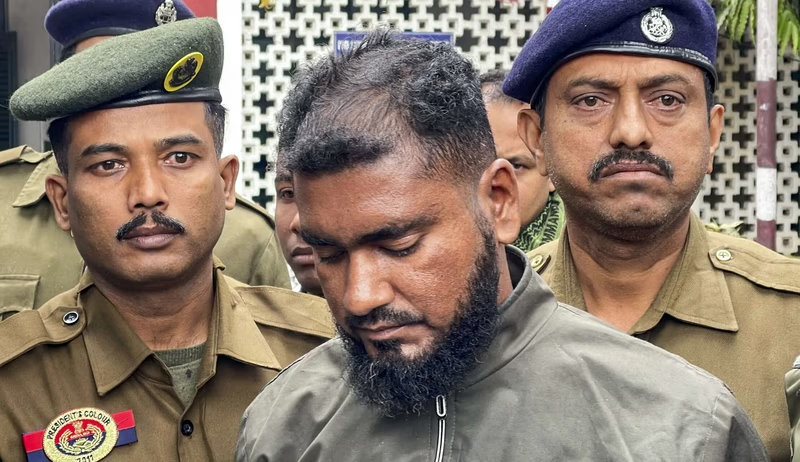
In a swift and coordinated crackdown, **Assam Police has busted a terror cell with direct links to Bangladesh**, arresting 11 individuals accused of radicalising young people across the state. The operation, which unfolded over several days in early 2026, uncovered a disturbing network that allegedly used social media, religious sermons, and financial incentives to lure vulnerable youth into extremist ideologies. The bust marks one of the most significant counter-terrorism successes in Northeast India in recent years—and raises urgent questions about cross-border radicalisation networks operating under the radar.
Table of Contents
- The Assam Terror Cell Bust: Operation Details
- How the Cell Operated: Radicalisation Tactics Exposed
- Bangladesh Connection: What Investigators Found
- Profile of the Arrested Suspects
- Impact on Northeast India’s Security Landscape
- National Response and Intelligence Reforms
- Conclusion: Vigilance in the Digital Age of Terror
- Sources
The Assam Terror Cell Bust: Operation Details
Acting on intelligence gathered over months, Assam Police’s Special Investigation Team (SIT) launched simultaneous raids across multiple districts—including Dhubri, Goalpara, and Nagaon—on January 15, 2026. The raids, supported by the National Investigation Agency (NIA), led to the arrest of **11 individuals**, including two alleged ringleaders with suspected ties to a banned Islamist outfit based in Bangladesh.
According to police officials, digital devices seized during the operation contained incriminating evidence: encrypted chats, propaganda videos, recruitment scripts, and financial transaction records pointing to foreign funding . “This was not just ideological talk—they were actively preparing to carry out attacks,” said a senior Assam Police officer.
How the Cell Operated: Radicalisation Tactics Exposed
Investigators revealed the cell used a multi-pronged strategy to radicalise youths, particularly those from economically disadvantaged backgrounds:
- Social media grooming: Fake profiles and private groups disseminated extremist content disguised as “religious enlightenment.”
- Local mosques and madrasas: Infiltrated religious spaces to spread distorted interpretations of faith.
- Financial enticement: Promised monthly stipends and “martyrdom rewards” to recruits and their families.
- Grievance exploitation: Leveraged local issues—unemployment, identity politics, and perceived injustice—to fuel anger and alienation.
Disturbingly, several minors were found in early stages of indoctrination, prompting authorities to alert schools and community leaders.
Bangladesh Connection: What Investigators Found
Digital forensics and interrogation records point to direct coordination with handlers in **Bangladesh’s Sylhet and Dhaka regions**. Messages recovered from seized phones referenced training camps, logistics support, and ideological guidance from across the border.
While Bangladesh’s government has publicly cracked down on extremism, Indian intelligence agencies warn that **residual cells** continue to operate, using the porous 4,096-km India-Bangladesh border to move operatives and funds. The Assam cell appears to be one such offshoot, leveraging familial and linguistic ties in border districts to blend in.
Profile of the Arrested Suspects
Of the 11 arrested:
- 3 are aged between 19–24—recent college dropouts with no criminal history.
- 2 are former clerics accused of delivering inflammatory sermons.
- 1 holds a passport with multiple recent trips to Bangladesh.
- 5 are local residents with no prior police record, indicating successful clandestine recruitment.
Notably, none belonged to traditional “militant hotspots,” underscoring how terror networks are now targeting previously quiet regions.
Impact on Northeast India’s Security Landscape
Assam has historically faced insurgencies rooted in ethnic and autonomy demands—but **ideological, transnational terrorism** is a newer, more dangerous threat. Unlike regional groups seeking political concessions, these networks aim to destabilise the entire nation under a global extremist agenda.
Security experts warn this bust may be the tip of the iceberg. “The Northeast’s demographic diversity and border complexity make it vulnerable,” says Dr. Arun Bhattacharya, a counter-terrorism analyst. “We must shift from reactive policing to preventive de-radicalisation.”
National Response and Intelligence Reforms
The Union Home Ministry has placed all northeastern states on high alert. In response, the government is fast-tracking two key initiatives:
- Border Surveillance Upgrade: Deployment of AI-powered CCTV and drone patrols along vulnerable stretches.
- Youth Outreach Program: Launch of “Safe Futures” initiative in Assam schools to counter online radicalisation with digital literacy and counseling.
The Ministry of Home Affairs has also called for enhanced intelligence sharing with Bangladesh under the existing bilateral counter-terrorism framework .
Conclusion: Vigilance in the Digital Age of Terror
The **Assam terror cell bust** is a stark reminder that modern terrorism doesn’t always wear a uniform—it often hides behind a smartphone screen, preying on confusion, poverty, and identity crises. While the arrests have neutralised an immediate threat, the real victory lies in preventing the next recruit.
As Assam rebuilds community trust and strengthens digital monitoring, this case must serve as a blueprint for proactive, intelligence-led security—not just in the Northeast, but across India’s vulnerable frontiers.
[INTERNAL_LINK:india-counter-terrorism-strategies] [INTERNAL_LINK:northeast-india-security-challenges]
Sources
Times of India: ‘Was radicalising youths’: Assam Police busts terror cell linked to Bangladesh; 11 arrested
Ministry of Home Affairs, Government of India: Official Portal