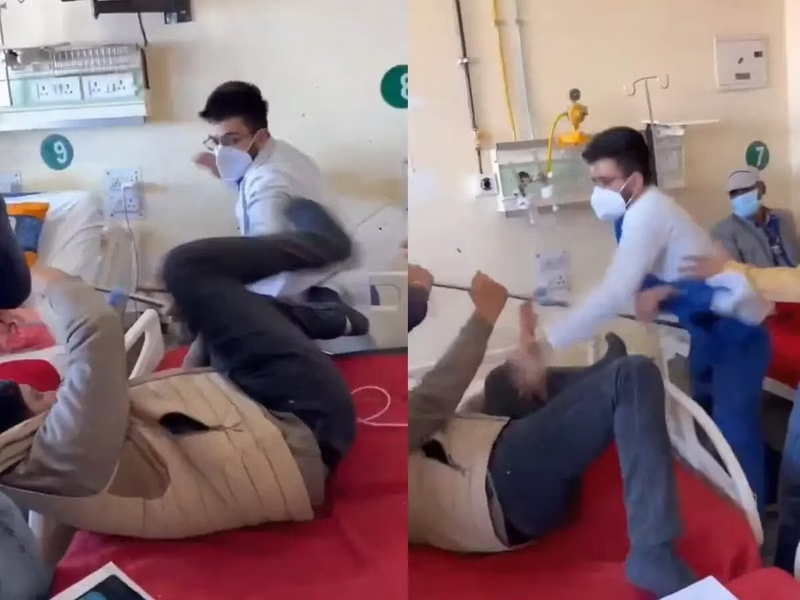
Tensions that once threatened to cripple healthcare across Himachal Pradesh have melted away—in the form of a heartfelt hug. In a dramatic and deeply human resolution, the **sacked doctor from Shimla** and the **patient at the center of the assault allegations** have publicly reconciled, apologizing to each other and to the public for the chaos their conflict unleashed.
What began as a heated altercation inside a hospital room escalated into a full-blown crisis: doctors across the state went on strike, outpatient departments shut down, and emergency services were stretched thin. But now, with a handshake, an embrace, and words of regret, the **Himachal doctor assault row** appears to be over—not through legal verdicts or bureaucratic decrees, but through empathy and dialogue.
Table of Contents
- What Happened in the Himachal Doctor Assault Row?
- The Strike That Paralyzed Himachal Pradesh’s Healthcare
- How Reconciliation Brought Peace
- Public and Medical Community Reaction
- The Bigger Lesson: Conflict Resolution in Healthcare
- What Happens to the Sacked Doctor Now?
- Conclusion: When Empathy Trumps Outrage
- Sources
What Happened in the Himachal Doctor Assault Row?
The controversy erupted when a patient alleged that a government doctor at a Shimla hospital physically assaulted him during a consultation. The details remain disputed, but the fallout was immediate: video clips went viral, public outrage grew, and within days, the state government **terminated the doctor’s service**—a move intended to show zero tolerance for misconduct.
However, the medical fraternity saw it differently. They argued the doctor was denied due process and that the rush to punish ignored the high-stress realities of public healthcare. What followed was unprecedented: **thousands of doctors across Himachal Pradesh launched a strike**, suspending non-emergency services in protest .
The Strike That Paralyzed Himachal Pradesh’s Healthcare
For several days, hospitals across the hill state operated at minimal capacity. Outpatient departments were closed, elective surgeries canceled, and even routine check-ups delayed. While emergency care was maintained, the strain on remaining staff was immense.
The strike wasn’t just about one doctor—it was a cry for systemic respect. As Dr. Anil Thakur, president of the Himachal Pradesh Medical Association, stated: *“We’re not defending violence. We’re defending fairness. No doctor should be fired based on allegations without a fair hearing.”*
The public, caught in the crossfire, faced real hardships—especially in remote districts where access to healthcare is already limited.
How Reconciliation Brought Peace
Amid growing pressure, mediators—including senior health officials and civil society leaders—facilitated a private meeting between the doctor and the patient. What emerged was a shared realization: both had acted in the heat of the moment, and both regretted the consequences.
In a moving public gesture, the two men **shook hands, exchanged apologies, and embraced**. The patient acknowledged the immense pressure doctors face, while the doctor expressed remorse for any distress caused. Their joint statement read: *“All is well.”*
This simple phrase became a symbol of de-escalation in an era of viral outrage.
Public and Medical Community Reaction
Social media, once flooded with polarized opinions, shifted tone overnight. Hashtags like #ForgivenessOverFury and #HealingHimachal began trending. Even critics of the doctor admitted the resolution was “mature and dignified.”
The state medical association hailed the reconciliation as a victory for dialogue. “This shows that **most conflicts in healthcare aren’t criminal—they’re human**,” said Dr. Thakur. “We need mediation, not just punishment.”
The Bigger Lesson: Conflict Resolution in Healthcare
The Himachal incident highlights a critical gap in India’s public health system: the lack of formal **grievance redressal and conflict mediation mechanisms** between patients and providers.
Consider these systemic issues:
- Overcrowded facilities: Doctors often see 100+ patients a day, increasing stress and miscommunication.
- No neutral mediators: Most hospitals lack ombudspersons or patient care committees to defuse tensions early.
- Punitive over preventative culture: Administrators often react with suspensions rather than investigations.
According to the World Health Organization (WHO), effective patient-provider communication reduces medical disputes by up to 40% . Himachal’s resolution offers a real-world case study in that principle.
What Happens to the Sacked Doctor Now?
Following the public reconciliation, the Himachal Pradesh government has indicated it will **review the doctor’s termination order**. While reinstatement isn’t guaranteed, sources within the health department suggest a “favorable reconsideration” is likely, given the patient’s withdrawal of hostility and the doctor’s clean service record.
Legal experts note that in India, administrative actions based solely on allegations—without inquiry—can be challenged in court. But with both parties now at peace, a bureaucratic reversal seems more probable than a legal battle.
Conclusion: When Empathy Trumps Outrage
The **Himachal doctor assault row** could have ended in lifelong bitterness, legal entanglements, or even deeper mistrust in public healthcare. Instead, it became a rare example of how **human connection can heal institutional fractures**.
In an age where every dispute risks becoming a social media war, this quiet hug in Shimla is a reminder: sometimes, the most powerful medicine isn’t in a pill—it’s in an apology, a handshake, and the courage to say, “All is well.”
[INTERNAL_LINK:india-public-healthcare-challenges] [INTERNAL_LINK:doctor-patient-communication-tips]
Sources
Times of India: All is well: Sacked Himachal doctor, patient ‘patch up’ with a hug; assault row ends
World Health Organization (WHO): People at the Centre of Health Care: Communicating with Patients