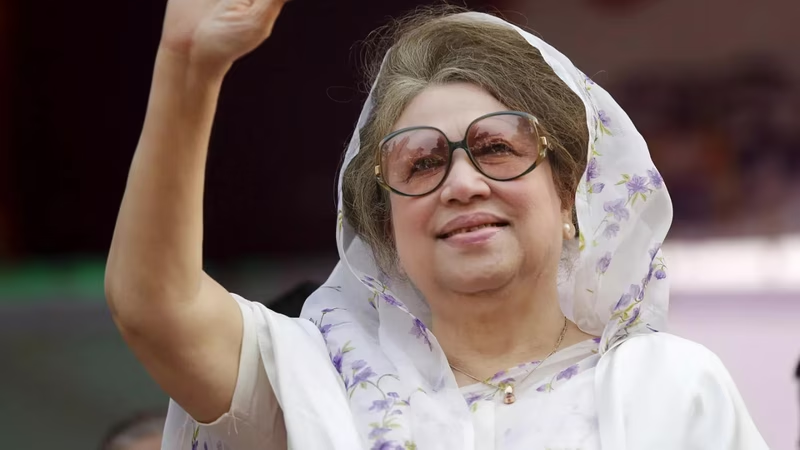
Border Bonds: How a Town in West Bengal Grieves Bangladesh’s Iron Lady
In the quiet lanes of Jalpaiguri, a town nestled near India’s northern border with Bangladesh, news of Khaleda Zia’s passing stirred a unique kind of sorrow. For decades, locals have whispered with pride that the first woman Prime Minister of Bangladesh—and one of South Asia’s most formidable political figures—was born right here. Now, as Bangladesh enters a period of national mourning, Jalpaiguri too lights candles, not just for a foreign leader, but for its own ‘daughter.’
This emotional connection underscores a little-known but deeply significant chapter in the shared history of India and Bangladesh. The story of Khaleda Zia Jalpaiguri roots is more than biographical trivia—it’s a living testament to how borders on maps often fail to reflect the cultural, familial, and historical ties that bind communities across them.
Table of Contents
- Who Was Khaleda Zia?
- The Jalpaiguri Connection: Birthplace and Legacy
- Local Reactions in West Bengal: Pride, Pain, and Memory
- Historical Context: Partition, Migration, and Shared Identities
- Political Implications Today: A Symbol Beyond Borders
- Why Her West Bengal Roots Matter in 2025
- Conclusion: A Daughter of Two Worlds
- Sources
Who Was Khaleda Zia?
Khaleda Zia served as Prime Minister of Bangladesh for three non-consecutive terms (1991–1996, 2001–2006), becoming the first woman to hold the office. As the widow of military ruler and President Ziaur Rahman, she rose from personal tragedy to lead the Bangladesh Nationalist Party (BNP) and became a central figure in the country’s often-turbulent democracy.
Her life was marked by both political triumph and personal hardship—including years of house arrest and legal battles. Yet across the border in India, and especially in her birthplace, she remained a source of quiet pride: a woman of extraordinary resilience who carried the imprint of Bengal in her voice, her demeanor, and her values.
The Jalpaiguri Connection: Birthplace and Legacy
Official records and family accounts confirm that Khaleda Zia was born on August 15, 1945, in the town of Jalpaiguri, in what was then British India and is now West Bengal. Her father, Mansur Rahman, was a lawyer stationed in the region, and the family later moved to East Bengal (now Bangladesh) after the 1947 Partition.
Though she spent most of her life in Bangladesh, her Indian origins were never erased. In fact, elders in Jalpaiguri still recall the Rahman family’s residence near the town’s civil courts. Today, a modest plaque—unofficial but cherished—marks the spot, drawing curious visitors and local historians alike.
Local Reactions in West Bengal: Pride, Pain, and Memory
Upon hearing of her death, residents of Jalpaiguri expressed a mix of reverence and nostalgia. “She was one of us,” said an 80-year-old shopkeeper near the old courthouse. “We always said Jalpaiguri gave Bangladesh its first woman PM.”
Local newspapers ran special features. Community centers held small prayer meetings. Even political rivals in West Bengal momentarily set aside differences to acknowledge her historic role—a rare moment of unity inspired by a shared regional identity.
This outpouring reflects more than mere celebrity worship. It speaks to a deep-seated belief that identity isn’t confined by passports. As one schoolteacher put it: “Her story reminds us that Bengal is one—whether you’re in Dhaka or Darjeeling.”
Historical Context: Partition, Migration, and Shared Identities
The story of Khaleda Zia Jalpaiguri cannot be understood without revisiting the trauma and fluidity of the 1947 Partition. Millions crossed newly drawn lines—Hindus to India, Muslims to East Pakistan—yet families, dialects, cuisines, and cultural practices remained intertwined.
Jalpaiguri, located just 30 kilometers from the Bangladesh border, has long been a melting pot of such cross-border identities. Many families there have relatives in Rangpur or Dinajpur. Languages blend. Festivals overlap. In this context, Khaleda Zia’s birth in West Bengal isn’t an anomaly—it’s emblematic of a shared sub-regional heritage that predates modern nation-states.
Political Implications Today: A Symbol Beyond Borders
In today’s climate of rising nationalism, Khaleda Zia’s dual legacy offers a powerful counter-narrative. While India-Bangladesh relations have seen both cooperation and tension—especially around issues like citizenship and border security—her life stands as a reminder of organic people-to-people bonds.
Notably, even as Bangladesh’s current government, led by the Awami League, has been at odds with the BNP, it issued a dignified statement honoring Zia’s contributions. In India, political leaders from across the spectrum—from Mamata Banerjee to national figures—acknowledged her historic role, subtly reinforcing the idea that her legacy transcends party lines and borders.
Why Her West Bengal Roots Matter in 2025
In an era of rigid borders and identity politics, remembering that Bangladesh’s first woman PM was born in Jalpaiguri is more than nostalgic—it’s politically and culturally vital. It challenges simplistic notions of “foreign” and “native.”
Consider these implications:
- Diplomatic soft power: Shared heritage can foster goodwill in bilateral relations.
- Cultural continuity: Bengali identity remains a unifying thread across borders.
- Historical accuracy: Erasing regional origins flattens complex histories.
[INTERNAL_LINK:india-bangladesh-border-history] could further explore these nuanced ties.
Conclusion: A Daughter of Two Worlds
Khaleda Zia’s life journey—from a small town in West Bengal to the highest office in Bangladesh—mirrors the turbulent yet intertwined history of the Bengal region. Her passing has not only triggered official mourning in Dhaka but also a quiet, heartfelt tribute in Jalpaiguri, where people still call her “our Khaleda.” In honoring her, both nations are reminded that the deepest human bonds often ignore the lines we draw on maps.
Sources
- Times of India: Border bonds: Jalpaiguri mourns its daughter Khaleda
- Encyclopædia Britannica: Khaleda Zia Biography
- West Bengal State Archives: Partition Migration Records, Jalpaiguri District (1945–1950)
- The Hindu: “Remembering Khaleda Zia’s Indian Roots,” December 2025