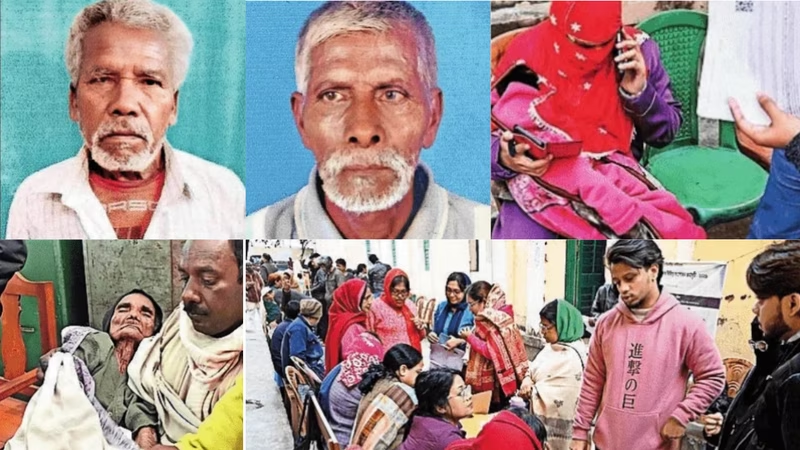
Bengal SIR Deaths: A Crisis of Process and Compassion
The ongoing Special Intensive Revision (SIR) of voter lists in West Bengal has taken a dark and tragic turn. What was meant to be a routine administrative exercise to clean up the electoral roll has now become a source of public outrage and legal action, following the deaths of elderly citizens who were caught in its bureaucratic net. This is the story of the Bengal SIR deaths, the families’ fight for justice, and the Election Commission’s response.
Table of Contents
- The Tragic Incident: What Happened?
- Families Take Legal Action Against Top Election Officials
- ECI Reacts to Allegations and Mounting Pressure
- The Broader Context of SIR in Bengal
- Political Fallout and Public Anger
- Conclusion: A System Under Scrutiny
- Sources
The Tragic Incident: What Happened?
The heart of the controversy lies in the cases of two elderly residents of West Bengal. In Purulia, 80-year-old Durjan Majhi, and in Tamluk, 75-year-old Shantimoni Ekka, both received official notices from the Election Commission as part of the SIR process. These notices were likely hearing notices, a standard procedure where an individual is flagged for potential removal from the voter list and is given a chance to defend their inclusion .
The stress and anxiety of potentially losing their fundamental right to vote, a right they had exercised for decades, are believed to have taken a severe toll. Both individuals passed away on the same Monday shortly after receiving these notices. Their families are adamant that the bureaucratic process directly contributed to their deaths, turning a simple administrative task into a life-ending ordeal .
Families Take Legal Action Against Top Election Officials
Refusing to accept these deaths as mere coincidences, the grieving families have taken a bold and unprecedented step. They have filed formal police complaints directly against two of the highest authorities in the Indian electoral system: Chief Election Commissioner (CEC) Gyanesh Kumar and West Bengal’s Chief Electoral Officer (CEO) Manoj Kumar Agarwal .
This legal action is a direct accusation of negligence and mishandling of the SIR process. The families argue that the process lacked the necessary sensitivity and humanity, especially when dealing with the state’s large elderly and often illiterate population. A police complaint of this nature against such high-ranking officials is a rare and powerful statement of the public’s deep dissatisfaction.
ECI Reacts to Allegations and Mounting Pressure
The Election Commission of India (ECI) has been forced to respond to this growing crisis. While a direct, public statement on these specific cases is still awaited, the ECI has acknowledged the broader concerns. Following a meeting with a ten-member TMC delegation that claimed a staggering 40 SIR-related deaths in the state, the Commission has been on the defensive .
The ECI maintains that the SIR is a necessary and lawful process to ensure the purity of the electoral rolls by removing names of deceased individuals. They report having already identified and processed the removal of approximately 15.53 lakh dead voters in West Bengal alone . However, the Commission now finds itself in a difficult position, having to balance administrative efficiency with public empathy and trust.
The Broader Context of SIR in Bengal
The SIR in West Bengal has been fraught with tension from the start. Political parties, especially the ruling Trinamool Congress (TMC), have heavily criticized the exercise, labeling it as “unplanned” and “heartless.” The process has generated a “barrage of complaints” from various political factions, prompting the ECI to even send a special delegation to the state to assess the situation .
Adding a layer of political complexity, the West Bengal Chief Minister Mamata Banerjee has announced financial compensation for the families of those who have died in connection with the SIR, a move widely seen as a direct challenge to the ECI’s narrative and an attempt to position her government as the protector of its citizens .
Political Fallout and Public Anger
The Bengal SIR deaths have ignited a political firestorm. The TMC has seized on these incidents to attack the central government and the ECI, framing the entire exercise as a politically motivated attempt to disenfranchise their voters. This has led to a significant erosion of public trust in what is supposed to be an independent and apolitical institution.
The core issue for many citizens is the perceived lack of a humane approach. As one citizen’s plea on a public SIR bulletin highlights, many elderly, valid voters are struggling with the process due to their age and lack of documentation, and they are asking for a “simple and easy way” to retain their voting rights—a request that seems to have fallen on deaf ears .
Conclusion: A System Under Scrutiny
The tragic Bengal SIR deaths are more than just isolated incidents; they are a symptom of a larger problem at the intersection of bureaucracy and human vulnerability. While the goal of a clean voter list is valid, the execution has been widely perceived as callous and insensitive. The legal action by the families of Durjan Majhi and Shantimoni Ekka has shifted the debate from mere political point-scoring to a fundamental question of accountability and citizen welfare. For the ECI, the path forward requires not just administrative correction, but a profound demonstration of empathy to restore its credibility. As this story continues to unfold, it serves as a critical reminder that in governance, the human element can never be an afterthought.
Sources
- Times of India: Bengal SIR deaths: Kin file complaints against CEC, state poll body chief; ECI reacts
- Election Commission of India Daily Bulletin, December 30, 2025
- India Today: West Bengal SIR Row: TMC Shares List of 40 Deaths
- The New Indian Express: West Bengal announces compensation linked to SIR