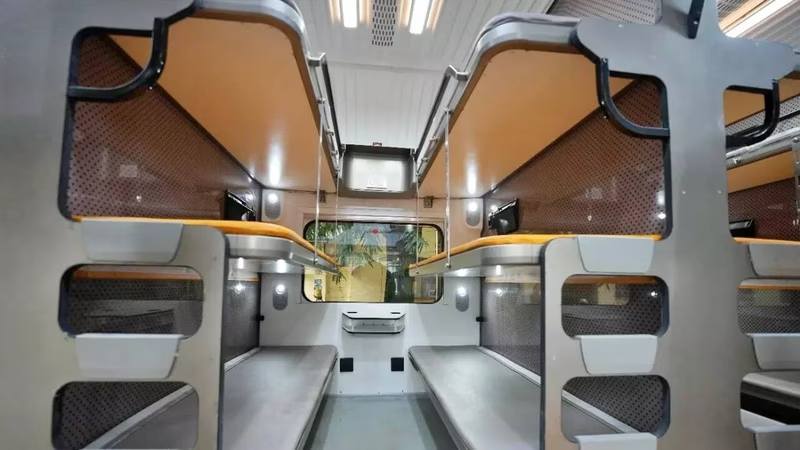
Imagine sipping your morning chai in a fully reclining berth, watching the countryside blur past at **180 kilometers per hour**—all while a glass of water on your tray stays perfectly still.
That’s not a scene from a sci-fi movie. That’s the new **Vande Bharat sleeper** train, and it just aced its most critical speed trial yet.
In a landmark moment for Indian Railways, the country’s first semi-high-speed sleeper variant of the Vande Bharat Express has officially touched **180 kmph** during dynamic testing overseen by the Commissioner of Railway Safety (CRS). Even more impressively, it passed the notorious “water test”—a real-world measure of ride smoothness—with flying colors .
Railway Minister Ashwini Vaishnaw didn’t just announce the feat—he shared a video of a water-filled glass on a table inside the moving train, completely ripple-free at top speed. “This is the stability India’s future rides on,” he declared .
Table of Contents
- What Is the Vande Bharat Sleeper Train?
- Vande Bharat Sleeper Hits Record 180 kmph
- The Water Test: Why It Matters
- Key Features of the New Sleeper Variant
- How It Compares to Existing Trains
- Launch Timeline and Routes
- What This Means for India’s Rail Future
- Conclusion: Not a Bullet Train—But Close Enough
- Sources
What Is the Vande Bharat Sleeper Train?
The **Vande Bharat sleeper** is the long-haul evolution of India’s flagship semi-high-speed train, originally launched in 2019 as a chair car for intercity routes like Delhi–Varanasi.
While the daytime Vande Bharat connects cities within 6–8 hours, the sleeper version is designed for **overnight journeys of 800–1,500 km**—think Delhi–Mumbai, Chennai–Kolkata, or Bengaluru–New Delhi. It combines the speed of express trains with the comfort of premium AC coaches, all while being 100% Make in India .
Vande Bharat Sleeper Hits Record 180 kmph
During recent trials on the Kota–Sawai Madhopur section of the West Central Railway—a stretch known for its straight, upgraded tracks—the train consistently hit **180 kmph**, making it the fastest passenger train ever tested in India .
For context:
- Gatimaan Express: 160 kmph (operational max)
- Original Vande Bharat (chair car): 180 kmph (design speed), but capped at 130–160 kmph in service
- Rajdhani/Shatabdi: 130 kmph average
While operational speeds will likely be capped at **160 kmph** due to track and signaling limitations on most routes, the 180 kmph test proves the train’s engineering readiness for future high-speed corridors .
The Water Test: Why It Matters
The “water test” isn’t just a viral marketing stunt—it’s a globally recognized benchmark for ride quality.
A glass of water is placed on a table inside the train. At high speeds, poor suspension, track misalignment, or aerodynamic instability cause ripples or spills. In the minister’s video, the water remained **absolutely still**—indicating exceptional suspension tuning, lightweight yet rigid carbody design, and precise wheel-rail interaction .
As the International Union of Railways (UIC) notes, such stability is critical for passenger comfort on overnight journeys—and a sign of advanced train dynamics engineering .
Key Features of the New Sleeper Variant
Built by Integral Coach Factory (ICF), Chennai, the Vande Bharat sleeper isn’t just fast—it’s packed with innovations:
- Modular AC 3-tier and AC 2-tier berths with privacy curtains and USB charging
- Automatic climate control per coach
- Kavach-compatible—India’s indigenous anti-collision system
- Regenerative braking that feeds power back to the overhead lines
- Onboard infotainment screens and Wi-Fi (planned for launch phase)
- 16-car configuration with enhanced luggage space
Unlike older trains, it’s a **train-set**—not locomotive-hauled—meaning distributed traction across multiple coaches for faster acceleration and smoother braking.
How It Compares to Existing Trains
| Feature | Vande Bharat Sleeper | Rajdhani Express | Duronto Express |
|——–|———————-|——————|——————|
| Max Speed (tested) | 180 kmph | 130 kmph | 130 kmph |
| Acceleration | 0–100 kmph in ~55 sec | ~120 sec | ~110 sec |
| Berth Comfort | Ergonomic, noise-reduced | Standard | Standard |
| Tech Integration | Kavach, GPS, sensors | Basic | Basic |
| Make in India | 100% | Partial | Partial |
The difference isn’t incremental—it’s generational.
Launch Timeline and Routes
While an official date hasn’t been announced, sources in the Ministry of Railways indicate a **mid-2026 launch** is targeted .
Planned inaugural routes include:
- New Delhi – Mumbai
- Chennai – Howrah (Kolkata)
- Bengaluru – Hazrat Nizamuddin
These corridors have been prioritized due to ongoing track upgradation under the **Mission Raftar** initiative, which aims to enable 160 kmph operations on key routes by 2027 .
What This Means for India’s Rail Future
The Vande Bharat sleeper isn’t just another train—it’s a statement. At a time when aviation dominates long-distance travel, Indian Railways is betting that **speed + comfort + affordability** can win back passengers.
More importantly, it proves India can design and manufacture world-class rail technology without foreign OEMs. This train uses indigenous propulsion, control systems, and bogies—developed by ICF, RDSO, and private partners like Medha Servo Drives .
As noted by the World Bank, modernizing rail is key to reducing India’s transport emissions. High-speed electric trains like this could cut millions of tons of CO₂ annually .
Conclusion: Not a Bullet Train—But Close Enough
India may not have a 320 kmph bullet train yet, but the **Vande Bharat sleeper** delivers 90% of the experience at a fraction of the cost. It’s fast, smooth, self-reliant, and built for real Indian conditions.
When it finally rolls into stations nationwide, it won’t just carry passengers—it’ll carry the promise of a new India: efficient, innovative, and moving forward at 180 kmph.
For more on India’s rail revolution, check out our deep dive on how Indian Railways is transforming travel.
Sources
- Times of India: Vande Bharat sleeper clocks 180 kmph
- Ministry of Railways, India: Vande Bharat Project Updates
- Integral Coach Factory (ICF): Technical Specifications – Vande Bharat Sleeper
- International Union of Railways (UIC): Ride Quality Standards for High-Speed Trains
- World Bank: Sustainable Transport in India Report (2024)