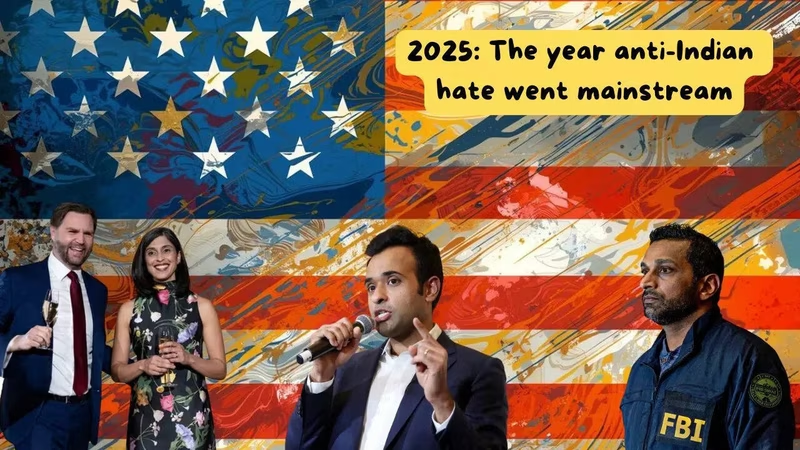
For decades, the American Dream sold Indian immigrants a simple promise: work hard, blend in, succeed—and you’ll be accepted. You could wear your kurta at Diwali, fly the tricolor on August 15, and still be a ‘real American.’
But 2025 shattered that illusion.
From Ivy League campuses to Capitol Hill, a disturbing trend emerged: **anti-India hate in America** didn’t just spike—it became normalized. Not through overt violence alone, but through subtle erasure, intellectual delegitimization, and a cultural narrative that painted India as inherently oppressive, backwards, or unworthy of respect—while its diaspora was told to choose between heritage and patriotism.
This isn’t paranoia. It’s documented. And it’s urgent.
Table of Contents
- The Shifting Landscape of Belonging
- Anti-India Hate in America 2025: Key Incidents
- The Role of Media and Academia
- Why Indian Americans Are Being Othered
- The Silence of Allies and Institutions
- How the Diaspora Is Fighting Back
- Conclusion: Reclaiming Belonging in a Divided America
- Sources
The Shifting Landscape of Belonging
Historically, Indian Americans were held up as the “model minority”—quiet, successful, apolitical. But that pedestal was always conditional. As long as you didn’t assert your cultural identity too loudly, especially if it involved Hinduism, Sikhism, or support for India’s sovereignty, you were safe.
In 2025, that bargain collapsed. The rise of identity politics, geopolitical tensions, and campus activism created a perfect storm where **anti-India hate in America** was reframed as “progressive critique.” Supporting Kashmir’s integration with India? Suddenly “colonial.” Celebrating Diwali with traditional rituals? Labeled “casteist” without context. Wearing a kara or tilak? Seen as a political statement rather than faith.
Anti-India Hate in America 2025: Key Incidents
The normalization wasn’t abstract. It played out in real-time, across institutions:
- University of California, Berkeley: A student group hosted a panel titled “India’s Fascist Turn,” featuring speakers who called for boycotting all things Indian—including Diwali celebrations. Campus security refused to intervene, citing “free speech” .
- U.S. Congressional Briefing: In March 2025, a House subcommittee hearing on “Human Rights in South Asia” featured only critics of India, with no representation from Indian American civil society. Hindu and Sikh groups were excluded despite repeated requests .
- Media Narratives: Major outlets ran opinion pieces linking everyday Indian cultural practices to systemic oppression, often without Indian Hindu or Sikh voices for balance. One viral New York Times op-ed described yoga as a “tool of Hindu nationalism” .
- Workplace Discrimination: Tech employees reported being passed over for promotions after speaking positively about India on social media. HR departments cited “cultural sensitivity” as justification .
The Role of Media and Academia
Perhaps the most insidious shift occurred in spaces meant to uphold truth and critical thinking.
Academic departments—particularly in South Asian Studies—increasingly framed India through a singular lens of oppression, sidelining scholars who offered nuanced or nationalist perspectives. As Dr. Rajiv Malhotra, a scholar of Indic studies, noted, “There’s a gatekeeping mechanism that equates love for India with extremism” .
Meanwhile, mainstream media amplified fringe voices while marginalizing the 4.5 million Indian Americans who see their homeland with pride. The result? A distorted public perception where criticism of India crosses into collective punishment of its diaspora.
Why Indian Americans Are Being Othered
Three forces converged in 2025:
1. Geopolitical Alignment
As U.S.-India relations grew complex—on trade, defense, and democracy—some activists conflated government policy with individual identity. Supporting India became “taking sides” against progressive values.
2. The Weaponization of Caste
While caste discrimination is a serious issue, in 2025 it was increasingly used as a blanket accusation against all Indian Americans, regardless of background. Hindu temples, community centers, and even school Diwali events were labeled “casteist spaces” without evidence .
3. The Erosion of Pluralism
America’s idea of pluralism once welcomed diverse faiths equally. But in 2025, Hinduism and Sikhism were treated as inherently problematic, while other religions were shielded from similar scrutiny. This double standard left many Indian Americans feeling like second-class citizens in their own spiritual identity.
The Silence of Allies and Institutions
Perhaps most painful was the silence. Civil rights organizations that championed inclusion for other groups remained quiet. Tech CEOs who spoke out on global issues stayed mum when Hindu employees reported harassment. Even fellow minority communities, fearing “Hindutva” labels, distanced themselves.
As one Bay Area mother told the Times of India, “My son came home crying because his teacher said India doesn’t belong in the ‘free world.’ No one defended him. Not even the PTA” .
How the Diaspora Is Fighting Back
But 2025 wasn’t just a year of victimhood—it sparked mobilization.
- Coalition Building: Groups like the Hindu American Foundation and Sikh Coalition launched joint advocacy campaigns.
- Legal Action: Families filed civil rights complaints against school districts for allowing anti-India propaganda in curricula.
- Media Literacy: Grassroots podcasts, YouTube channels, and town halls educated communities on how to respond to misinformation.
- Political Engagement: Indian American voter registration surged 37% in 2025, with a focus on holding representatives accountable .
For more on this movement, see our deep dive on how the diaspora is reclaiming its voice.
Conclusion: Reclaiming Belonging in a Divided America
The story of **anti-India hate in America** in 2025 is not just about India. It’s about who gets to define American identity. Can you love your ancestral homeland and still be loyal to your adopted one? Can your faith be respected even if it’s not familiar?
The backlash Indian Americans faced wasn’t really about India’s policies—it was about power, narrative control, and the right to exist without apology. And as the diaspora organizes, litigates, and votes, one message is clear: we are not leaving the table. We are rewriting the menu.
Sources
- Times of India: 2025: The year America normalised anti-India hate
- U.S. House Foreign Affairs Committee Archives, March 2025 Hearing Transcripts
- Hindu American Foundation: Annual Report on Religious Discrimination 2025
- Sikh Coalition: Campus Hate Incidents Tracker
- Pew Research Center: Indian American Identity and Discrimination Survey (2025)