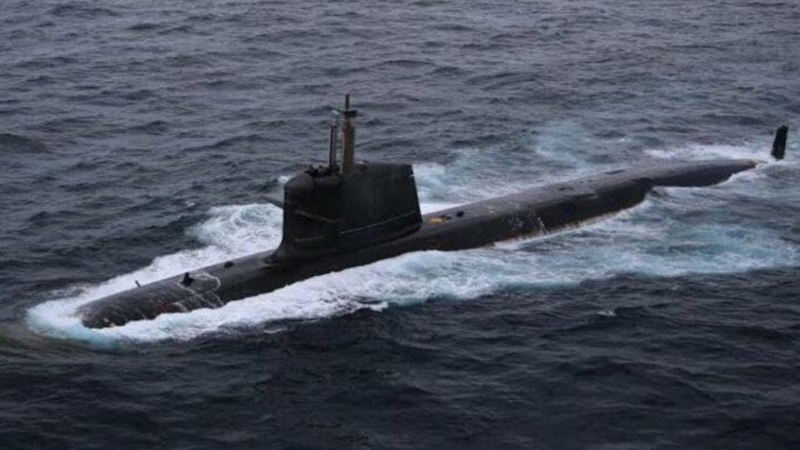
India just took a giant leap toward future-proofing its armed forces. In a decisive move announced in late December 2025, the Ministry of Defence cleared two critical contracts totaling **₹4,666 crore**—one for the Army’s elite counter-terrorism units and another for the Navy’s deep-sea warfare arsenal .
This isn’t just another procurement update. This **India defense deal 2025** is a clear signal: New Delhi is prioritizing lethality, agility, and self-reliance in an increasingly volatile security landscape. From urban combat zones to the depths of the Indian Ocean, these new systems are designed to give Indian forces a decisive edge.
Table of Contents
- What’s in the India Defense Deal 2025?
- Close Quarter Battle Carbines for the Army
- Heavyweight Torpedoes for the Navy
- Strategic Impact on India’s Military Readiness
- The ‘Make in India’ Angle
- Conclusion: A New Era of Indigenous Combat Power
- Sources
What’s in the India Defense Deal 2025?
The Ministry of Defence (MoD) announced two separate but equally significant contracts under the Buy (Indian-IDDM) category—a procurement route that favors domestically designed and developed systems .
The breakdown is as follows:
- ₹2,869 crore: For the supply of **Close Quarter Battle (CQB) carbines** to the Indian Army and other central armed police forces.
- ₹1,797 crore: For the procurement of **heavyweight torpedoes** for the Indian Navy’s submarine fleet.
Together, these form the core of India’s latest military modernization push—and both are being manufactured entirely within India, aligning with Prime Minister Modi’s **‘Make in India’** and **‘Aatmanirbhar Bharat’** (self-reliant India) initiatives .
Close Quarter Battle Carbines for the Army
Urban warfare has changed. From terror strikes in metros to high-altitude bunkers in Kashmir, the Indian Army needs weapons that are compact, accurate, and lethal at short ranges. The new CQB carbines answer that call.
Developed by the **Ordnance Factory Board (OFB)** in collaboration with Indian private defense firms, these carbines are chambered in 5.56x30mm—a cartridge specifically designed for close-range engagements with minimal collateral damage .
Key features include:
- Effective range of up to 150 meters
- High rate of fire with low recoil
- Modular design for attachments (red-dot sights, tactical lights, suppressors)
- Lightweight (under 3 kg) for rapid maneuverability
These will be issued primarily to special forces like the **Para (Special Forces)**, **Rashtriya Rifles**, and **NSG commandos**, as well as CRPF and other CAPFs deployed in counter-insurgency operations . Unlike the long-delayed tender for 400,000+ assault rifles, this procurement was fast-tracked under emergency powers—showing a new urgency in military preparedness.
Why CQB Carbines Matter
In tight spaces—railway stations, aircraft cabins, or narrow alleyways—standard rifles are too bulky. The CQB carbine fills this gap with surgical precision. During the 2008 Mumbai attacks, Indian forces struggled with inadequate close-range firepower. These new weapons ensure that history won’t repeat itself.
Heavyweight Torpedoes for the Navy
While the Army gets its urban edge, the Navy is diving deep—literally. The ₹1,797 crore contract is for the supply of a new generation of **heavyweight torpedoes**, designed to be launched from submarines against enemy ships and other subs .
These torpedoes are being developed by **Bharat Dynamics Limited (BDL)** in partnership with the **Naval Science and Technological Laboratory (NSTL)**, a DRDO lab. They are expected to replace older, imported systems and significantly extend the strike range and lethality of India’s submarine fleet, including the Kalvari-class (Scorpène) and future SSNs.
Capabilities of the new torpedoes:
- Range exceeding 50 km
- Advanced acoustic homing for target tracking
- High-explosive warhead capable of sinking destroyers
- Compatibility with Indian and Russian-origin submarines
This move is a direct response to China’s expanding undersea presence in the Indian Ocean Region (IOR). With PLAN submarines regularly spotted near Sri Lanka and the Maldives, India can no longer afford to rely on outdated or foreign-dependent underwater weapons .
Strategic Impact on India’s Military Readiness
This dual procurement isn’t just about hardware—it’s about **deterrence**. By simultaneously upgrading urban combat gear and deep-sea strike capabilities, India is sending a clear message to adversaries across land and sea.
For the **Army**, the carbines reduce dependence on foreign suppliers like Israel or the U.S., ensuring uninterrupted supply during conflicts. For the **Navy**, indigenous torpedoes mean operational autonomy—no risk of embargoes during a crisis.
As defense analyst Dr. Ajai Shukla notes, “Indigenous weapons systems give you strategic freedom. You control the logistics, the upgrades, and the doctrine” .
The ‘Make in India’ Angle
What truly sets this **India defense deal 2025** apart is its 100% indigenous origin. Both the CQB carbine and the heavyweight torpedo were designed and will be manufactured in India—creating jobs, boosting private defense R&D, and cutting the import bill.
According to the Stockholm International Peace Research Institute (SIPRI), India was the world’s largest arms importer between 2018–2022 . Deals like this are reversing that trend. In fact, defense exports hit a record **$3 billion in 2024**, and systems like these could become exportable in the near future—especially to friendly nations in Southeast Asia and Africa.
For more on India’s defense industry transformation, see our deep dive on India’s rising role as a global defense exporter.
Conclusion: A New Era of Indigenous Combat Power
The ₹4,666 crore **India defense deal 2025** marks a turning point. No longer is India just buying weapons to fill gaps. It’s building a self-sustaining ecosystem of design, production, and deployment—tailored to its unique security challenges.
From the alleyways of Srinagar to the abyssal plains of the Arabian Sea, Indian forces will soon be armed with homegrown tools that offer **“world-class lethality”**—as the MoD proudly declared .
As geopolitical tensions rise, this isn’t just smart procurement. It’s national insurance.
Sources
- Times of India: India inks deals worth Rs 4,666 crore for CQB carbines, heavyweight torpedoes
- Ministry of Defence, India: Official Procurement Announcements
- DRDO: Naval Science and Technological Laboratory (NSTL)
- SIPRI: Trends in International Arms Transfers, 2024
- The Hindu: Analysis of India’s Defense Modernization