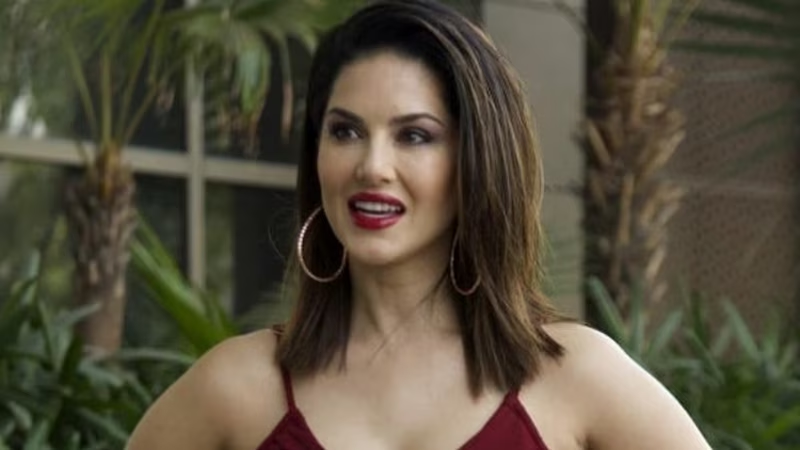
Sunny Leone’s Mathura New Year Gig Cancelled Amid Religious Outcry—Tradition vs. Entertainment?
In a dramatic turn of events just days before New Year’s Eve, a glitzy celebration at a luxury hotel in Mathura—featuring Bollywood actress and former adult film star Sunny Leone—was abruptly cancelled. The reason? Fierce opposition from local seers and religious leaders who deemed the event “incompatible” with the spiritual sanctity of the Braj region, believed to be the birthplace of Lord Krishna .
Despite having obtained all necessary permissions, completing technical rehearsals, and confirming ticket sales, the organizers chose to pull the plug, stating they were acting out of “deep respect for the traditions and sentiments of the saint community.” But this decision has sparked a heated national debate: where should India draw the line between cultural sensitivity and creative freedom?
Table of Contents
- What Happened to Sunny Leone’s Mathura Event?
- Why the Seers Objected to the New Year Show
- Organizers’ Response: Respect or Capitulation?
- Mathura as a Sacred Space: The Braj Context
- Precedents: Similar Controversies in India
- Public Reaction: Polarized Opinions Online
- Legal and Cultural Implications
- Conclusion: Tradition, Entertainment, and the Indian Identity
- Sources
What Happened to Sunny Leone’s Mathura Event?
The event was scheduled for December 31, 2025, at a five-star hotel on the outskirts of Mathura. Promoted as a “premium New Year’s Eve gala,” it promised live music, celebrity appearances, and a performance by Sunny Leone, who has successfully rebranded herself as a mainstream entertainer through films, web series, and brand endorsements.
Tickets were sold out within hours, and the hotel had deployed extra security. However, within 48 hours of the event, video clips of local seers condemning the “vulgarity” and “moral pollution” of hosting such a show in Krishna’s land went viral. By December 29, the organizers issued a formal cancellation notice .
Why the Seers Objected to the New Year Show
The protest was led by influential figures from the Akhil Bharatiya Akhara Parishad and local mathadhis (monastery heads), who argued that Mathura is not just a city—it’s a tirtha (pilgrimage site) where millions come to seek spiritual solace.
Their objections centered on three core concerns:
- Moral incompatibility: They claim Sunny Leone’s past work conflicts with the “sattvic” (pure) ethos of Braj culture.
- Religious sanctity: Hosting a late-night, alcohol-served party near Krishna Janmabhoomi is seen as sacrilegious.
- Community sentiment: “You cannot treat Mathura like Goa or Mumbai,” said Mahant Gopal Giri of the Digambar Akhara .
Notably, the protest wasn’t just about one individual—it was about defending a cultural identity they feel is under siege from commercialized entertainment.
Organizers’ Response: Respect or Capitulation?
In their official statement, the event organizers emphasized that “all legal and municipal norms were followed,” including noise permits, fire safety checks, and liquor licenses. Yet, they chose to cancel, saying: “We hold the spiritual heritage of Braj in highest regard and do not wish to hurt anyone’s sentiments.”
Critics argue this sets a dangerous precedent—where vocal religious groups can override lawful, consensual entertainment. Others applaud the move as an example of “responsible event management” in sensitive regions [[INTERNAL_LINK:entertainment-regulations-india]].
Mathura as a Sacred Space: The Braj Context
To understand the intensity of the backlash, one must appreciate Mathura’s cultural geography. The Braj region—encompassing Mathura, Vrindavan, and Govardhan—is the heartland of Krishna devotion. Daily life revolves around raslila performances, temple rituals, and devotional singing.
Unlike cosmopolitan cities, public behavior here is subtly governed by unwritten codes of piety. Even mainstream Bollywood films are often edited for local screenings. As cultural anthropologist Dr. Meera Nanda notes in Economic & Political Weekly, “Sacred cities in India operate under a dual legal-moral framework—where law permits, but tradition forbids” .
Precedents: Similar Controversies in India
This isn’t the first time entertainment has clashed with religious sentiment:
- 2019: A rave party in Rishikesh was shut down after protests from ashrams.
- 2021: A music festival near Varanasi faced backlash for scheduling during Maha Shivaratri.
- 2023: A fashion show in Ujjain was cancelled over “objectionable” attire.
Each case reflects the growing tension between India’s globalized urban culture and its deeply rooted spiritual geographies.
Public Reaction: Polarized Opinions Online
Social media exploded with divided opinions:
- Supporters of cancellation: “Mathura is Krishna’s home, not a nightclub.”
- Critics: “So only ‘pure’ people can enjoy New Year? This is moral policing.”
- Sunny Leone fans: “She’s a legal citizen with the right to work anywhere in India.”
Many pointed out the irony: the same seers who opposed the event had no issue with large-scale political rallies or election-related noise in the same area.
Legal and Cultural Implications
Legally, the organizers had every right to proceed. India’s Constitution guarantees freedom of profession (Article 19) and prohibits discrimination based on past occupation. However, courts have also upheld “reasonable restrictions” in the interest of “public order, decency, or morality” (Article 19(2)).
The bigger question is cultural: can pluralistic societies accommodate both devotion and diversion without one silencing the other? As India urbanizes, this conflict will only intensify—especially in tier-2 and tier-3 spiritual hubs.
Conclusion: Tradition, Entertainment, and the Indian Identity
The cancellation of the Sunny Leone Mathura event is more than a celebrity controversy—it’s a microcosm of India’s ongoing identity negotiation. On one side: the desire to preserve sacred spaces with reverence. On the other: the right to inclusive, modern leisure. Finding balance won’t be easy, but dialogue—not diktat—must lead the way. Otherwise, every festival, concert, or celebration risks becoming a battleground of beliefs.