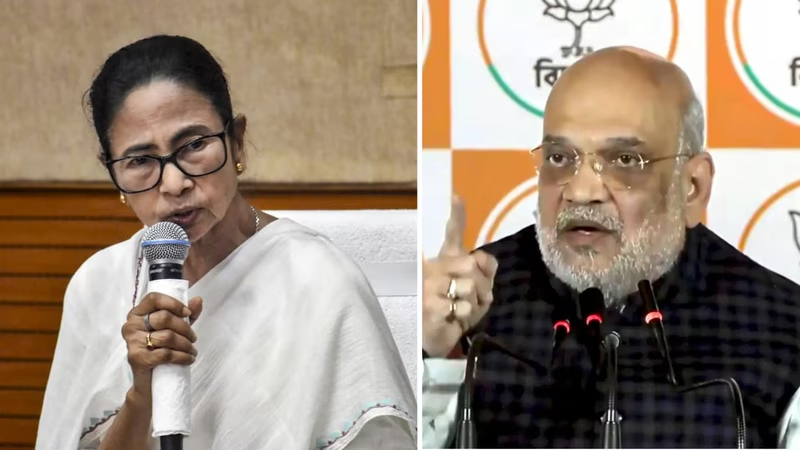
Amit Shah Slams Mamata Banerjee: ‘Fear and Corruption Are Bengal’s Identity’
In a fiery political salvo that’s reignited tensions ahead of the 2026 West Bengal Assembly elections, Union Home Minister Amit Shah has directly targeted Chief Minister Mamata Banerjee, accusing her Trinamool Congress (TMC) government of turning the state into a hub of “fear and corruption.” Speaking at a public rally in North Bengal, Shah didn’t just criticize policies—he questioned the very identity of Bengal under TMC rule .
Shah’s remarks, which included a pointed “bhaipo” (brother-in-law) jibe referencing TMC’s controversial political kinship culture, come amid rising national scrutiny over border security. His central allegation? That Mamata’s government has deliberately stalled land acquisition for critical border fencing along the Bangladesh frontier—creating a national security vulnerability that enables illegal infiltration.
Table of Contents
- Amit Shah on Mamata Banerjee: The Core Allegations
- The Border Fencing Controversy: What You Need to Know
- The “Bhaipo” Dig: Decoding Shah’s Political Jibe
- BJP’s 2026 Ambition: A Two-Thirds Majority Pledge
- TMC Response and Public Reaction
- Historical Context: BJP vs TMC in Bengal
- Why This Rhetoric Matters for National Security
- Conclusion: A Battle for Bengal’s Soul
- Sources
Amit Shah on Mamata Banerjee: The Core Allegations
Shah’s speech was loaded with sharp political messaging, centered on three key accusations:
- Blocking border infrastructure: “For years, the Bengal government has refused to hand over land for fencing. Is this negligence—or complicity?”
- Institutionalizing corruption: “From ministers to their bhaipos, everyone is in the business of commissions.”
- Spreading fear: “Journalists, opposition workers, and dissenters live in terror. This is not governance—it’s suppression.”
These claims aren’t new, but Shah’s platform—backed by the Union Home Ministry—gives them unprecedented weight. As the minister responsible for internal security, his words carry policy implications beyond electioneering .
The Border Fencing Controversy: What You Need to Know
The India-Bangladesh border stretches 4,096 km, with West Bengal sharing 2,217 km of it—the longest segment. Since the 1990s, the central government has pursued fencing to curb illegal immigration, cattle smuggling, and human trafficking.
However, land acquisition in Bengal has been fraught with delays. According to a Ministry of Home Affairs report, over 180 km of fencing remains incomplete in Bengal due to non-allocation of land by the state government .
Shah argues this gap enables infiltration, which he links to rising crime and demographic shifts in districts like Malda and Murshidabad—a narrative BJP has weaponized since 2019.
The “Bhaipo” Dig: Decoding Shah’s Political Jibe
Shah’s use of “bhaipo” (Bengali for brother-in-law) is a direct reference to allegations that TMC leaders appoint relatives to lucrative posts. The term gained notoriety during the 2021 elections when BJP posters mocked “Didi-ke-bhaipo” (Didi’s brothers-in-law).
This isn’t just slang—it’s strategic. By invoking familial nepotism, Shah taps into public frustration over perceived cronyism in TMC’s governance, especially after high-profile corruption cases involving aides close to Banerjee [[INTERNAL_LINK:tmc-corruption-scandals-explained]].
BJP’s 2026 Ambition: A Two-Thirds Majority Pledge
Shah didn’t stop at criticism—he laid out a bold electoral vision: “In 2026, BJP will form the government in Bengal with a two-thirds majority.”
This is significant. In 2021, BJP won 77 seats—up from 3 in 2016—but still fell far short of unseating TMC, which secured 213 seats. A two-thirds majority (206+ seats in the 294-member assembly) would allow BJP to pass constitutional amendments and override gubernatorial vetoes.
To achieve this, BJP is doubling down on:
- Border security as a national issue.
- Hindutva consolidation in Hindu-majority districts.
- Anti-corruption messaging targeting urban voters.
TMC Response and Public Reaction
The TMC hit back swiftly. Senior leader Abhishek Banerjee called Shah’s comments “desperate lies from a party that lost Bengal twice.” He accused the Centre of using “security” as a smokescreen to divert attention from unemployment and inflation.
Public reaction remains polarized. In rural Bengal, many see border fencing as disruptive to farming livelihoods. In urban centers, however, security concerns are gaining traction—especially among middle-class voters weary of political violence.
Historical Context: BJP vs TMC in Bengal
Bengal was long considered a Congress bastion until Mamata Banerjee ended 34 years of Left rule in 2011. BJP, historically marginal, capitalized on anti-TMC sentiment post-2016, fueled by:
- NRC-CAA protests (2019–2020)
- Allegations of minority appeasement
- Central-state friction over law and order
Despite losing in 2021, BJP established itself as the principal opposition—setting the stage for a prolonged battle for Bengal’s political soul.
Why This Rhetoric Matters for National Security
When the Union Home Minister frames a state government’s actions as a “national security threat,” it crosses from politics into policy. Shah’s statements could justify:
- Central takeover of border management under Article 355.
- Increased deployment of BSF without state consent.
- Legal action over non-cooperation on critical infrastructure.
As [The Hindu notes](https://www.thehindu.com), such escalations risk deepening India’s federal tensions—but also signal BJP’s willingness to use constitutional tools to pressure opposition-ruled states.
Conclusion: A Battle for Bengal’s Soul
Amit Shah’s attack on Mamata Banerjee isn’t just campaign rhetoric—it’s a declaration of ideological war. By tying TMC rule to corruption, fear, and national insecurity, BJP is positioning itself not just as an alternative government, but as Bengal’s moral and strategic savior. With the 2026 elections looming, this showdown will define not only Bengal’s future but also the trajectory of India’s federal democracy.