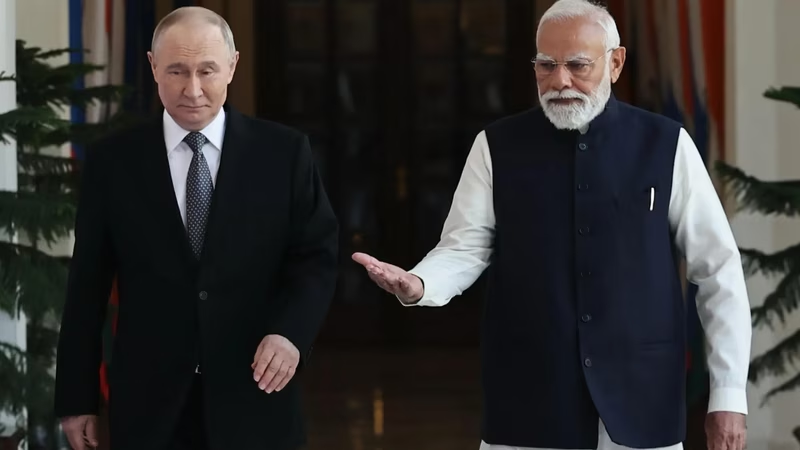
PM Modi ‘Deeply Concerned’ Over Attack on Putin’s House—Calls for Global Restraint
In a rare and high-stakes diplomatic intervention, Indian Prime Minister Narendra Modi has issued a strong statement following reports of an alleged attack on Russian President Vladimir Putin’s private residence. Describing himself as “deeply concerned,” PM Modi urged all parties to exercise restraint and prioritize dialogue over escalation—a message that carries significant weight amid rising geopolitical volatility .
While details of the incident remain murky and unverified by independent sources, the mere suggestion of an attack on one of the world’s most heavily guarded leaders has sent shockwaves through global security circles. Modi’s swift and measured response not only underscores India’s commitment to peaceful diplomacy but also highlights the delicate balancing act New Delhi maintains between major global powers.
Table of Contents
- What We Know About the Alleged Attack on Putin’s House
- PM Modi on Putin House Attack: A Diplomatic Balancing Act
- Why India’s Response Matters on the Global Stage
- India-Russia Relations: Strategic Partnership in Turbulent Times
- Global Reactions to the Putin Residence Incident
- What Next for International Security and Diplomacy?
- Conclusion: Modi’s Call for Calm in a Volatile World
- Sources
What We Know About the Alleged Attack on Putin’s House
As of late December 2025, reports—primarily emerging from unverified social media channels and a few regional outlets—claim an attempted breach or attack near President Putin’s residence outside Moscow. Russian state media has not confirmed any such incident, and Kremlin officials have remained silent, fueling speculation but offering no clarity .
Security experts caution against jumping to conclusions. “Presidential residences in Russia are among the most fortified locations on Earth,” notes Dr. Elena Petrova, a senior fellow at the International Institute for Strategic Studies (IISS) . “Any confirmed breach would represent an unprecedented security failure—or a deliberate disinformation campaign.”
Nonetheless, the mere circulation of these reports has triggered anxiety in diplomatic corridors worldwide—prompting responses like PM Modi’s before facts are fully established.
PM Modi on Putin House Attack: A Diplomatic Balancing Act
Prime Minister Modi’s statement—“deeply concerned by the reports… urges all sides to show restraint and resolve differences through dialogue”—is carefully calibrated . It avoids assigning blame, refrains from validating unconfirmed reports, yet clearly signals India’s opposition to violence or destabilization of any kind.
This approach reflects India’s long-standing foreign policy doctrine of strategic autonomy. Even as India deepens defense and energy ties with Russia—buying discounted oil and S-400 missile systems—it maintains strong partnerships with the U.S., EU, and Quad allies. In this context, Modi’s neutrality is not weakness—it’s tactical prudence.
By calling for “dialogue,” Modi also reaffirms a core tenet of Indian diplomacy: that even the most intractable conflicts must be resolved through peaceful means, not force.
Why India’s Response Matters on the Global Stage
India is not just any observer. As the world’s most populous democracy, a G20 president in 2023, and a rising economic and military power, its voice carries growing influence. Modi’s stance matters for three key reasons:
- Credibility as a neutral broker: Unlike Western nations, India has not sanctioned Russia over Ukraine, giving it unique leverage to mediate.
- Economic interdependence: India relies on Russian oil and defense tech; Russia counts on Indian markets and diplomatic cover at forums like the UN.
- Global South leadership: Many developing nations look to India as a model of non-aligned, principle-based foreign policy.
In an era of polarized alliances, India’s call for restraint offers a third path—one rooted in sovereignty and peaceful coexistence.
India-Russia Relations: Strategic Partnership in Turbulent Times
The India-Russia relationship, forged during the Cold War, remains resilient despite global shifts. In 2025, bilateral trade hit a record $65 billion, largely driven by energy . Defense cooperation continues, with joint production of AK-203 rifles in India and ongoing talks about manufacturing Russian fighter jet engines.
Yet, the partnership is evolving. India now diversifies its arms imports (increasing buys from France and the U.S.) and abstains on key UN votes condemning Russia—walking a fine line between loyalty and strategic diversification.
Modi’s response to the Putin residence reports fits this pattern: affirming friendship without endorsing actions. This nuanced approach preserves one of India’s oldest strategic ties while safeguarding its broader geopolitical interests [[INTERNAL_LINK:india-russia-defense-deal-2025]].
Global Reactions to the Putin Residence Incident
While Western governments have largely remained silent—likely awaiting official confirmation—the incident has sparked debate among analysts:
- The U.S. State Department declined to comment, citing “unverified information.”
- China called for “calm and stability,” echoing Modi’s language.
- NATO sources suggested the reports might be “psychological operations” aimed at destabilizing Russian leadership.
As [Reuters reports](https://www.reuters.com/world/), disinformation campaigns targeting high-level figures have surged since 2022, making verification critical before any diplomatic fallout occurs.
What Next for International Security and Diplomacy?
If the attack reports are confirmed, it could trigger a major security crackdown in Russia and further isolate Putin’s regime. If debunked, it may signal a new phase of hybrid warfare—using rumors to provoke overreactions.
Either way, leaders like PM Modi play a crucial role in preventing escalation. His emphasis on “dialogue” isn’t just diplomatic rhetoric; it’s a survival strategy in a world where miscalculation could have catastrophic consequences.
Conclusion: Modi’s Call for Calm in a Volatile World
In a time of rampant misinformation and geopolitical brinkmanship, Prime Minister Modi’s response to the alleged attack on Putin’s house stands out for its clarity, caution, and commitment to peace. By urging restraint and dialogue—without taking sides—India reinforces its identity as a responsible global stakeholder. As tensions simmer worldwide, such voices of reason may be our best defense against chaos.