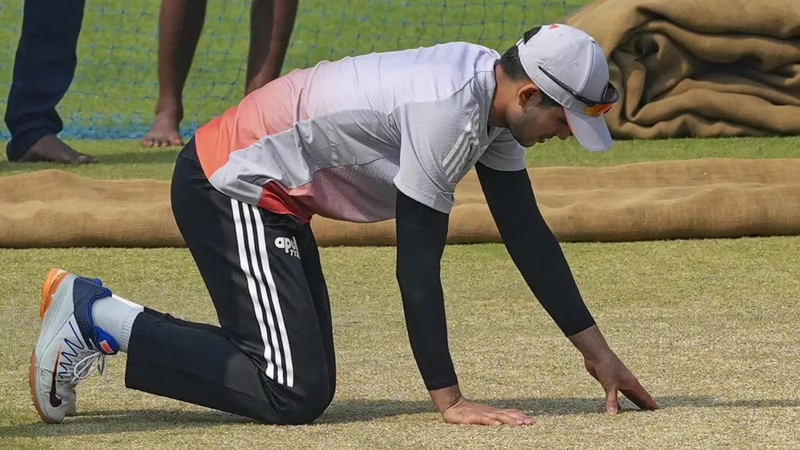
Eden Gardens Pitch Rated ‘Satisfactory’ by ICC—But Is It Fair?
Cricketers came, spinners conquered, and the match wrapped up in just three days. Yet, the real drama from the India vs South Africa Test at Eden Gardens might not be on the field—but in the paperwork. The International Cricket Council (ICC) has officially rated the Kolkata pitch as “satisfactory,” a verdict that’s already dividing fans, former players, and coaches across the cricketing world.
Coming on the heels of the Melbourne Cricket Ground’s (MCG) Ashes pitch being slapped with an “unsatisfactory” rating for producing a two-day Test, the ICC’s contrasting stance on Eden Gardens has raised eyebrows. Was the Kolkata track a fair test of skill, or did it cross the line into being overly bowler-friendly? Let’s break down the Eden Gardens pitch rating controversy from all angles.
Table of Contents
- What Happened in the IND vs SA Test?
- Eden Gardens Pitch Rating by ICC
- Why the Rating Is Sparking Debate
- Contrasting the MCG and Eden Gardens Pitches
- What the Coaches and Experts Say
- ICC Pitch Assessment Criteria Explained
- What This Means for Future Tests in India
- Conclusion
- Sources
What Happened in the IND vs SA Test?
The second Test between India and South Africa at Eden Gardens was a whirlwind. The entire match concluded in just 72.2 overs of South Africa’s second innings—less than three full days of play. India posted 245 in their first innings, South Africa collapsed for 104, then India declared their second innings at 281/7. South Africa, needing 423 to win, were bowled out for 131.
Spinners dominated: Ravichandran Ashwin and Ravindra Jadeja claimed 15 of the 20 South African wickets. The pitch offered sharp, early turn—something even India’s batting coach, Vikram Rathour, admitted was “unexpected” .
Eden Gardens Pitch Rating by ICC
Despite the lopsided result and minimal batting time, the ICC’s pitch panel gave Eden Gardens a “satisfactory” rating—the second-highest on its five-tier scale, which includes: Very Good, Good, Satisfactory, Below Average, and Poor .
Critically, this means the pitch will **not** trigger any sanctions for the Board of Control for Cricket in India (BCCI). A “poor” rating would have led to a one-Test suspension for the venue. But “satisfactory” implies the surface, while challenging, still fell within acceptable parameters for a fair contest between bat and ball.
Why the Rating Is Sparking Debate
Many argue that a pitch producing 40 wickets in under 150 overs—with batters struggling from ball one—should not be deemed “satisfactory.” Critics point to:
- Lack of balance: The pitch offered excessive turn from Day 1, rarely seen in modern Tests.
- Short duration: A three-day Test limits broadcast revenue and fan engagement.
- Double standard: The MCG’s pitch, which also produced a quick result, was rated “unsatisfactory” just days earlier.
However, defenders counter that cricket should reflect local conditions—spin in India, seam in England, bounce in Australia. [INTERNAL_LINK:history-of-subcontinental-pitch-design]
Contrasting the MCG and Eden Gardens Pitches
The timing of these two ratings has fueled accusations of inconsistency. Let’s compare:
| Aspect | MCG (Ashes Test) | Eden Gardens (IND vs SA) |
|---|---|---|
| Match Duration | 2 days | 3 days |
| Total Overs Bowled | ~80 | ~150 |
| Pitch Behavior | Excessive seam movement, no batting chance | Sharp turn, variable bounce from Day 1 |
| ICC Rating | Unsatisfactory | Satisfactory |
Why the difference? The ICC likely considered that Eden Gardens’ pitch, while spin-friendly, still allowed India’s batters to post 245 and 281/7—proof of *some* batting resilience, unlike the MCG where top-order collapses were near-instantaneous.
What the Coaches and Experts Say
India’s head coach, Gautam Gambhir, staunchly defended the pitch, calling it a “true test of skill” that rewarded preparation and technique . He argued that if batters can’t handle turning tracks in India, they shouldn’t be playing Test cricket there.
Conversely, former South African captain AB de Villiers called the surface “borderline unplayable,” while ex-India spinner Harbhajan Singh said it “offered too much, too early” . The split in opinion highlights the subjective nature of pitch evaluation.
ICC Pitch Assessment Criteria Explained
The ICC doesn’t just judge based on match length. Its criteria include:
- Whether the pitch provided a fair contest between bat and ball
- If it deteriorated prematurely or unnaturally
- Whether it posed any danger to players
- If it reflected typical local playing conditions
According to the ICC’s official guidelines, pitches in the subcontinent are expected to assist spin—and that’s factored into evaluations .
What This Means for Future Tests in India
The “satisfactory” rating gives the BCCI a green light to continue preparing turning tracks for home series—a strategy that has brought India immense success in the World Test Championship cycle. Upcoming venues like Nagpur and Chennai may follow suit.
However, the global debate may push the ICC to refine its rating system to better account for regional norms without compromising the spirit of a “contest.”
Conclusion
The Eden Gardens pitch rating by the ICC as “satisfactory” may be technically correct within its framework, but it won’t silence critics who believe modern Test cricket needs more balance to survive. While spin is India’s home advantage, the line between “challenging” and “extreme” remains hotly contested. One thing is clear: as long as pitches produce results, the debate—and the drama—will continue.