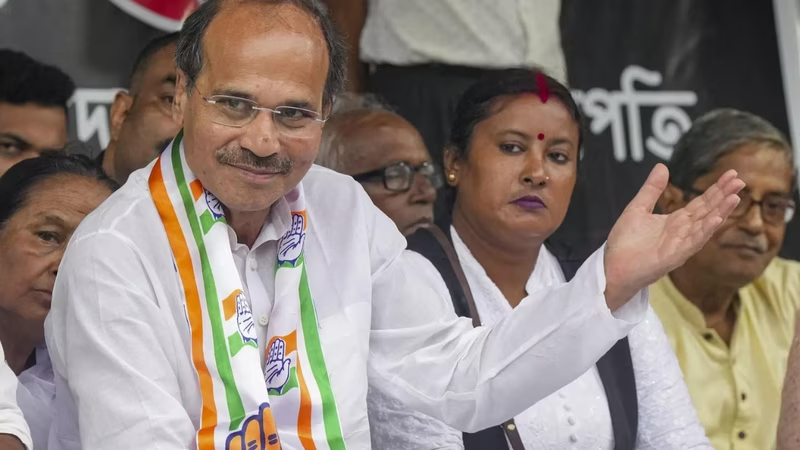
When Congress leader Adhir Ranjan Chowdhury walked into Prime Minister Narendra Modi’s office this week, it wasn’t just another political courtesy call. It was a high-stakes intervention—on behalf of thousands of Indian citizens being wrongly branded as ‘foreign infiltrators’ simply because they speak Bengali.
The meeting, centered on the rising tide of violence and harassment against Bengali-speaking migrant workers in BJP-ruled states, has ignited a fierce national debate about identity, citizenship, and the dangerous blurring of lines between Banglabhasi (Bengali-speaking Indians) and Bangladeshi nationals. And with West Bengal’s 2026 assembly elections looming—and Union Home Minister Amit Shah already on the ground reviewing BJP’s poll strategy—the timing couldn’t be more politically charged.
Table of Contents
- Adhir Chowdhury Meets PM Modi: The Stakes
- The Crisis: Banglabhasi Mistaken for Bangladeshi
- Reported Incidents of Violence and Detention
- Why This Is Happening: Political and Administrative Factors
- The West Bengal 2026 Election Shadow
- Legal and Constitutional Implications
- Opposition and Civil Society Response
- Conclusion
- Sources
Adhir Chowdhury Meets PM Modi: The Stakes
The rare meeting between a senior Congress leader and the Prime Minister—typically reserved for national emergencies or bipartisan consensus—underscores the gravity of the situation. According to sources, Chowdhury presented documented evidence of arbitrary detentions, mob attacks, and workplace evictions targeting Bengali-speaking laborers in states like Assam, Gujarat, and Maharashtra .
His core message was clear: “Our people are being treated as infiltrators,” he reportedly told the PM. “They carry valid voter IDs, Aadhaar cards, and birth certificates—yet they’re being rounded up, humiliated, and sometimes deported based on accent alone.”
The Crisis: Banglabhasi Mistaken for Bangladeshi
At the heart of this crisis lies a dangerous administrative and linguistic confusion. Banglabhasi refers to native Bengali speakers from India—particularly from West Bengal, Tripura, and the Barak Valley of Assam. Bangladeshi, meanwhile, denotes citizens of the neighboring country.
But in practice, especially in states with heightened border vigilance or anti-immigration rhetoric, the distinction is often ignored. Local police, vigilante groups, and even employers have allegedly begun treating any Bengali speaker with suspicion—regardless of documentation.
Reported Incidents of Violence and Detention
Recent months have seen a disturbing pattern:
- In Ahmedabad, a group of construction workers from Murshidabad (West Bengal) were evicted from their site after being accused of “not sounding Indian.”
- In Guwahati, a tea stall owner was detained for three days despite producing an Indian passport—authorities claimed his “accent didn’t match.”
- In Pune, a domestic worker’s children were denied school admission after neighbors reported her as a “possible illegal immigrant” .
These cases, while geographically scattered, share a common thread: Bengali identity is being weaponized as a proxy for illegality.
Why This Is Happening: Political and Administrative Factors
Experts point to several converging factors:
- Rhetoric around NRC/CAA: The 2019 Citizenship Amendment Act and proposed National Register of Citizens created a climate of suspicion around non-Hindi, non-Hindu speakers.
- Local enforcement bias: Police in non-Bengali states often lack training to distinguish between linguistic and citizenship status.
- Electoral mobilization: In states like Assam and West Bengal, “anti-infiltration” narratives have become key campaign tools.
As political scientist Dr. Rekha Chowdhary notes, “When citizenship is framed as cultural rather than legal, language becomes a marker of loyalty—and vulnerability” .
The West Bengal 2026 Election Shadow
The timing of Chowdhury’s meeting is no coincidence. With West Bengal’s next assembly elections just a year away, both the BJP and TMC are aggressively courting voter sentiment. The BJP, under Amit Shah’s direct supervision, is pushing a “national security” narrative that links migration to law and order issues .
Meanwhile, the Congress—seeking relevance in a state dominated by Mamata Banerjee’s TMC—is positioning itself as the defender of Bengali identity across party lines. Chowdhury’s outreach to Modi may be as much about national credibility as local optics.
Legal and Constitutional Implications
India’s Constitution guarantees equality (Article 14) and prohibits discrimination based on language or place of birth (Article 15). Arbitrary detention based solely on linguistic identity may violate these core principles.
The Supreme Court has previously ruled that “accent or dialect cannot be grounds for questioning citizenship” (in the State of West Bengal v. Anwar Ali Sarkar precedent). Yet enforcement remains inconsistent. Civil rights groups are now urging the NHRC to issue guidelines for police handling of linguistic minorities.
Opposition and Civil Society Response
Chowdhury’s move has drawn support across the political spectrum. TMC leaders called it “long overdue,” while CPI(M) demanded a parliamentary inquiry. Meanwhile, NGOs like the People’s Union for Civil Liberties (PUCL) have launched legal aid cells for affected families.
For more on citizenship rights in India, see [INTERNAL_LINK:citizenship-act-and-minority-rights].
Conclusion
The Adhir Chowdhury meets PM Modi episode is more than a political headline—it’s a warning. When citizens are profiled, detained, or attacked based on how they speak, the very fabric of India’s pluralistic democracy is at risk. As the 2026 West Bengal elections approach, this issue will test not just party strategies, but the nation’s commitment to its constitutional promise of dignity for all—regardless of accent.
Sources
Times of India: ‘Treated as infiltrators’: Congress’ Adhir Ranjan Chowdhary meets PM Modi
Supreme Court of India: Judgments on Citizenship
People’s Union for Civil Liberties (PUCL): Official Site
Constitution of India: Articles 14 & 15