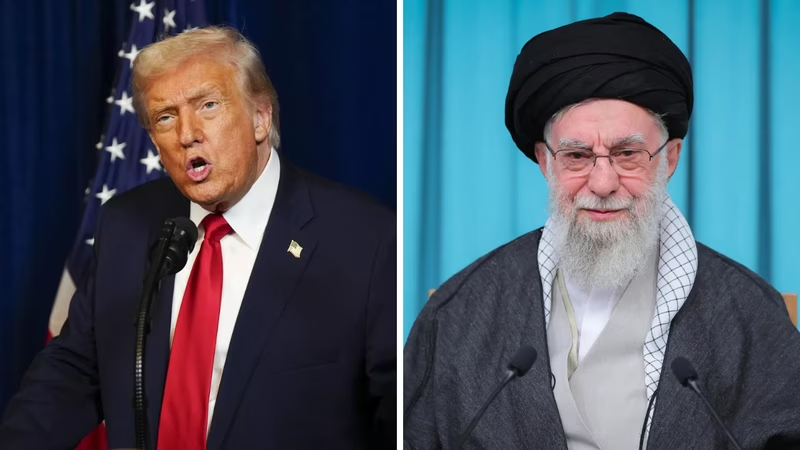
“We will knock them down.”
With those blunt words, Donald Trump has reignited one of the most volatile flashpoints in global security: the standoff between the United States and Iran over ballistic missile development. The former U.S. president—widely seen as positioning for a potential 2028 comeback—issued a stern public warning on December 29, 2025, declaring that any Iranian attempt to rebuild its missile program would trigger “severe and immediate consequences” .
Within hours, Tehran responded with equal force. A senior advisor to Iran’s Supreme Leader called Trump’s remarks “bluster from a defeated politician” and vowed that “any aggression will be met with fire.” The exchange has sent shockwaves through diplomatic circles, raising urgent questions: Is this posturing—or a prelude to real conflict?
In this deep-dive analysis, we unpack the origins of the Trump Iran missile warning, assess the credibility of Iran’s alleged missile revival, and explore what this means for regional stability ahead of a potentially pivotal U.S. election year.
Table of Contents
- What Exactly Did Trump Say?
- Is Iran Really Reviving Its Missile Program?
- The Strategic Calculus Behind Trump’s Red Line
- Tehran’s Counter: More Than Just Rhetoric?
- From JCPOA to Maximum Pressure: A Timeline of US-Iran Tensions
- How Israel, Saudi Arabia, and Gulf States Are Reacting
- Domestic Politics: Is This Trump’s 2028 Play?
- What Happens Next? Scenarios and Risks
- Conclusion: Brinkmanship in a Powder Keg Region
- Sources
What Exactly Did Trump Say?
Speaking at a private security forum in Florida, Trump—though no longer in office—delivered a message clearly aimed at both Tehran and Washington’s current leadership:
“They’re moving equipment to new sites. They think we’re not watching. But we are. And if they fire up that missile program again, we will knock them down—harder than before.”
He referenced past U.S. strikes on Iranian-linked targets, including the 2020 drone strike that killed Qasem Soleimani, and hinted that future actions could include direct strikes on missile facilities—even if they’re located near civilian areas .
Is Iran Really Reviving Its Missile Program?
Intelligence reports from U.S. and European agencies suggest Iran has indeed begun relocating missile assembly equipment to hardened, underground sites in central and western Iran—possibly to evade satellite surveillance .
While Iran’s nuclear program remains constrained under IAEA monitoring, its ballistic missile development has never been part of the 2015 JCPOA deal. Tehran maintains that its missiles are “defensive” and not designed to carry nuclear warheads—though the UN Security Council has repeatedly called on Iran to halt all long-range missile testing.
Recent satellite imagery analyzed by the Arms Control Association shows construction activity at two known missile bases near Qom and Kermanshah—consistent with silo reinforcement and fuel storage expansion .
The Strategic Calculus Behind Trump’s Red Line
Trump’s warning isn’t just ideological—it’s tactical:
- Deterrence Signaling: By drawing a public red line, he pressures the Biden administration to act—or appear weak.
- Alliance Reassurance: Israel and Gulf states have long feared U.S. disengagement; Trump is reminding them of American firepower.
- Legacy Defense: Trump wants history to remember his “maximum pressure” campaign as successful—not undermined by a resurgent Iran.
Notably, Trump’s language echoes his 2019 statement before the Soleimani strike: “If Iran wants to fight, that will be the official end of Iran.”
Tehran’s Counter: More Than Just Rhetoric?
Iran didn’t hold back. In an official statement, Supreme National Security Council advisor Ali Shamkhani declared:
“America’s threats are paper tigers. If they dare attack our sovereign territory, our response will not be limited to one front. The entire region will respond.”
Analysts interpret this as a veiled reference to Iran-backed militias in Iraq, Syria, Lebanon (Hezbollah), and Yemen (Houthis)—all capable of striking U.S. or allied interests within hours .
From JCPOA to Maximum Pressure: A Timeline of US-Iran Tensions
To understand today’s crisis, consider this recent history:
- 2015: Iran signs JCPOA, limiting nuclear activity in exchange for sanctions relief.
- 2018: Trump unilaterally withdraws U.S. from deal, reimposes “maximum pressure” sanctions.
- 2020: U.S. kills Soleimani; Iran retaliates with missile strikes on Iraqi bases hosting U.S. troops.
- 2023–2025: Indirect nuclear talks stall; Iran enriches uranium to 60% purity.
- Dec 2025: Trump issues new missile warning; Iran vows retaliation.
For deeper context, see our timeline on [INTERNAL_LINK:us-iran-relations-post-2015].
How Israel, Saudi Arabia, and Gulf States Are Reacting
Israel has remained publicly silent but is reportedly on high alert. Unnamed IDF sources say “all options are being reviewed” if Iran accelerates missile deployment .
Meanwhile, Saudi Arabia is walking a tightrope—engaged in backchannel talks with Tehran on normalization, yet deeply wary of Iranian missile reach. The UAE, still recovering from 2022 Houthi drone attacks, is urging “maximum restraint.”
Domestic Politics: Is This Trump’s 2028 Play?
Trump’s timing is no accident. With the 2026 midterms approaching and 2028 speculation mounting, he’s reinforcing his image as a “strong on Iran” leader—a key plank of his base’s foreign policy identity.
By framing the current administration as “weak,” he sets up a stark contrast: peace through strength vs. diplomacy without deterrence.
What Happens Next? Scenarios and Risks
Three paths could unfold:
- De-escalation: Backchannel talks lead to mutual restraint; missile sites remain inactive.
- Covert Action: U.S. or Israeli cyber/sabotage operations disrupt Iranian missile supply chains.
- Direct Strike: If Iran tests a long-range missile, Trump-era allies may push for airstrikes—risking regional war.
Conclusion: Brinkmanship in a Powder Keg Region
The Trump Iran missile warning is more than political theater—it’s a dangerous game of chicken in a region already saturated with weapons, proxies, and historical grievances. While Trump speaks as a private citizen, his words carry weight in Tehran, Tel Aviv, and Washington.
One miscalculation, one misread signal, and the “knock them down” rhetoric could spiral into something far deadlier. In the Middle East, red lines don’t just warn—they ignite.
Sources
- Times of India: ‘We will knock them down’: Trump draws red line on Iran’s missile programme
- Reuters: U.S. intelligence detects Iranian missile site reactivation
- Arms Control Association: Iran’s Ballistic Missile Program – Fact Sheet
- Al Jazeera: Iran warns US against military action after Trump threat
- The Guardian: Israel on alert amid Trump-Iran missile standoff