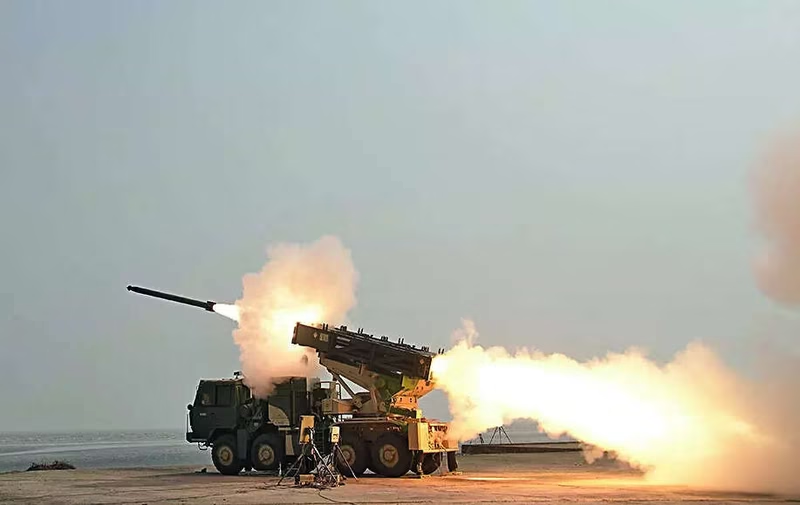
In one of the most significant defence decisions of the year, the Indian government has given the green light to military modernisation projects worth a staggering ₹79,000 crore—a clear signal that New Delhi is accelerating its efforts to future-proof its armed forces amid rising regional threats and technological warfare.
Headlining the approvals by the Defence Acquisition Council (DAC)—the apex body for military procurement—is the long-anticipated lease of two additional MQ-9B Predator drones from the United States, valued at ₹1,600 crore. But this is just the tip of the iceberg. The package includes critical upgrades across the Army, Navy, and Air Force, with a strong emphasis on indigenous manufacturing under the ‘Make in India’ initiative .
What does this mean for India’s defence posture? And why now? Let’s break down the strategic, operational, and geopolitical implications of this mega approval.
Table of Contents
- Key Projects Approved Under the ₹79,000 Crore Package
- The MQ-9B Predator Drones: Eyes in the Sky
- Why India’s Military Modernisation Projects Are Urgent
- Make in India: How Local Industry Benefits
- Strategic Impact: Countering China and Securing Borders
- Budget Allocation and Delivery Timeline
- Challenges in Implementation
- Conclusion: A New Era of Indian Military Readiness
- Sources
Key Projects Approved Under the ₹79,000 Crore Package
The DAC, chaired by Defence Minister Rajnath Singh, cleared a mix of capital acquisitions and infrastructure upgrades. Major highlights include:
- Lease of 2 additional MQ-9B SeaGuardian/ SkyGuardian drones – ₹1,600 crore
- Indigenous Air Defence Guns and Ammunition – Developed by Bharat Forge and DRDO
- Next-Gen Anti-Tank Guided Missiles (ATGMs) – For mountainous terrain operations
- Submarine-Launched Communication Systems – To enhance naval stealth and coordination
- Modernisation of Artillery Regiments – Including advanced fire control systems
Notably, over 65% of the total value is earmarked for domestic suppliers—a win for India’s defence industrial base .
The MQ-9B Predator Drones: Eyes in the Sky
The approval of two more MQ-9B High-Altitude Long-Endurance (HALE) drones adds to the 31 already contracted from General Atomics in 2021. These drones—capable of flying for over 30 hours and carrying precision munitions—are expected to be deployed across three services:
- Indian Navy: For Indian Ocean Region (IOR) surveillance
- Indian Air Force: For real-time strike coordination
- Indian Army: For monitoring Line of Actual Control (LAC) and counter-insurgency ops
With a sensor suite including synthetic aperture radar (SAR) and maritime surveillance radar, the MQ-9B can detect ship movements and ground targets even in poor weather—making it a game-changer against both China and non-state threats .
Why India’s Military Modernisation Projects Are Urgent
India’s armed forces have been grappling with aging equipment and capability gaps. Consider these realities:
- The average age of IAF fighter jets is over 30 years.
- Army artillery hasn’t fully replaced Soviet-era guns.
- Navy faces growing Chinese submarine presence in the IOR.
Meanwhile, China has doubled its defence R&D spending since 2020. In this context, the military modernisation projects India has approved aren’t just upgrades—they’re essential for credible deterrence.
As the Stockholm International Peace Research Institute (SIPRI) notes, India is now the world’s third-largest military spender—but efficiency and modernisation remain key challenges .
Make in India: How Local Industry Benefits
A major shift in this approval cycle is the emphasis on domestic production. For example:
- The new air defence guns will be co-manufactured by Bharat Forge and DRDO.
- ATGMs will be built by Bharat Dynamics Limited (BDL) with tech from foreign partners.
- Over 50 Indian MSMEs are involved in subsystem supply chains.
This aligns with the government’s goal of reducing defence imports—currently at ~$13 billion annually—and achieving 70% indigenisation by 2027 .
For deeper insights, explore our analysis on [INTERNAL_LINK:make-in-india-defence-success-stories].
Strategic Impact: Countering China and Securing Borders
With China’s aggressive posture along the LAC and its expanding naval footprint, India needs multi-domain awareness. The Predator drones alone will provide:
- 24/7 surveillance of 3,500+ km LAC
- Real-time tracking of PLA troop movements
- Maritime domain awareness across 7,500 km coastline
Combined with new artillery and ATGMs, India is building a layered defence—deterrence through detection, speed, and precision.
Budget Allocation and Delivery Timeline
The ₹79,000 crore package will be rolled out in phases:
- 2025–2026: Predator drones delivery (first batch by Q3 2026)
- 2026–2027: Indigenous gun and missile production ramps up
- 2027 onward: Full integration into combat systems
Funding comes from the Capital Acquisition Budget, which saw a 9.8% increase in the 2025–26 Union Budget—reaching ₹1.72 lakh crore .
Challenges in Implementation
Despite the bold vision, hurdles remain:
- Bureaucratic delays in contract finalisation
- Quality control in domestic manufacturing
- Inter-service coordination for drone operations
Experts warn that without faster decision-making, even the best approvals risk becoming “paper modernisation.”
Conclusion: A New Era of Indian Military Readiness
The approval of these military modernisation projects India has long awaited marks more than a budgetary milestone—it’s a strategic declaration. In an era of hybrid warfare and great-power competition, India is betting on technology, self-reliance, and integrated deterrence.
From Predator drones circling the Himalayas to homegrown missiles guarding the desert frontiers, the blueprint for a 21st-century Indian military is no longer theoretical. It’s being funded, built, and deployed—right now.
Sources
- Times of India: DAC approves ₹1,600 cr lease of 2 more Predator drones
- The Hindu: DAC clears ₹79,000 crore in defence acquisitions
- Deccan Herald: DAC approves Predator drones and major indigenous projects
- SIPRI: SIPRI Military Expenditure Database 2025
- Press Information Bureau (PIB): Defence Ministry Statement on DAC Approvals – Dec 2025