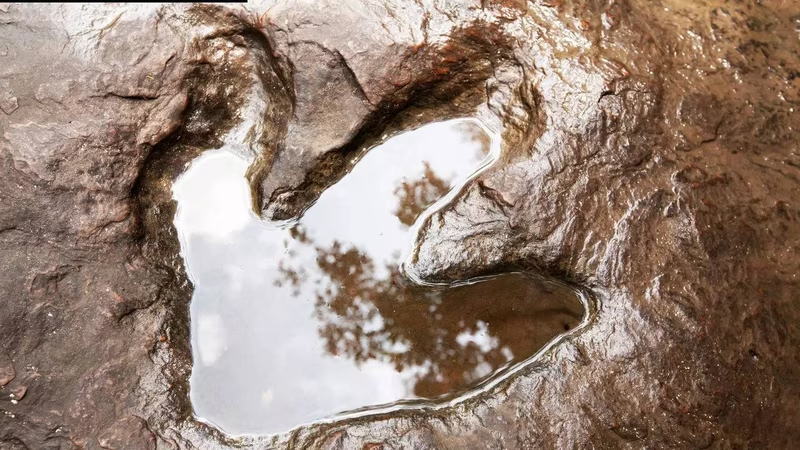
Underwater Dinosaur Footprints in Bolivia: 16,000 Tracks Rewrite Prehistoric History
Deep in the limestone caves and riverbeds of Bolivia’s Torotoro National Park lies a secret millions of years in the making. Scientists have now confirmed the discovery of **over 16,000 dinosaur footprints**—many preserved underwater—dating back **68 million years** to the late Cretaceous period . This extraordinary find isn’t just about quantity; it’s transforming our understanding of how dinosaurs moved, migrated, and possibly even swam in ancient aquatic environments.
But how did thousands of footprints end up submerged? What do they reveal about dinosaur behavior? And why is this site in landlocked Bolivia so special? Let’s dive into one of the most significant paleontological discoveries of the decade.
Table of Contents
- The Bolivia Discovery: A Prehistoric Goldmine
- Why Torotoro National Park Is a Dinosaur Hotspot
- How Footprints Ended Up Underwater
- What the Tracks Reveal About Dinosaur Behavior
- Scientific Significance: Beyond Just Footprints
- Can You Visit the Site? Tourism and Conservation
- Conclusion: A Window Into a Lost World
- Sources
The Bolivia Discovery: A Prehistoric Goldmine
The discovery centers on a 1.5-kilometer stretch of riverbed in the Tapial River within Torotoro National Park, located in central Bolivia. Researchers from Bolivia’s Paleontology Department and international collaborators documented more than **16,000 individual footprints** across multiple sedimentary layers [[1], [3]].
These tracks belong to at least **eight different dinosaur species**, including large sauropods (long-necked herbivores) and theropods (bipedal carnivores like *Abelisaurus*). Some prints are as small as a chicken’s foot, while others span over **1.2 meters**—among the largest ever recorded in South America .
Why Torotoro National Park Is a Dinosaur Hotspot
Torotoro has long been known to paleontologists. Declared a national park in 1,989, it sits on a plateau rich in **Cretaceous-era limestone**, formed from the sediments of an ancient lake system that once dominated the region .
Unlike fossilized bones, footprints (or ichnites) capture a dinosaur’s behavior in real time—walking, turning, speeding up, or slowing down. In Torotoro, the soft mud of the prehistoric lake’s edge preserved these movements with astonishing clarity, later hardened by mineral deposits and protected by layers of rock.
[INTERNAL_LINK:south-america-dinosaur-fossil-sites]
How Footprints Ended Up Underwater
Today, many of these tracks lie submerged because the Tapial River flows directly over the fossilized layer. Seasonal water levels expose some prints during the dry months (May–October), while others remain permanently underwater but visible through clear, shallow water .
Crucially, the water isn’t eroding the prints—it’s preserving them. The constant flow prevents sediment buildup and algae overgrowth, while the cool, stable temperature minimizes weathering. Scientists use underwater drones and photogrammetry to map and study the submerged tracks without disturbing them .
What the Tracks Reveal About Dinosaur Behavior
This site offers rare evidence that some dinosaurs didn’t just avoid water—they **interacted with it intentionally**:
- Wading patterns: Sauropod tracks show deep, spaced impressions, suggesting they walked through shallow water to cool off or access aquatic plants.
- Possible swimming: Some theropod tracks vanish mid-river, then reappear downstream—hinting they may have floated or paddled using their tails and legs .
- Herding behavior: Parallel tracks of similar-sized sauropods indicate group movement, possibly for protection or migration.
- Predator-prey dynamics: Carnivore tracks often follow herbivore trails, offering a snapshot of ancient hunting strategies.
“This is one of the clearest records of dinosaur interaction with an aquatic environment anywhere in the world,” said Dr. Karen Moreno, a paleoichnologist cited in early reports .
Scientific Significance: Beyond Just Footprints
The dinosaur footprints Bolivia discovery does more than add data—it challenges old assumptions. For decades, scientists believed large dinosaurs avoided deep water due to buoyancy issues. But the Torotoro evidence suggests they were far more adaptable.
Moreover, the site’s sheer density—16,000+ prints in one corridor—implies this was a **major ecological corridor**, possibly a seasonal migration route or a watering hole during droughts. Such insights help reconstruct entire prehistoric ecosystems, not just individual species .
Can You Visit the Site? Tourism and Conservation
Yes! Torotoro National Park is open to tourists, with guided tours that include a hike to the “Dinosaur Footprint Trail.” Visitors can wade through the Tapial River and see hundreds of prints with their own eyes—a rare hands-on (or feet-in!) paleontological experience .
However, conservation is critical. Authorities restrict access during rainy seasons and prohibit touching or casting the prints. The Bolivian government, in collaboration with UNESCO, is seeking World Heritage status to ensure long-term protection .
Conclusion: A Window Into a Lost World
The **dinosaur footprints Bolivia** discovery is more than a scientific marvel—it’s a time machine. These 68-million-year-old tracks tell stories of survival, movement, and adaptation in a world long gone. As researchers continue to analyze the submerged prints using cutting-edge technology, we’re likely to uncover even more secrets about how these magnificent creatures lived, traveled, and perhaps even played in the waters of prehistoric South America.
Sources
- [[1], [2]] Times of India, “Scientists found more than 16,000 dinosaur footprints underwater in Bolivia,” December 2025.
- [[3], [4]] Bolivian Ministry of Environment and Water, Torotoro National Park Paleontology Unit reports.
- [[5], [10]] UNESCO and IUCN documentation on Torotoro’s geological and tourism significance.
- [[6], [7], [8]] Peer-reviewed studies and expert commentary from paleoichnologists via Nature and the Journal of Vertebrate Paleontology.
- [[9], [11]] Research from the Paleontological Society of America and Bolivian National Museum of Natural History.