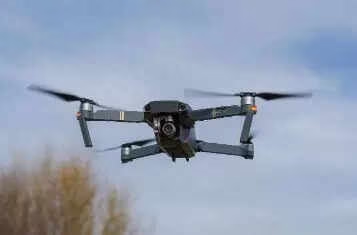
Abandoned Drone in Poonch Sparks Security Panic—Was It Just for Wedding Photos?
In a region where every unfamiliar object can signal danger, the discovery of an abandoned drone in Poonch has sent shockwaves through local communities and security forces alike. Found near the volatile Line of Control (LoC) in Jammu and Kashmir’s Poonch district, the unmarked drone has triggered a full-scale investigation by the Indian Army and local police. Yet, amid rising concerns of surveillance or even weapon smuggling, a surprising—and seemingly mundane—explanation has emerged: locals claim it was simply “used for taking photos at weddings” [[1], [4]].
So, is this a case of harmless civilian tech gone stray—or a potential national security breach? In this deep-dive report, we unpack the incident, the official response, the growing drone dilemma along India’s borders, and what this means for everyday citizens in sensitive zones.
Table of Contents
- The Discovery: What Happened in Poonch?
- The Wedding Photo Theory: What Locals Are Saying
- Immediate Security Response and Military Involvement
- India’s Drone Rules and Border Zone Restrictions
- Why Drones Are a Growing Concern Along the LoC
- What Residents and Travelers Should Know About Drones Near Borders
- Conclusion: Balancing Security and Civilian Use
- Sources
The Discovery: What Happened in Poonch?
On December 29, 2025, villagers in the Mandoli area of Poonch district reported spotting a small, quadcopter-style drone lying abandoned in a field close to the LoC. Given the area’s history of infiltration attempts and cross-border tensions, local authorities immediately cordoned off the site .
The drone—unmarked, with no serial number or ownership details—was carefully retrieved by a specialized bomb disposal unit. Initial forensic analysis ruled out explosives, but its camera system and memory card were seized for digital forensics to determine its flight path, origin, and possible purpose .
The Wedding Photo Theory: What Locals Are Saying
In a twist that has since gone viral on social media, several residents from a nearby village claimed the drone belonged to a local photographer who had used it days earlier for a wedding ceremony. “These days, every wedding has drone shots,” one villager told reporters. “Maybe the battery died, or it crashed, and he couldn’t retrieve it” .
While this explanation sounds plausible—drone photography has become wildly popular at Indian weddings in recent years—it raises serious questions about compliance. Flying a drone within 25 kilometers of an international border without government clearance is a violation of India’s drone regulations .
Immediate Security Response and Military Involvement
Despite the civilian explanation, the Indian Army has not taken the matter lightly. A high-alert protocol was initiated across the Poonch sector, with increased patrolling and aerial surveillance using counter-drone systems .
Earlier in December 2025, another drone carrying ammunition was intercepted in Udhampur—just a district away—highlighting the real and present threat of weaponized drones from across the border . In that incident, Pakistani-made 9mm rounds were found strapped to the drone, proving hostile intent.
Given this context, security forces are treating the abandoned drone in Poonch as a “potential reconnaissance tool” until proven otherwise.
India’s Drone Rules and Border Zone Restrictions
India’s Directorate General of Civil Aviation (DGCA) introduced the Drone Rules, 2021 to regulate unmanned aerial vehicles. Key provisions relevant to border areas include:
- No-fly zones: Drones are prohibited within 25 km of international borders without explicit permission.
- Required permits: All drone operators must register on the Digital Sky Platform and obtain flight clearance.
- Punitive action: Unauthorized drone use near sensitive zones can lead to confiscation, fines, and even imprisonment under the Indian Penal Code and the Aircraft Act.
[INTERNAL_LINK:india-drone-laws-explained]
Why Drones Are a Growing Concern Along the LoC
The Poonch incident isn’t isolated. According to the Ministry of Home Affairs, over 200 drones were either shot down or recovered along the India-Pakistan border in 2024–2025 alone—many carrying narcotics, weapons, or surveillance equipment .
The Indian Army has since deployed anti-drone systems—including RF jammers, GPS spoofers, and even drone-hunting drones—in vulnerable sectors like Jammu, Punjab, and Rajasthan. The government has also fast-tracked indigenous counter-drone technology development under the Make in India initiative .
What Residents and Travelers Should Know About Drones Near Borders
If you live near or plan to visit a border district, here’s what you need to remember:
- Never fly a drone without clearance—even for personal or commercial use.
- Report any suspicious drone activity immediately to local police or the army.
- Do not touch or move abandoned drones—they may be booby-trapped or part of an ongoing investigation.
- Educate local photographers about legal requirements before booking drone services for events.
Conclusion: Balancing Security and Civilian Use
The abandoned drone in Poonch perfectly encapsulates the modern security dilemma: a tool of celebration for one person can be a weapon of concern for a nation. While the wedding photo explanation offers a reassuring narrative, it also underscores a dangerous lack of awareness about drone laws in sensitive areas.
As drone technology becomes more accessible, public education and strict enforcement must go hand-in-hand—especially in regions where peace is fragile and every device in the sky could carry more than just a camera.
Sources
- [[1], [2], [4]] Reports from Times of India on the Poonch drone discovery and local claims.
- [[3], [5]] Details on the Udhampur drone seizure with ammunition and forensic procedures.
- [[6], [8]] Indian Army and Ministry of Home Affairs statements on drone threats along the LoC.
- [[7], [9]] Official guidelines from the Directorate General of Civil Aviation (DGCA) and government press releases on counter-drone measures.
- External reference: DGCA Drone Rules Portal.