Table of Contents
- The Tragedy: An Arson Attack on Molai Forest
- Who Is Jadav Payeng: The ‘Forest Man’ of India?
- What Is the Molai Kathoni 2.0 Forest?
- Extent of the Damage: Wildlife and Ecosystem Impact
- Why Would Someone Target a Forest?
- Legal and Conservation Response
- Broader Implications for Grassroots Conservation
- How to Support Molai Forest Recovery
- Summary
- Sources
The Tragedy: An Arson Attack on Molai Forest
In a heart-wrenching blow to India’s environmental legacy, the arson attack on Molai Forest has left conservationists and citizens reeling. Unidentified individuals deliberately set fire to a significant portion of the Molai Kathoni 2.0 forest in Assam’s Jorhat district—a green oasis born not from government policy, but from the unwavering dedication of one man: Jadav “Molai” Payeng .
Local authorities report that the fire, suspected to be intentional due to multiple ignition points, burned for over 36 hours before being brought under control. By then, hundreds of trees, nesting sites, and critical habitats had been reduced to ash—undoing years of ecological progress in a single night.
Who Is Jadav Payeng: The ‘Forest Man’ of India?
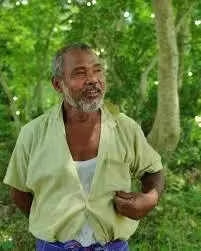
Jadav Payeng is no ordinary environmentalist. Born into the Mising tribe of Assam, he began planting trees on a barren sandbar of the Brahmaputra River in 1979 at just 16 years old—after witnessing snakes die from heat exhaustion with no tree cover.
For over four decades, Payeng worked alone, often mocked by villagers, to transform 1,360 acres of wasteland into a thriving forest now home to tigers, rhinos, elephants, and over 100 species of birds. His work earned him the Padma Shri in 2015 and global recognition, including features in documentaries by BBC and National Geographic.
“I never thought I’d see someone try to destroy what nature and I built together,” Payeng told local media, visibly shaken .
What Is the Molai Kathoni 2.0 Forest?
While the original Molai Forest (over 550 hectares) is well-known, the recently targeted “Molai Kathoni 2.0” is a newer extension—launched in 2020 with the support of NGOs and local youth. Spanning over 200 additional acres, this second-phase forest was designed to:
- Act as a buffer zone against Brahmaputra erosion
- Provide corridors for wildlife movement between fragmented habitats
- Showcase community-led reforestation in climate-vulnerable regions
Unlike state-managed reserves, Molai Kathoni 2.0 was maintained by Payeng and a team of volunteers—making it especially vulnerable to deliberate sabotage.
Extent of the Damage: Wildlife and Ecosystem Impact
Preliminary assessments by the Assam Forest Department and wildlife experts indicate severe ecological consequences:
- Over **200 mature trees**, including teak, bamboo, and fig, destroyed
- Nesting areas of hornbills and migratory birds completely incinerated
- Tracks of elephants and deer leading into the forest—now ending in charred earth
- Soil erosion accelerating due to loss of root systems along riverbanks
“This isn’t just tree loss—it’s the collapse of a micro-ecosystem,” said Dr. Anjali Dhar, an ecologist with Aaranyak, a Guwahati-based biodiversity NGO . “Recovery could take 10–15 years.”
Why Would Someone Target a Forest?
While motives remain under investigation, local sources suggest several possible triggers:
- Land encroachment: Criminal elements may seek to clear forest cover to claim riverine land for illegal sand mining or agriculture.
- Retaliation: Payeng has publicly opposed deforestation and poaching in the region, possibly angering vested interests.
- Negligence vs. malice: Though officials confirm multiple fire origins, ruling out accidental causes like discarded cigarettes.
Alarmingly, this is not the first time Payeng’s forest has been threatened. In 2022, illegal loggers were caught felling trees under cover of night.
Legal and Conservation Response
The Assam Police have registered a case under Sections 435 (mischief by fire) and 427 (mischief causing damage) of the IPC, along with relevant clauses of the Forest Conservation Act, 1980. A special investigation team (SIT) has been formed.
Meanwhile, environmental groups are demanding:
- 24/7 patrolling of the forest perimeter
- Installation of CCTV and fire-alert sensors
- Recognition of Molai Forest as a “Community Heritage Site” with legal protection
The National Green Tribunal (NGT) is also being petitioned to intervene, citing the site’s national ecological significance.
Broader Implications for Grassroots Conservation
This arson attack on Molai Forest exposes a critical gap: India celebrates eco-heroes like Payeng but often fails to institutionalize protection for their work. Unlike national parks, community forests lack dedicated security or legal safeguards.
According to the UN Food and Agriculture Organization (FAO), community-managed forests account for 25% of global forest cover—yet receive less than 1% of conservation funding .
[INTERNAL_LINK:community-forestry-india-challenges] initiatives must go beyond applause—they need policy backing, surveillance, and legal recognition.
How to Support Molai Forest Recovery
While justice is pursued, restoration begins now. Citizens can help by:
- Donating to verified NGOs like Aaranyak or Green Guard Nature Organization for replanting drives
- Advocating for “Molai Forest Protection Act” via social media campaigns
- Volunteering for tree-planting camps (coordinated via Payeng’s foundation)
As Payeng himself says: “Trees are my children. If one falls, we plant ten more.”
Summary
The arson attack on Molai Forest is more than an ecological crime—it’s an assault on the spirit of individual conservation that India so proudly champions. Jadav Payeng’s forest stands as a testament to what one person can achieve against all odds. Now, it’s the nation’s turn to protect his legacy. Without urgent action, this tragedy could become a precedent for eco-vandalism across vulnerable, community-led green spaces.
Sources
- Times of India: Brutal attack on nature: Molai Kathoni 2.0 forest set ablaze
- BBC News Profile: The man who planted a forest
- Aaranyak Biodiversity Conservation: Official Website
- FAO State of the World’s Forests 2022: Community Forest Management Report