Table of Contents
- Trump’s Hot Mic Claim at Mar-a-Lago
- Trump Claims India-Pakistan Ceasefire: What He Said
- India’s Official Response: ‘No Foreign Mediator’
- What Actually Happened in February 2019?
- Why Trump’s Narrative Doesn’t Hold Up
- The Diplomatic Risks of False Credit
- Broader Pattern: Trump and ‘Conflict Resolution’ Claims
- Summary
- Sources
Trump’s Hot Mic Claim at Mar-a-Lago
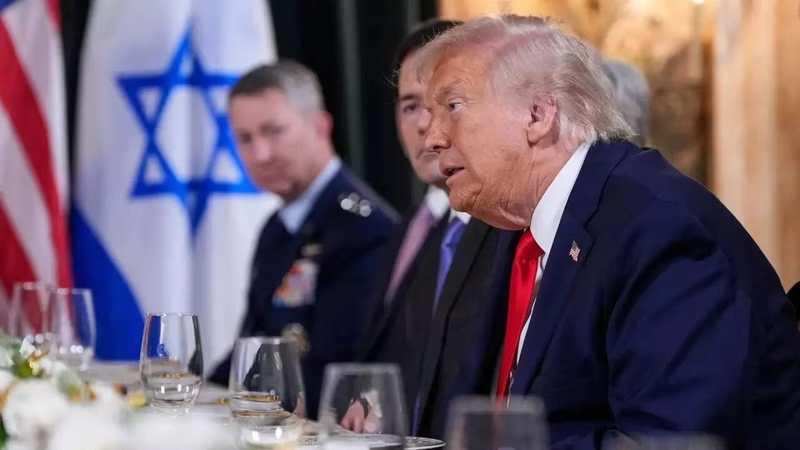
During a private conversation with Israeli Prime Minister Benjamin Netanyahu at his Mar-a-Lago estate, former U.S. President Donald Trump made a bold—and now widely disputed—statement caught on a live microphone: “I solved 8 wars. How about India and Pakistan? I got them to stop immediately.”
The remark, made while cameras were rolling but before the formal event began, quickly went viral, reigniting a diplomatic controversy first sparked in 2019. While Trump has long styled himself as a master dealmaker, this latest claim directly contradicts India’s official stance and raises questions about historical accuracy versus political branding.
Trump Claims India-Pakistan Ceasefire: What He Said
Trump’s full quote, as reported by multiple outlets, was: “I was the one that stopped India and Pakistan. You know that, right? They were ready to go—and I got them to stop immediately.” He framed it as one of his proudest foreign policy achievements, lumping it alongside his dealings with North Korea and the Middle East.
This isn’t the first time Trump has made this assertion. He previously claimed credit during a 2019 press conference with then-Pakistani PM Imran Khan, saying he’d spoken to PM Narendra Modi, who “thanked me for my help” in de-escalating tensions. But crucially—India has never confirmed this version of events.
India’s Official Response: ‘No Foreign Mediator’
The Government of India has been unequivocal: there was no third-party mediation in the India-Pakistan standoff following the Pulwama attack and India’s Balakot airstrike in February 2019.
Prime Minister Narendra Modi himself clarified: “No foreign leader asked India to stop its military operations.” Instead, India emphasized that de-escalation occurred through direct, backchannel military communications between the Director Generals of Military Operations (DGMOs) of both countries—a long-standing protocol.
Indian officials have consistently maintained that any suggestion of external mediation undermines India’s sovereignty and misrepresents the facts. As one MEA spokesperson put it: “India handles its national security matters independently.”
What Actually Happened in February 2019?
Timeline of key events:
- Feb 14: Pulwama attack—40 CRPF personnel killed by Pakistan-based Jaish-e-Mohammed.
- Feb 26: India conducts airstrike on JeM camp in Balakot, Khyber Pakhtunkhwa.
- Feb 27: Pakistan retaliates; dogfight ensues; Wing Commander Abhinandan Varthaman captured.
- Feb 28: India and Pakistan DGMOs hold direct talks.
- Mar 1: Pakistan announces return of Abhinandan as “peace gesture.”
- Mar 2 onward: Tensions gradually de-escalate through bilateral channels.
While the U.S., China, and others expressed concern and urged restraint, no formal mediation took place. The U.S. State Department at the time merely “welcomed” the return of the pilot and called for dialogue—but never claimed a role in brokering peace.
Why Trump’s Narrative Doesn’t Hold Up
Several facts debunk Trump’s claim:
- No public or private record exists of Trump speaking to Modi about de-escalation during the crisis.
- India’s Ministry of External Affairs (MEA) has never acknowledged U.S. involvement.
- Pakistan’s own military statements credited “backchannel talks,” not Trump.
- International media archives from Feb–Mar 2019 show no mention of U.S. mediation.
Experts suggest Trump may be conflating his public statements of concern with actual diplomatic intervention. But in geopolitics, perception can sometimes shape reality—even when it’s inaccurate.
The Diplomatic Risks of False Credit
When a global leader falsely claims credit for resolving a conflict between two nuclear-armed states, it carries real risks:
- It undermines trust between allies, especially when one party denies the account.
- It emboldens revisionist narratives in adversarial capitals (e.g., Islamabad may use it to claim international validation).
- It complicates future diplomacy by muddying historical records.
As noted by the Council on Foreign Relations, accurate attribution of diplomatic outcomes is essential for crisis prevention and alliance management.
Broader Pattern: Trump and ‘Conflict Resolution’ Claims
This isn’t isolated. Trump has repeatedly claimed to have “solved” or “prevented” conflicts with little evidence:
- North Korea: Claimed he “ended the war” despite no formal peace treaty.
- Iran: Said he “stopped war” after Soleimani strike—though tensions escalated.
- Taliban: Took credit for the Doha deal, which was largely negotiated by career diplomats.
While presidents often highlight foreign policy wins, Trump’s tendency to inflate personal agency—especially in sensitive regions like South Asia—raises concerns about the integrity of historical record and strategic communication.
Summary
The claim that Trump claims India-Pakistan ceasefire was his doing is a compelling political soundbite—but it collapses under factual scrutiny. India’s consistent position, backed by timeline evidence and official statements, confirms that de-escalation was achieved through direct bilateral military channels, not U.S. mediation. As Trump eyes a potential 2024 comeback, such narratives may serve domestic branding—but they risk eroding trust with key strategic partners like India, who guard their foreign policy autonomy fiercely.
Sources
- Times of India: ‘I solved 8 wars, how about India and Pakistan?’: Trump repeats claims on hot mic
- Ministry of External Affairs, India: Official Statements Archive (2019)
- Council on Foreign Relations (CFR): U.S.-India Relations and South Asia Security
- U.S. Department of State Archives: Press Briefings, February–March 2019