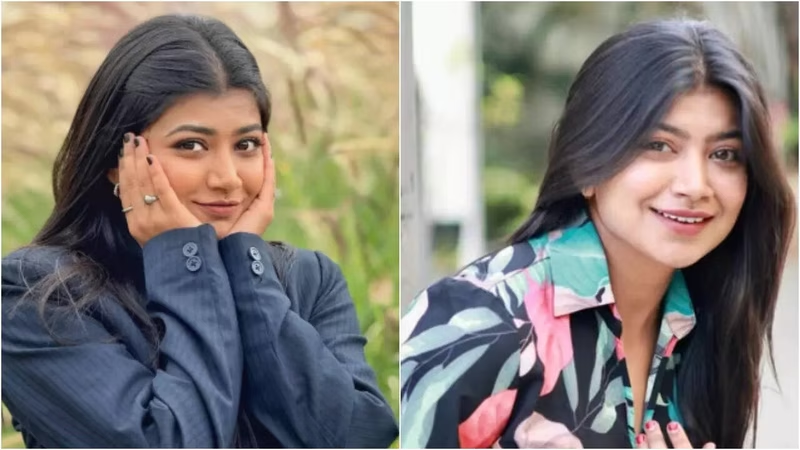
The Kannada entertainment world is mourning the tragic loss of Nandini CM, a 26-year-old television actress whose promising career was cut short under heartbreaking circumstances. On December 28, 2025, she was found dead by suicide in her paying guest (PG) accommodation in Bengaluru. Police have registered an Unnatural Death Report (UDR), and early findings point to immense personal and professional pressures as contributing factors .
What makes Nandini’s story especially poignant is a handwritten diary discovered at the scene—one that reveals a young woman deeply passionate about acting, yet torn by familial obligations and societal expectations. In it, she expressed reluctance to take up a government job secured for her after her father’s passing, writing, “I don’t want a chair in an office. I want to be on screen, telling stories that move people” .
This devastating incident has reignited urgent conversations about mental health, career pressure, and the hidden struggles of young artists in India’s regional entertainment industries.
Table of Contents
- Who Was Nandini CM? Her Rise in Kannada TV
- The Tragic Discovery and Police Response
- Nandini CM Suicide: Diary Reveals Inner Conflict
- Pressure Cooker Industry: Young Actors and Mental Health
- What Needs to Change: Support Systems for Regional Artists
- How to Help: Resources for Those in Crisis
- Sources
Who Was Nandini CM? Her Rise in Kannada TV
Nandini CM, though not a household name nationally, had built a loyal following in Karnataka through her roles in popular daily soaps like Putta Gowri Maduve and Namma Lacchi. Known for her expressive eyes and natural delivery, she was often cast as the resilient daughter or the quiet romantic lead.
Colleagues described her as “dedicated, punctual, and always rehearsing lines—even during tea breaks.” She moved to Bengaluru from Mandya a few years ago to pursue acting full-time, supporting herself through small roles and part-time work .
Her big break was anticipated in an upcoming serial, where she was set to play a lead role—a dream she documented excitedly in her diary just weeks before her death.
The Tragic Discovery and Police Response
According to Bengaluru City Police, Nandini was found unresponsive in her room by fellow PG residents and staff after she failed to respond to repeated knocks. She was discovered hanging, and despite immediate efforts, she was declared dead on the spot .
No suicide note in the traditional sense was found, but investigators recovered a personal journal containing dated entries that spanned the past six months. These writings are now being examined as part of the UDR, though police have confirmed there were no signs of foul play or external harassment .
Her body was released to her family, who arrived from Mandya in shock and silence. A close friend told reporters, “She never said she was giving up. She just said she was tired of choosing between her heart and her duty.”
Nandini CM Suicide: Diary Reveals Inner Conflict
The diary has become the emotional core of this tragedy. In raw, unfiltered prose, Nandini detailed the grief of losing her father—a retired schoolteacher—earlier in 2025. Out of compassion, a relative helped her secure a clerical position in a state government office, a “safe” career path her family strongly encouraged.
But Nandini resisted. “They think acting is a phase,” she wrote. “But it’s my breath. How do I explain that without sounding ungrateful?”
Other entries mention financial stress, audition rejections, and the loneliness of living alone in a big city. Yet, amid the despair, there were also sparks of hope: notes about dialogue practice, character ideas, and excitement over her new role.
Her story reflects a painful reality for many young artists: the clash between personal dreams and familial security in a risk-averse society.
Pressure Cooker Industry: Young Actors and Mental Health
The regional TV industry in India—especially in languages like Kannada, Tamil, and Telugu—is known for its demanding schedules, low pay for newcomers, and lack of institutional mental health support. Actors often work 12–16 hour days for months on end, with little job security.
A 2024 study by the Film and Television Institute of India (FTII) found that 68% of young actors in regional television reported symptoms of anxiety or depression, yet fewer than 15% had access to counseling .
[INTERNAL_LINK:mental-health-indian-entertainment] Unlike Bollywood, which has slowly begun addressing mental wellness through initiatives like the CINTAA helpline, regional industries often lack even basic support structures.
What Needs to Change: Support Systems for Regional Artists
Nandini’s death must not be just another headline. It should be a catalyst for change. Key reforms are urgently needed:
- Mandatory mental health access: Production houses and guilds must provide free, confidential counseling.
- Artist welfare funds: State governments should expand support beyond film to include television performers.
- Destigmatize help-seeking: Industry leaders must speak openly about mental health, just as they do about talent and hard work.
Organizations like the Karnataka Television Artists Association have pledged to review their support protocols in light of this tragedy.
How to Help: Resources for Those in Crisis
If you or someone you know is struggling, please reach out. You are not alone:
- Vandrevala Foundation Helpline: Call or WhatsApp 9999 666 555 (24/7, free, confidential)
- iCall: Email icall@tiss.edu or call 9152987821 (Monday–Saturday, 10 AM–8 PM)
- National Suicide Prevention Lifeline (India): Dial 1800-599-0019
Conclusion
The Nandini CM suicide is more than a personal tragedy—it’s a mirror held up to an industry and a society that often demands dreams be sacrificed for stability. Her diary proves she wasn’t giving up on life; she was fighting to live the life she loved. As we mourn her loss, let us honor her by building a world where young artists don’t have to choose between their passion and their peace.
Sources
- Times of India: Kannada TV actress Nandini CM dies by suicide in Bengaluru
- Deccan Herald: Diary Shows Nandini’s Conflict Between Acting and Duty
- TV9 Kannada: Industry Mourns Loss of Promising Talent
- Bengaluru City Police: Unnatural Death Report Summary (Dec 2025)
- FTII Research: Mental Health Among Regional TV Artists (2024)