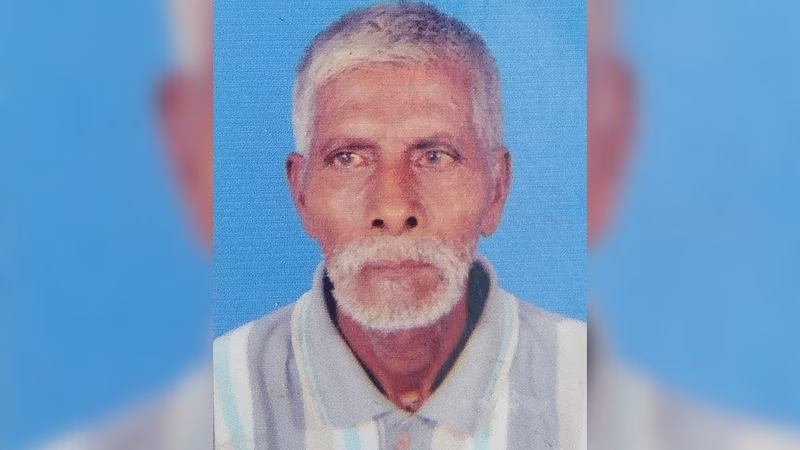
West Bengal is in the grip of a growing humanitarian and political crisis. What was meant to be a procedural step in land acquisition—the Special Investigation Report (SIR) hearings—has spiraled into a scene of chaos, grief, and public alarm. Across multiple districts, elderly residents have reportedly died from stress and exhaustion during or shortly after being summoned to these mandatory SIR hearings, igniting fierce backlash from civil society, opposition parties, and human rights groups .
The SIR hearings Bengal initiative, launched under the state’s updated land acquisition framework, requires landowners to attend in-person verification sessions. But for thousands of aging, ailing, and economically vulnerable citizens—many of whom rely on small plots for survival—the process has become a matter of life and death .
Table of Contents
- What Are SIR Hearings—and Why Are They Controversial?
- Reports of Elderly Deaths and Public Distress
- Government Response and Opposition Reaction
- Legal and Human Rights Concerns
- What Happens Next?
- Sources
What Are SIR Hearings—and Why Are They Controversial?
The Special Investigation Report (SIR) is a key component of West Bengal’s land acquisition process, intended to verify land ownership and assess compensation claims before the government proceeds with expropriation for infrastructure or development projects. In theory, these hearings are meant to be transparent and participatory.
However, in practice, the implementation has been deeply flawed:
- Mandatory attendance: Landowners—often elderly or infirm—are required to appear in person at district collection centers, sometimes traveling long distances with no transportation support.
- Poor organization: Hearings are frequently held in overcrowded venues with inadequate seating, water, or medical facilities .
- Lack of clarity: Many citizens report receiving vague or last-minute notices, with little explanation of their rights or the consequences of non-attendance.
These systemic issues have turned a bureaucratic exercise into a source of acute physical and psychological stress—particularly for senior citizens who have lived on the same land for decades.
Reports of Elderly Deaths and Public Distress
Disturbing accounts are emerging from districts like Nadia, Murshidabad, and North 24 Parganas, where at least three elderly individuals are reported to have collapsed or died shortly after attending SIR hearings .
One such case involves 78-year-old Ramprosad Mondal of Ranaghat, who walked 4 kilometers to the hearing center in sweltering heat. He fainted on-site and passed away en route to the hospital. His family claims he had pre-existing heart conditions but was told his land claim would be forfeited if he didn’t appear .
Beyond fatalities, widespread distress has been documented:
- Hundreds of seniors waiting for hours without shade or water.
- Families reporting panic attacks and hospitalizations among elderly relatives.
- Local doctors noting a spike in hypertension and cardiac incidents coinciding with hearing dates .
Community leaders and NGOs have described the scenes as “inhumane” and “institutionally cruel,” arguing that the state is prioritizing procedural speed over citizen welfare.
Government Response and Opposition Reaction
So far, the West Bengal government has offered minimal public comment. A spokesperson from the Land & Land Reforms Department stated that “proper arrangements” are in place and that deaths are “unfortunate but unrelated” to the hearings .
This response has drawn sharp criticism. The opposition Trinamool Congress (TMC), along with civil society organizations like the People’s Union for Democratic Rights (PUDR), has demanded an immediate suspension of all SIR hearings Bengal-related activities until safeguards are implemented.
“You cannot treat citizens like paperwork,” said opposition leader Sushmita Dev. “When the elderly are dying from exhaustion just to prove they own their own land, the system has failed catastrophically” .
Legal and Human Rights Concerns
Experts warn that the current implementation may violate both national and international human rights standards. The Right to Property, though no longer a fundamental right in India, is still protected under Article 300A of the Constitution, which requires a fair and just process for deprivation.
Furthermore, the United Nations Principles on Housing and Land Rights emphasize that forced evictions and coercive acquisition processes must be avoided—especially when they disproportionately impact vulnerable groups like the elderly and poor .
[INTERNAL_LINK:land-rights-india] The situation in Bengal echoes past controversies, such as the Singur and Nandigram land protests, where aggressive acquisition policies led to mass unrest. Without course correction, history may be repeating itself—this time with tragic human costs.
What Happens Next?
Pressure is mounting on the Mamata Banerjee-led administration to act. Civil society groups are planning a statewide solidarity march, while legal petitions are being prepared to challenge the mandatory in-person requirement in court.
Potential reforms could include:
- Allowing proxy representation or virtual hearings for senior citizens and persons with disabilities.
- Providing transportation, medical tents, and hydration stations at all hearing venues.
- Extending deadlines and ensuring clear, multilingual communication about rights and procedures.
Until then, the SIR hearings Bengal process remains a flashpoint of public anger—and a stark reminder that development must never come at the cost of human dignity.
Conclusion
The unfolding crisis surrounding the SIR hearings in West Bengal is more than a bureaucratic misstep—it’s a profound failure of empathy and governance. As reports of elderly deaths and suffering continue to surface, the state faces a critical choice: double down on a flawed system or adopt humane, inclusive reforms that respect the rights and lives of its most vulnerable citizens. The nation is watching.
Sources
- Times of India: Elderly deaths, distress reported amid SIR hearings across Bengal
- The Hindu: West Bengal Land Hearings Linked to Elderly Deaths
- Indian Express: SIR Hearings in Bengal Spark Public Outrage Over Elderly Distress
- NDTV: Elderly in Bengal Complain of Neglect During SIR Hearings
- Human Rights Watch: Development at Any Cost? Forced Evictions in India