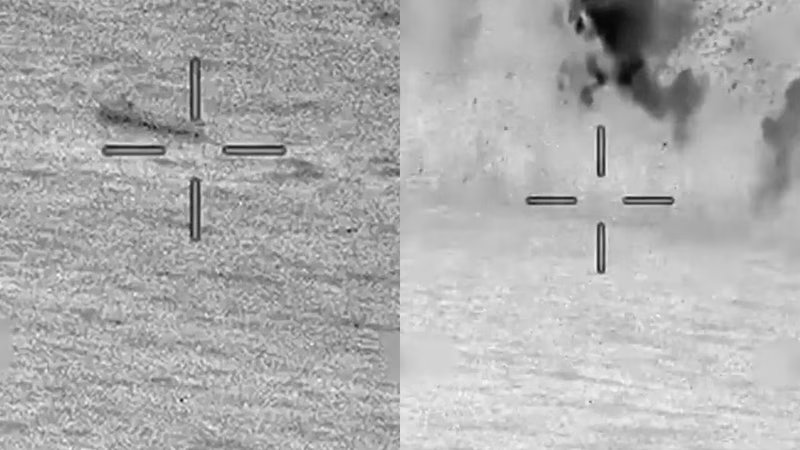
In a remote stretch of the Eastern Pacific Ocean, far from public view, the United States military has been waging a shadowy and increasingly deadly campaign against suspected drug traffickers. A recent strike—killing two more individuals described only as ‘male narco-terrorists’—has pushed the official death toll past 100. But as the body count rises, so do urgent questions about the legality, transparency, and real-world impact of these US drug war strikes.
According to the Pentagon, the latest operation targeted a vessel confirmed through intelligence to be involved in international drug smuggling. Yet, despite years of such operations, the US government has released virtually no verifiable evidence—no intercepted communications, no cargo manifests, no forensic reports—to substantiate its claims. This lack of accountability has ignited a fierce debate among legal scholars, human rights advocates, and foreign policy experts.
Table of Contents
- The Latest Strike and the 100-Death Milestone
- How the US Drug War Strikes Work
- Legal and Ethical Questions Mount
- Effectiveness of Military-Led Interdiction
- International Reactions and Diplomatic Tensions
- What Needs to Happen Next
- Conclusion: The Cost of a Covert Campaign
- Sources
The Latest Strike and the 100-Death Milestone
The most recent US drug war strike occurred in late December 2025, targeting a small boat allegedly transporting narcotics through international waters near Central America. The US Southern Command (SOUTHCOM) announced the deaths of two suspects, bringing the total number of individuals killed in such operations since the campaign’s intensification to at least 107.
Officials described the targets as ‘narco-terrorists’—a term that blurs the lines between criminal activity and acts of war. However, the individuals were never named, and their affiliations remain unverified by independent sources. The strike itself was conducted without judicial oversight, relying solely on military intelligence assessments that are not subject to public scrutiny .
How the US Drug War Strikes Work
These operations are primarily carried out by the US Navy and Coast Guard, often with support from surveillance drones and intelligence from agencies like the DEA and CIA. Vessels are tracked in the Eastern Pacific—a known corridor for cocaine shipments from South America to North America.
When a suspect vessel is identified, the protocol typically involves attempts to hail and board it. But in cases where resistance is anticipated or the vessel is deemed ‘hostile,’ the military has increasingly resorted to lethal force. The justification hinges on the claim that these boats are often armed and operated by transnational criminal organizations with ties to terrorist groups.
However, this narrative has been challenged. As the Human Rights Watch notes, labeling all armed smugglers as ‘terrorists’ can be a legal overreach that bypasses due process and international maritime law.
Legal and Ethical Questions Mount
Under international law, the use of lethal force at sea is strictly regulated. The United Nations Convention on the Law of the Sea (UNCLOS) permits boarding and seizure of vessels engaged in illicit traffic, but it does not automatically authorize summary executions.
Critics argue that the US drug war strikes may violate fundamental human rights principles, including the right to life and the presumption of innocence. “Killing suspects without trial, based on secret intelligence, sets a dangerous precedent,” said Dr. Elena Martinez, a professor of international law at Columbia University.
Moreover, the term ‘narco-terrorist’ itself is not a legally recognized category under international humanitarian law. Its use appears designed to legitimize military action normally reserved for armed conflicts—not law enforcement operations.
Effectiveness of Military-Led Interdiction
Beyond legality, there’s the question of results. Has this aggressive military approach actually reduced drug flows?
According to the Journal of Illicit Economies and Development, interdiction efforts in the Pacific have had minimal long-term impact on drug availability in the US. Traffickers simply adapt—using submarines, go-fast boats, or shifting routes. Meanwhile, the human cost continues to climb.
Key concerns include:
- Collateral damage: Civilians or low-level crew members may be among those killed.
- Lack of accountability: No independent body reviews these strikes.
- Strategic displacement: Operations push trafficking into more dangerous or environmentally sensitive zones.
International Reactions and Diplomatic Tensions
Several Latin American nations have expressed unease over the unilateral nature of these operations. While some governments cooperate with US interdiction efforts, others worry about sovereignty violations and the militarization of regional waters.
Regional bodies like the Organization of American States (OAS) have called for greater transparency and multilateral oversight. So far, Washington has resisted these calls, citing operational security.
What Needs to Happen Next
To restore legitimacy and ensure accountability, experts recommend several steps:
- Public disclosure: Release redacted intelligence justifying each strike.
- Independent review: Establish an external oversight panel with international representation.
- Shift in strategy: Redirect resources from military strikes to public health and community-based prevention. [INTERNAL_LINK:drug-policy-reform-us]
- Legal clarity: Define ‘narco-terrorism’ in alignment with international law.
Conclusion: The Cost of a Covert Campaign
The US government frames its US drug war strikes as a necessary defense against a global threat. But a campaign that has killed over 100 people without trial, transparency, or proven effectiveness demands deeper scrutiny. In the name of security, are we sacrificing the very rule of law we claim to uphold? As the death toll climbs, the world is watching—and waiting for answers.
Sources
- Times of India: Another US strike, two more dead: Anti-drug campaign toll crosses 100
- Human Rights Watch: International Justice Program
- United Nations Office on Drugs and Crime (UNODC): World Drug Report 2025
- US Southern Command (SOUTHCOM) Official Statements