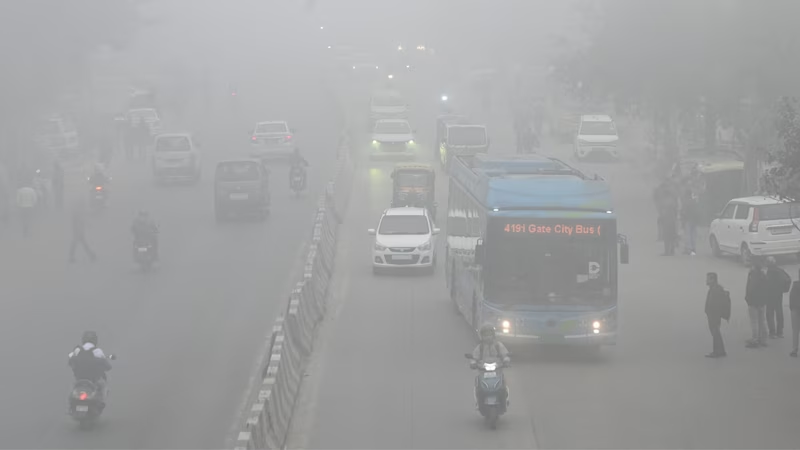
Delhi is gasping for breath—again. On Tuesday, December 30, 2025, the city was blanketed in thick, yellowish fog that slashed visibility to under 200 meters in many areas, turning morning commutes into hazardous crawls. But the real danger wasn’t just what you could see—it was what you couldn’t: invisible pollutants pushing the Air Quality Index (AQI) to a staggering **390**, deep into the ‘very poor’ category and bordering on ‘severe’ in several hotspots like Anand Vihar and Wazirpur .
The India Meteorological Department (IMD) responded by issuing an **orange alert**, urging vulnerable groups to avoid outdoor activity and advising schools to consider closures. With winter peak season in full swing, this latest episode is a grim reminder that Delhi’s air pollution crisis is far from solved—and may be getting worse.
Table of Contents
- Delhi Air Pollution Crisis Today: What the Numbers Show
- Dense Fog and Chaos: Traffic and Visibility Impact
- Why Does Delhi Air Quality Plummet in December?
- Health Risks of ‘Very Poor’ AQI: Who Is Most at Risk?
- What the Government Is Doing: GRAP Phase IV and Emergency Measures
- How to Protect Yourself During Delhi Air Pollution Spikes
- Conclusion: Is Delhi Heading Toward Another Toxic Winter?
- Sources
Delhi Air Pollution Crisis Today: What the Numbers Show
According to the Central Pollution Control Board (CPCB), Delhi’s 24-hour average AQI hit **390** by 9 AM—up from 320 the previous day. To put this in perspective:
- 0–50: Good
- 101–200: Moderate to Poor
- 301–400: Very Poor (current level)
- 401–500: Severe
Key pollutants driving the spike include **PM2.5** (fine inhalable particles) at 320 µg/m³—over **12 times** the WHO’s safe limit of 25 µg/m³—and **PM10** levels exceeding 400 µg/m³ in industrial zones .
Dense Fog and Chaos: Traffic and Visibility Impact
Compounding the pollution crisis was a sudden bout of **radiation fog**—a common December phenomenon caused by clear skies, calm winds, and high moisture. The fog mixed with pollutants to create a dense, toxic smog that:
- Reduced visibility to **100–200 meters** on major roads like NH-44 and Ring Road
- Caused multi-vehicle pileups near Noida-Greater Noida Expressway
- Delayed over 30 domestic flights at IGI Airport
- Disrupted Metro schedules due to signal visibility issues
“It’s like driving through a cloud of poison,” said one commuter on Twitter. “You can’t see, and you can’t breathe.”
Why Does Delhi Air Quality Plummet in December?
While stubble burning in Punjab and Haryana has tapered off by late December, other factors dominate this time of year:
- Temperature Inversion: Cold air traps pollutants near the ground, preventing dispersion.
- Local Emissions: Vehicular exhaust, industrial activity, and construction dust remain high.
- Festival Residue: Lingering pollutants from Diwali fireworks continue to affect air quality.
- Reduced Wind Speed: Winter calm means pollutants accumulate instead of blowing away.
According to the CPCB, local sources now account for **over 70%** of Delhi’s winter pollution—debunking the myth that farm fires are the sole culprit .
Health Risks of ‘Very Poor’ AQI: Who Is Most at Risk?
At AQI 390, even healthy individuals may experience:
- Irritated eyes, nose, and throat
- Shortness of breath during light activity
- Increased coughing and wheezing
But vulnerable groups face serious dangers:
- Children: Developing lungs are more susceptible to damage.
- Elderly: Higher risk of heart attacks and respiratory failure.
- Asthmatics & COPD patients: May require emergency care.
- Pregnant women: Linked to low birth weight and preterm births.
Hospitals across Delhi report a **30% surge** in respiratory admissions this week .
What the Government Is Doing: GRAP Phase IV and Emergency Measures
The Commission for Air Quality Management (CAQM) has activated **GRAP (Graded Response Action Plan) Phase III**, with Phase IV measures under review. Current actions include:
- Ban on diesel generator sets (except for essential services)
- Work-from-home mandated for 50% of government staff
- No entry for truck traffic except essentials
- Schools and colleges closed until further notice
- Increased mechanized road sweeping and anti-smog guns deployed
Critics argue these are reactive, not preventive. “We need year-round emission controls, not just emergency brakes,” says environmentalist Sunita Narain .
How to Protect Yourself During Delhi Air Pollution Spikes
Don’t wait for an alert—act now:
- Stay indoors between 7 AM and 11 AM, when pollution peaks.
- Use N95 or N99 masks if you must go out (cloth masks won’t filter PM2.5).
- Run air purifiers with HEPA filters at home—keep windows sealed.
- Avoid strenuous outdoor exercise until AQI improves.
- Stay hydrated and consume antioxidant-rich foods (oranges, walnuts, spinach).
Real-time AQI updates are available via the **Sameer App** (by CPCB) or **AQICN.org**.
Conclusion: Is Delhi Heading Toward Another Toxic Winter?
The Delhi air pollution crisis of December 30, 2025, isn’t an anomaly—it’s a symptom of systemic failure. Without long-term investments in public transport, renewable energy, green buffers, and emission enforcement, these orange alerts will become the winter norm.
For now, residents must protect themselves while demanding accountability. Because clean air isn’t a luxury—it’s a right. And in Delhi, it’s one that’s being suffocated day by day.
For more on urban environmental health, explore our guides on [INTERNAL_LINK:best-air-purifiers-for-delhi-homes] and [INTERNAL_LINK:how-to-check-aqi-in-real-time].
Sources
[1] The Times of India. “Delhi pollution: IMD issues orange alert as dense fog blankets city”, December 30, 2025.
[2] Central Pollution Control Board (CPCB). “Delhi Air Quality Data – December 30, 2025”, https://www.cpcb.nic.in
[3] CAQM Technical Report. “Source Apportionment of Delhi Winter Pollution”, November 2025.
[4] AIIMS Delhi. “Respiratory Admission Surge During High AQI Periods”, Weekly Bulletin, December 2025.
[5] Interview with Sunita Narain, Director General, Centre for Science and Environment (CSE), December 2025.