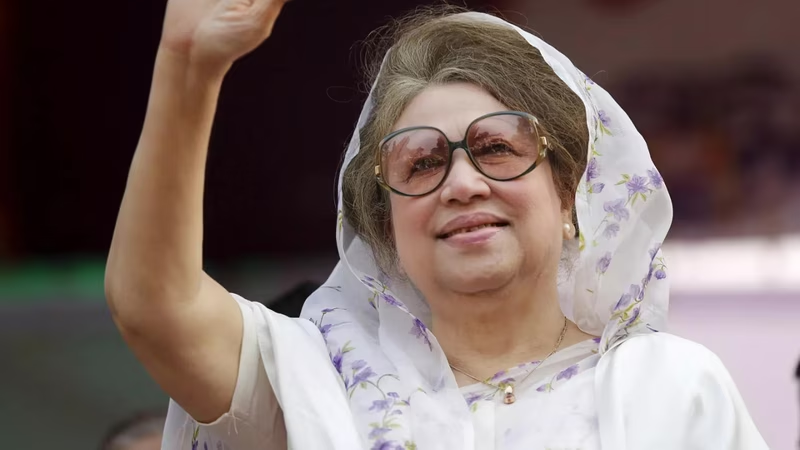
Bangladesh is in mourning. Khaleda Zia, the nation’s first female Prime Minister and long-time chairperson of the Bangladesh Nationalist Party (BNP), has passed away at the age of 80. Her death, confirmed by party officials in Dhaka on Tuesday, December 30, 2025, marks the end of a defining political era that spanned over four decades .
Zia had been in critical condition for several months, receiving treatment both domestically and abroad. Her health had been a subject of national concern, especially as Bangladesh navigates deep political polarization ahead of potential elections. Now, her absence creates both a symbolic and strategic void in a country where she and Sheikh Hasina—her longtime rival and current Prime Minister—have dominated the political landscape like twin pillars of fire and ice.
Table of Contents
- Who Was Khaleda Zia?
- Khaleda Zia Death and Final Days
- Her Historic Political Career and Legacy
- The Rivalry with Sheikh Hasina
- What Comes Next for the BNP?
- National and International Reactions
- Conclusion: The End of a Political Dynasty?
- Sources
Who Was Khaleda Zia?
Born on August 15, 1945, in Dinajpur, Khaleda Zia entered politics not by ambition but by tragedy. After the assassination of her husband, President Ziaur Rahman, in 1981, she was thrust into public life. What began as a tribute to her husband’s legacy evolved into a formidable political movement.
She founded the Bangladesh Nationalist Party (BNP) on the principles of nationalism, democracy, and economic liberalization—values that resonated deeply with urban and rural voters alike.
Khaleda Zia Death and Final Days
Zia had been suffering from multiple age-related illnesses, including respiratory and cardiac complications. She was flown to London for specialized care in mid-2025 but returned to Dhaka in November under strict medical supervision. Despite round-the-clock care at her Gulshan residence, her condition deteriorated rapidly in late December.
Her son, Tarique Rahman—the BNP’s acting chairperson and key strategist—was at her bedside. Party spokesperson Ruhul Kabir Rizvi confirmed her passing, stating, “She left us peacefully, surrounded by family and prayers.”
Her Historic Political Career and Legacy
Khaleda Zia made history in 1991 when she became Bangladesh’s first female Prime Minister—a milestone not just for her country but for South Asia. She went on to serve two non-consecutive terms (1991–1996 and 2001–2006), steering the nation through economic reforms, infrastructure development, and complex foreign policy shifts.
Key achievements under her leadership include:
- Privatization of state-owned industries
- Expansion of rural electrification and education
- Strengthening ties with China, the U.S., and the Middle East
- Establishing the Caretaker Government system to ensure fair elections (later abolished)
However, her tenure was also marred by allegations of corruption, political violence, and strained civil-military relations.
The Rivalry with Sheikh Hasina
No account of Khaleda Zia’s life is complete without mentioning her decades-long rivalry with Sheikh Hasina, leader of the Awami League and current Prime Minister. Their feud—often described as a “battle of the begums”—shaped modern Bangladesh.
While Hasina framed her politics around secularism and her father’s (Sheikh Mujibur Rahman) 1971 liberation legacy, Zia positioned herself as a nationalist conservative with Islamic democratic leanings. Their clashes led to mass protests, electoral boycotts, and, at times, deadly street violence.
In recent years, the rivalry turned one-sided as Zia faced legal cases and house arrest, while Hasina consolidated power. Many analysts saw Zia’s political marginalization as a key factor in Bangladesh’s democratic backsliding .
What Comes Next for the BNP?
With Zia’s death, leadership formally passes to her son, Tarique Rahman, who has lived in self-imposed exile in London since 2008 due to corruption convictions (which he denies). His ability to mobilize the party from abroad remains uncertain.
Internal factions may emerge, especially among younger BNP leaders who advocate for digital activism and grassroots organizing over dynastic control. The party also faces a crucial test: whether it can revive mass protests or negotiate a return to electoral politics under Hasina’s watch.
As noted by the BBC South Asia desk, “The BNP without Khaleda Zia is like a ship without its original compass—it may sail, but in which direction?” .
National and International Reactions
Prime Minister Sheikh Hasina issued an official statement expressing “deep sorrow” and declared a three-day national mourning period. Opposition parties, civil society groups, and international diplomats have all acknowledged Zia’s historic role.
The U.S. State Department called her “a pivotal figure in Bangladesh’s democratic journey,” while India’s Ministry of External Affairs noted her “contributions to regional stability” .
Conclusion: The End of a Political Dynasty?
The Khaleda Zia death is more than the passing of a leader—it’s the closing of a chapter that defined Bangladesh’s post-independence identity. She broke gender barriers, challenged authoritarianism, and gave voice to millions who saw her as a symbol of resistance.
Yet her legacy is complex: a champion of democracy who also presided over turbulent governance, a woman of principle entangled in dynastic politics. As Bangladesh enters a new phase of uncertainty, her absence will be felt not just in the streets of Dhaka, but in the very soul of its political discourse.
For deeper insights into South Asian political transitions, explore our coverage on [INTERNAL_LINK:bangladesh-political-history] and [INTERNAL_LINK:sheikh-hasina-leadership-analysis].
Sources
[1] The Times of India. “Bangladesh: Former PM & BNP chairman Khaleda Zia passes away at 80”, December 30, 2025.
[2] International Crisis Group. “Bangladesh’s Democratic Decline: The Zia-Hasina Era”, October 2024.
[3] BBC News. “Khaleda Zia: The Iron Lady of Bangladesh Politics”, December 2025.
[4] U.S. Department of State Press Release, “Statement on the Passing of Khaleda Zia”, December 30, 2025.
[5] Ministry of External Affairs, Government of India – Official Statement, December 30, 2025.