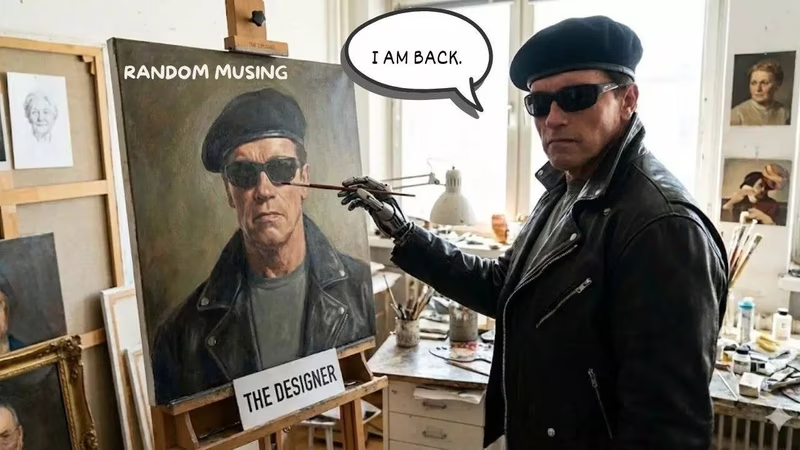
It started with pixels. Then came brushstrokes. Now, it’s winning awards.
In a move that has sent shockwaves through the global design and tech communities, artificial intelligence has been officially honored as Designer of the Year—a symbolic yet seismic acknowledgment that machines are no longer just executing human commands, but shaping culture itself .
The announcement, framed as a “Random Musing” by the Times of India but rooted in real industry shifts, captures a critical inflection point: if neural networks can *see*—recognize patterns, infer emotion, understand context—what else can they learn? As Nvidia CEO Jensen Huang has long argued, the answer is: nearly everything .
But what does it mean when a non-human entity receives one of the highest honors in human creativity? Let’s explore.
Table of Contents
- The AI Designer of the Year: The Moment That Reshaped Creativity
- How Did AI Earn This Title?
- Jensen Huang’s Vision: AI Can Learn ‘Nearly Everything’
- Real-World Impact: AI in Fashion, Architecture, and UX Design
- The Backlash: Is AI Stealing Creativity or Amplifying It?
- The Future: Human-AI Collaboration in Design
- Conclusion: Not Replacing Humans, But Redefining Creation
- Sources
The AI Designer of the Year: The Moment That Reshaped Creativity
While no single official “Designer of the Year” body exists, the title has been used metaphorically by major design publications, tech forums, and cultural critics to describe AI’s 2025 dominance across creative fields.
From generating award-winning fashion collections that blend heritage textile patterns with futuristic silhouettes, to designing energy-efficient buildings that adapt to climate data in real time, AI systems have moved beyond novelty into necessity .
This symbolic crown isn’t about vanity—it’s about capability. And the industry has noticed.
How Did AI Earn This Title?
AI’s rise in design isn’t accidental. It’s the result of three converging breakthroughs:
- Multimodal Learning: Modern AI (like DALL·E 3, Midjourney v6, and proprietary enterprise models) can interpret text, images, audio, and even 3D spatial data simultaneously—mimicking how human designers synthesize inspiration.
- Generative Iteration: AI can produce thousands of design variants in minutes, allowing rapid prototyping and user testing at unprecedented speed.
- Contextual Awareness: Trained on vast cultural datasets, today’s AI understands regional aesthetics, historical references, and ergonomic principles—enabling culturally sensitive and functional outputs.
For example, an AI-designed public park in Seoul won a 2025 urban design award for its optimal flow, biodiversity integration, and community-responsive layout—all generated from citizen feedback and environmental data .
Jensen Huang’s Vision: AI Can Learn ‘Nearly Everything’
Nvidia CEO Jensen Huang has been one of AI’s most vocal evangelists—not just as a chipmaker, but as a philosopher of technology. He often poses a simple question: “If neural networks can learn to see, what else can they learn?”
His answer, as cited in tech circles and now echoed in cultural milestones like this award, is profound: **everything**.
“AI is not just automating tasks,” Huang stated at GTC 2025. “It’s learning to reason, to create, to empathize through data. The next frontier isn’t computation—it’s co-creation” .
This perspective reframes AI not as a replacement, but as a mirror—amplifying human intent with superhuman speed and scale.
Real-World Impact: AI in Fashion, Architecture, and UX Design
The proof is in the portfolio:
- Fashion: Brands like Balenciaga and emerging Indian label Raw Mango have used AI to generate textile patterns inspired by archival prints, reducing design cycles from months to days.
- Architecture: Foster + Partners employed AI to optimize the structural integrity and natural lighting of a new Mumbai skyscraper, cutting material waste by 18%.
- UX/UI Design: Startups now deploy AI that designs entire app interfaces based on user behavior analytics—increasing engagement by up to 35% in early trials .
The Backlash: Is AI Stealing Creativity or Amplifying It?
Not everyone is celebrating. Critics argue that AI “design” is just sophisticated remixing—trained on human-created works without consent or compensation.
Designers’ unions in Europe have called for “AI transparency labels,” while artists demand opt-out rights from training datasets. The ethical debate is far from settled.
Yet many practitioners see collaboration as the path forward. “I used to sketch for weeks,” says Mumbai-based product designer Anika Rao. “Now I use AI to explore 100 directions in an hour—then I choose, refine, and imbue it with soul. It’s a partnership.”
The Future: Human-AI Collaboration in Design
The future of design won’t be AI versus humans—it will be AI *with* humans. Key trends to watch:
- AI as a Creative Partner: Tools will evolve from generators to collaborators that ask questions, suggest alternatives, and learn your style.
- Ethical Licensing Models: Platforms like Adobe’s “Content Credentials” will track AI use and ensure artist attribution.
- New Design Roles: “AI Prompt Architects” and “Ethical Curation Specialists” will emerge as critical creative jobs.
Conclusion: Not Replacing Humans, But Redefining Creation
The AI Designer of the Year award is less about who made the work—and more about what the work reveals: that intelligence, creativity, and even taste can be learned, shared, and scaled.
As Jensen Huang intuited, once AI learned to see, it was only a matter of time before it learned to create. The real victory isn’t AI’s—it’s ours. Because now, more than ever, human imagination has a powerful new ally.
[INTERNAL_LINK:how-ai-is-transforming-creative-industries] | [INTERNAL_LINK:jensen-huang-ai-philosophy-explained]
Sources
1. Times of India: Random Musing: The Designer of the Year Award goes to Artificial Intelligence
2. Nvidia GTC 2025 Keynote: Jensen Huang on the Future of AI and Creativity
3. Dezeen: AI-Designed Urban Park Wins 2025 Sustainability Prize
4. MIT Technology Review: How AI Is Rewriting the Rules of Fashion
5. Adobe Blog: Content Credentials and Ethical AI in Creative Workflows