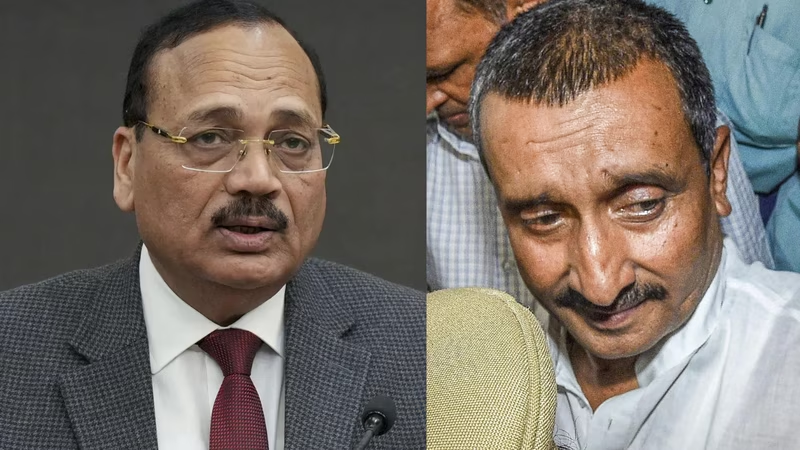
In a powerful reaffirmation of judicial independence and moral clarity, the Supreme Court of India has delivered a landmark intervention in the Unnao rape case—halting the suspension of Kuldeep Singh Sengar’s life sentence and issuing a sharp warning against the weaponization of justice for political gain .
The Court’s remarks—particularly that judges are “not sitting in ivory towers”—have resonated far beyond the courtroom, striking a chord with millions who see this case as a litmus test for India’s commitment to justice for survivors of sexual violence .
Here’s a detailed breakdown of what happened, why it matters, and what comes next for one of India’s most high-profile sexual assault cases.
Table of Contents
- Background: The Unnao Rape Case and Kuldeep Sengar
- The Delhi High Court Decision That Sparked Outrage
- Supreme Court Intervenes in Unnao Rape Case
- ‘Judges Not in Ivory Towers’: A Rebuke to Politicization
- Survivor Reacts: Vows to Fight for Death Penalty
- Legal Implications and What Happens Next
- Conclusion: A Landmark Moment for Justice in India
- Sources
Background: The Unnao Rape Case and Kuldeep Sengar
The Unnao rape case first shocked the nation in 2017 when a minor girl from Unnao, Uttar Pradesh, accused Kuldeep Singh Sengar—a then-BJP MLA—of raping her. What followed was a harrowing saga of intimidation, cover-ups, and a near-fatal car crash that killed two of her aunts and left the survivor and her lawyer critically injured .
Public outrage forced the case to be transferred to Delhi. In December 2019, a Delhi court convicted Sengar and sentenced him to life imprisonment. He was later given a second life term for the murder of the survivor’s father in custody—a crime that exposed the brutal nexus between political power and law enforcement .
The Delhi High Court Decision That Sparked Outrage
In late December 2025, the Delhi High Court granted Sengar’s plea to suspend his life sentence in the rape case, citing his age (65), health, and time already served. The order—issued during the winter vacation bench—drew immediate condemnation from activists, legal experts, and the survivor herself .
Crucially, the High Court’s decision came amid heightened political tension in Uttar Pradesh, fueling suspicions that the move was being exploited to influence public sentiment—a concern the Supreme Court would later explicitly address.
Supreme Court Intervenes in Unnao Rape Case
Acting with remarkable speed, the Supreme Court stayed the High Court’s order just days later, effectively reinstating Sengar’s life sentence. A vacation bench comprising Justices Surya Kant and Ujjal Bhuyan emphasized that the case involved “exceptional circumstances” and “national importance” .
The Court noted that Sengar remains incarcerated anyway due to his separate life sentence for the custodial murder of the survivor’s father—making the suspension legally questionable and ethically dangerous.
‘Judges Not in Ivory Towers’: A Rebuke to Politicization
Perhaps the most striking moment came when the apex court directly confronted the issue of political motive. “We are not sitting in ivory towers,” the bench declared, underscoring that judges are acutely aware of how such orders can be misused in the public sphere .
This statement was a clear message: the judiciary sees through attempts to leverage sensitive criminal cases for partisan advantage. It reaffirmed the Court’s role not just as a legal arbiter, but as a guardian of social justice—especially for the most vulnerable.
Survivor Reacts: Vows to Fight for Death Penalty
The survivor, who has shown extraordinary courage throughout this eight-year ordeal, welcomed the Supreme Court’s decision. In a statement, she expressed relief and renewed determination: “This is not the end. I will fight until he gets the death penalty for what he did to me and my family” .
Her resolve highlights a critical point often overlooked: justice isn’t just about conviction—it’s about proportionality, deterrence, and societal acknowledgment of the trauma inflicted.
Legal Implications and What Happens Next
The Supreme Court’s intervention sets several important precedents:
- Heightened Scrutiny for Politically Sensitive Cases: Courts may now be more cautious when granting relief in cases involving powerful figures during politically charged periods.
- Reinforcement of Victim-Centric Justice: The ruling underscores that the survivor’s dignity and public interest outweigh routine considerations like age or time served in egregious crimes.
- Clarification on Sentence Suspension: The Court signaled that suspending sentences in cases involving multiple convictions (especially for related crimes) requires exceptional justification.
Next, the case will be listed before a regular bench for a full hearing. Meanwhile, Sengar remains behind bars.
Conclusion: A Landmark Moment for Justice in India
The Supreme Court’s decisive action in the Unnao rape case is more than a legal correction—it’s a moral stand. By halting the suspension of Sengar’s sentence and denouncing political interference, the judiciary has reaffirmed its commitment to impartiality and the rule of law.
For survivors across India, this ruling sends a vital message: your pain will not be politicized, and your quest for justice will not be sidelined. As the survivor continues her fight for the death penalty, the nation watches—not just as spectators, but as stakeholders in a justice system that must never lose its humanity.
[INTERNAL_LINK:landmark-sexual-assault-cases-in-india] | [INTERNAL_LINK:role-of-supreme-court-in-protecting-victims]
Sources
1. Times of India: Unnao rape case: SC warns against political motives; adds judges ‘not sitting in ivory towers’
2. BBC News: Unnao rape case: The story that shook India
3. The Hindu: Kuldeep Sengar convicted in Unnao rape case
4. Supreme Court of India: Official Judgments and Orders Portal