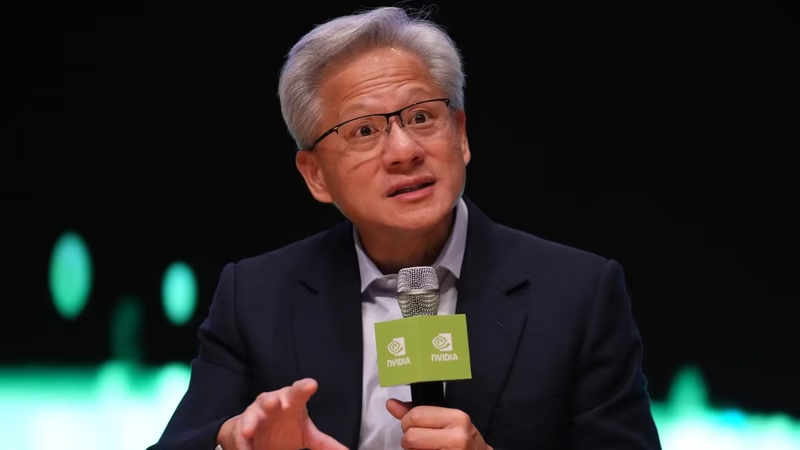
It’s a wake-up call from the man who powers the AI revolution. Nvidia CEO Jensen Huang—the architect behind the GPUs fueling everything from ChatGPT to cutting-edge robotics—has dropped a bombshell: the U.S. might be on the verge of losing the US-China AI race.
Despite America’s clear lead in semiconductor technology and proprietary AI models, Huang points to a silent but critical vulnerability: national sentiment and sluggish real-world deployment. In a candid commentary reported by the Times of India, Huang argues that China’s aggressive, open-source AI strategy and rapid application of AI across industries could give it a decisive long-term edge .
Let’s unpack what this means—and why it should matter to every policymaker, business leader, and tech enthusiast.
Table of Contents
- Jensen Huang’s Stark Warning on the US-China AI Race
- Why the US Leads in Chips But Lags in AI Adoption
- China’s Open-Source AI Advantage
- Infrastructure and Sentiment: The Hidden US Weaknesses
- What the US Must Do to Stay Ahead
- Conclusion: A Race Not Just of Tech, But of Speed and Will
- Sources
Jensen Huang’s Stark Warning on the US-China AI Race
Jensen Huang isn’t just another tech executive—he’s the de facto king of AI hardware. His company, Nvidia, controls over 80% of the high-end AI chip market . So when he says the U.S. is at risk, it’s not hyperbole—it’s a strategic red alert.
Huang’s core argument is this: technological superiority alone doesn’t win races. What matters is how fast a nation can deploy, diffuse, and scale that technology across its economy and society. And here, he believes, China is moving faster .
“One of the reasons America may lose the AI race to China is Americans,” Huang reportedly stated—highlighting a paradox where public skepticism, regulatory hesitation, and bureaucratic inertia could undermine America’s innovation edge .
Why the US Leads in Chips But Lags in AI Adoption
Make no mistake: the U.S. still dominates the foundational layers of AI.
- Chip Leadership: Nvidia’s H100 and upcoming Blackwell chips are unmatched in performance for training large AI models.
- Proprietary Models: U.S. companies like OpenAI, Anthropic, and Google lead in developing closed, high-performance AI systems.
Yet, leadership in labs doesn’t always translate to leadership in the field. Many American enterprises are still in the “pilot purgatory” phase—testing AI in silos without enterprise-wide integration. In contrast, China is pushing AI into manufacturing, logistics, education, and local government services at an astonishing pace .
China’s Open-Source AI Advantage
While the U.S. focuses on guarded, proprietary models, China has doubled down on open-source AI. Models like Qwen (from Alibaba), Yi (from 01.ai), and DeepSeek are freely available, well-documented, and optimized for Chinese language and business contexts.
This open approach creates a powerful flywheel:
- Developers rapidly build applications on these models.
- Enterprises adopt them without licensing barriers.
- Feedback loops accelerate model improvement.
- Government support scales deployment nationwide.
According to Stanford’s 2025 AI Index Report, China now leads in the number of open-source AI model contributions and citations—signaling a shift from imitation to innovation .
Infrastructure and Sentiment: The Hidden US Weaknesses
Huang’s warning about “Americans” isn’t a critique of talent—it’s about culture and systems.
Public Sentiment: In the U.S., AI is often framed through a lens of job loss, bias, and existential risk. While these concerns are valid, they’ve created a climate of caution that slows adoption. In China, AI is portrayed as a tool for national progress and economic resilience.
Infrastructure Gaps: Deploying cutting-edge AI requires more than software—it demands data centers, fiber networks, and cloud access. The U.S. lacks a coordinated national AI infrastructure plan, while China has built AI industrial parks in over 30 cities, complete with subsidized compute and talent pipelines .
What the US Must Do to Stay Ahead
The path forward isn’t about building better chips—it’s about building better ecosystems. Experts suggest the U.S. should:
- Launch a “National AI Diffusion Initiative” to help SMEs integrate AI affordably.
- Balance regulation with innovation—create sandboxes for AI deployment in healthcare, energy, and education.
- Incentivize open-source contributions from U.S. labs to compete with China’s collaborative model.
- Invest in AI-ready infrastructure, including next-gen data centers and workforce training.
As Huang implies, the race isn’t won in boardrooms—it’s won in factories, hospitals, and classrooms.
Conclusion: A Race Not Just of Tech, But of Speed and Will
The US-China AI race is no longer just about who has the smartest algorithm or the fastest chip. It’s about who can embed AI into the fabric of daily life most effectively.
Jensen Huang’s warning is clear: America’s greatest threat isn’t Chinese technology—it’s its own hesitation. To win, the U.S. must shift from a mindset of control to one of catalytic deployment. Because in the age of AI, speed of adoption is the ultimate competitive advantage.
[INTERNAL_LINK:ai-infrastructure-us-vs-china] | [INTERNAL_LINK:future-of-open-source-ai]
Sources
1. Times of India: Nvidia CEO Jensen Huang on why America may lose AI race to China
2. Bloomberg: Nvidia Dominates AI Chip Market With Over 80% Share
3. MIT Technology Review: How China Is Deploying AI at Unprecedented Scale
4. Stanford AI Index 2025: Stanford University’s Annual AI Index Report
5. South China Morning Post: China’s AI Industrial Parks Accelerate Tech Sovereignty Push