Table of Contents
- The Diplomatic Blowback: India’s Strong Rejection
- Pakistan’s Allegations: A Closer Look and Their Timing
- Documented Evidence of Pakistan’s Minority Crisis
- India’s Defense and Its Own Challenges
- A New Commission or a Public Relations Stunt?
- Conclusion: A War of Narratives with Real-World Consequences
- Sources
The Diplomatic Blowback: India’s Strong Rejection
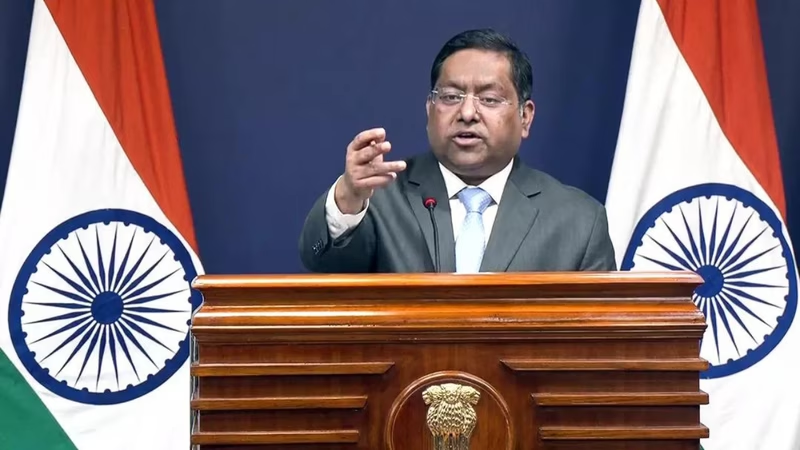
The latest salvo in the long-standing India-Pakistan rivalry has taken a sharp turn, focusing on the sensitive and critical issue of religious minorities. In a forceful statement, India’s Ministry of External Affairs (MEA) has categorically rejected accusations from its neighbor regarding alleged attacks on minorities within India. The MEA didn’t just dismiss the claims; it labeled them as mere “finger-pointing.”
In a move that sets the tone for the entire diplomatic row, an MEA spokesperson was unequivocal, stating that India “unequivocally rejects the baseless and unfounded allegations” and instead turned the spotlight firmly on Pakistan . The core of India’s counter-argument hinges on what it calls Pakistan’s “abysmal record” on the very same issue it’s now accusing India of mishandling .
This isn’t just a routine diplomatic spat. The language used by the MEA is unusually direct, suggesting a deep-seated frustration with what it perceives as Pakistan’s persistent attempts to deflect attention from its own internal crises by manufacturing controversies about India. This exchange is a prime example of the ongoing India Pakistan minority rights conflict that has become a central theme in their bilateral tensions.
Pakistan’s Allegations: A Closer Look and Their Timing
Pakistan’s foreign affairs spokesperson had raised concerns, citing specific incidents of alleged violence against minorities in India. While the details of these specific incidents can often be complex and intertwined with local socio-political dynamics, the Indian government’s response suggests it views these accusations as part of a broader, hostile propaganda campaign .
New Delhi has consistently maintained that its democratic institutions, independent judiciary, and free press are fully capable of addressing any such incidents. The government argues that to take Pakistan’s word on the state of India’s internal affairs is fundamentally misplaced, given the source’s own track record. This creates a classic “who watches the watchmen?” scenario in international diplomacy.
Documented Evidence of Pakistan’s Minority Crisis
India’s counter-accusation of Pakistan’s “abysmal record” isn’t mere rhetoric; it’s backed by a substantial body of evidence from international human rights organizations and its own long history. Reports from groups like the United States Commission on International Religious Freedom (USCIRF) consistently place Pakistan among the world’s worst violators of religious freedom .
Religious minority communities in Pakistan—including Christians, Hindus, Shi’a, and particularly the Ahmadiyya Muslim community—face a harsh reality characterized by:
- Discriminatory Laws: The notorious blasphemy laws are often weaponized to settle personal scores or incite mob violence against minorities. Even an accusation can be a death sentence, as the state often fails to protect the accused .
- Targeted Violence: Attacks by Islamist militants specifically targeting religious minorities have increased, with dozens of people killed in recent years .
- Forced Conversions: Minority groups, especially young girls from the Hindu and Christian communities, are frequently subjected to forced conversions and marriages .
- Systemic Marginalization: Beyond physical violence, minorities in Pakistan suffer from deep-seated social and economic marginalization, with their fundamental constitutional rights often remaining just words on paper .
As one report starkly puts it, “Being a Christian in Pakistan is not safe anymore” . This environment of fear and persecution forms the factual bedrock upon which India’s diplomatic counter-offensive is built.
India’s Defense and Its Own Challenges
While India’s focus on Pakistan’s record is a powerful diplomatic tool, it’s important for a balanced perspective to acknowledge that India itself faces scrutiny over its treatment of minorities. International organizations have expressed concerns about the rise in hate speech, mob lynching, and the impact of anti-conversion laws in certain states .
However, the Indian government’s position is that these are isolated incidents that are being addressed through its robust legal and democratic framework. This stands in stark contrast, they argue, to Pakistan’s systemic and state-tolerated persecution. The key difference, from India’s perspective, is the presence of a functioning system capable of course-correction versus a state that is often complicit in the abuse. For a deeper dive into India’s complex social fabric, see our analysis on [INTERNAL_LINK:religious-freedom-in-modern-india].
A New Commission or a Public Relations Stunt?
In a twist that adds a layer of irony to this diplomatic row, Pakistan’s Parliament recently passed the “National Commission for Minority Rights Bill 2025” in December 2025 . On the surface, this appears to be a positive step towards addressing the very issues India is highlighting.
Yet, critics and human rights groups remain deeply skeptical. They argue that the commission, as structured, is largely symbolic and lacks any real power to enforce change or protect vulnerable communities . More damningly, some analyses suggest the law itself is designed to entrench persecution, particularly against the Ahmadiyya community, by defining “minorities” in a way that excludes them from its protective scope . This raises the question of whether the new commission is a genuine reform or a strategic public relations move timed to counter international criticism, like India’s recent statements.
Conclusion: A War of Narratives with Real-World Consequences
The current clash between India and Pakistan over minority rights is far more than a simple exchange of barbs. It’s a high-stakes battle for the global narrative, where each nation seeks to position itself as the victim and the other as the villain. India’s strategy is clear: use the overwhelming and well-documented evidence of Pakistan’s abysmal record on minority rights as an impenetrable shield against its own accusations.
For readers and the international community, the task is to look beyond the diplomatic rhetoric and examine the concrete, on-the-ground realities for religious minorities in both nations. While challenges exist in many democracies, the scale, state complicity, and systemic nature of the persecution in Pakistan, as reported by numerous independent sources, present a uniquely severe crisis. This diplomatic row, therefore, is not just about words; it’s about the lived experiences of millions of vulnerable people.
Sources
- Times of India: ‘Abysmal record’: India flays Pak over attacks on minorities; refutes charges
- MEA Statement: Ministry of External Affairs, Government of India (Press Releases, Nov 2025)
- USCIRF 2025 Annual Report on Pakistan
- Human Rights Commission of Pakistan (HRCP) – Freedom of Religion Report
- Human Rights Watch – World Report 2025: Pakistan
- United States Department of State – International Religious Freedom Report
- Dawn News: Pakistan’s parliament passes law to establish long-delayed commission for minorities