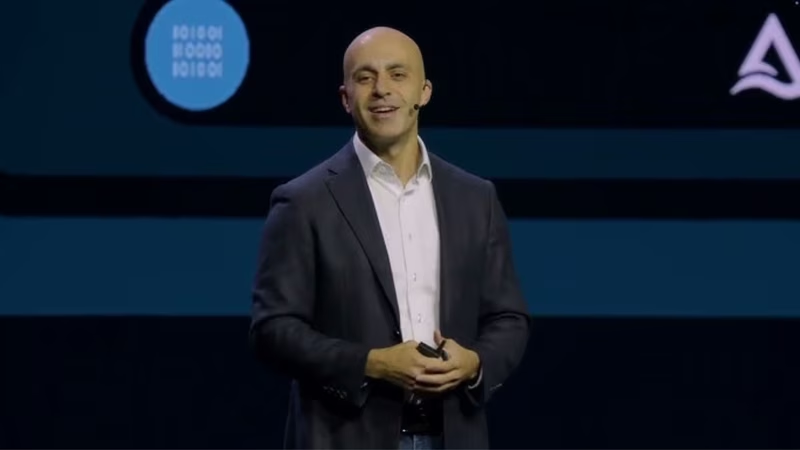
Is the AI gold rush about to go bust? One of the industry’s most influential voices just dropped a bombshell that’s got investors and founders on edge. Ali Ghodsi, the CEO of the $134 billion data and AI powerhouse Databricks, has issued a blunt warning: we’re in the middle of an AI bubble, and it’s built on shaky foundations .
Ghodsi’s comments come at a time when AI startups are commanding eye-watering valuations, often with little more than a pitch deck and a demo to show for it. His critique is not just about over-optimism—it’s a direct call-out of a dangerous trend he sees unfolding in real-time. Let’s break down what he said, why it matters, and what it could mean for the future of artificial intelligence.
Table of Contents
- Ghodsi’s Stark AI Bubble Warning
- The Dangerous Game of Circular Financing
- Where the Real AI Value Lies: Agents, Not Hype
- Why Foundation Models Are Becoming Commodities
- Silicon Valley Vibes: ‘Even VCs Are Exhausted’
- Beyond the Bubble: A More Sustainable AI Future?
Ghodsi’s Stark AI Bubble Warning
Speaking with unusual candor, Ghodsi painted a grim picture of the current AI investment landscape. He pointed to numerous startups with “billions of dollars in valuation but no revenue” as clear evidence of an inflating AI bubble . This isn’t just a case of high expectations; it’s a fundamental disconnect between market value and business fundamentals.
His concern is that the market has become so intoxicated by the promise of AI that it’s ignoring basic financial realities. This speculative frenzy, Ghodsi warns, is unsustainable and is likely to lead to a painful market correction. “The vibes in Silicon Valley are bad,” he noted, adding that even venture capitalists, the usual cheerleaders of disruption, are feeling exhausted by the pressure to keep funding unproven ideas .
The Dangerous Game of Circular Financing
One of Ghodsi’s most incisive criticisms is aimed at what he calls “circular financing.” This is a practice where AI startups raise money from investors and then immediately turn around and spend that capital buying services or infrastructure from other AI companies—often ones backed by the same investors .
This creates a false ecosystem of revenue that exists only on paper, artificially inflating the valuations of all parties involved. It’s a house of cards, and Ghodsi believes it’s only a matter of time before it collapses. This practice, he argues, distorts the true health of the AI market and masks the fact that many of these companies have no viable path to profitability or real customer adoption.
Where the Real AI Value Lies: Agents, Not Hype
Despite his dire warnings about the bubble, Ghodsi is far from a pessimist when it comes to AI’s long-term potential. His optimism is focused squarely on a specific application: AI agents.
At Databricks, they’ve observed a significant trend: a large portion of the databases their customers are building are being created directly by AI agents, not human engineers . This is a tangible, measurable use case that’s already delivering value. Ghodsi believes the future of revenue in AI won’t come from the underlying models themselves, but from the intelligent applications and agents that solve real-world problems for businesses.
- AI Agents can automate complex workflows like data ingestion and transformation.
- They are already creating production-ready databases on Databricks’ platform.
- This represents a shift from “AI for show” to “AI for work.”
Why Foundation Models Are Becoming Commodities
Ghodsi’s view on the future of AI economics is clear: the foundational layer—the large language models (LLMs) that power everything—is rapidly becoming a commodity . As more open-source and proprietary models flood the market, the competitive advantage of any single model diminishes.
“You can’t build a lasting business just by offering another slightly better LLM,” he implies. The real money, the sustainable business models, will be built on top of these models. The winners will be the companies that create specialized, vertical-specific AI applications that integrate seamlessly into existing business processes and deliver a clear return on investment. This is a crucial insight for any startup founder or investor navigating the current AI landscape.
Silicon Valley Vibes: ‘Even VCs Are Exhausted’
Ghodsi’s observation that “even venture capitalists are exhausted” speaks volumes about the current state of the tech ecosystem . After years of breakneck funding, sky-high valuations, and the FOMO (fear of missing out) that has driven the AI boom, there’s a growing sense of fatigue.
Investors are starting to ask harder questions about unit economics, customer acquisition costs, and—perhaps most importantly—actual revenue. This shift in sentiment is a key indicator that the market is maturing and that the easy money phase may be coming to an end. For more on this shift, check out our [INTERNAL_LINK:venture-capital-trends-2025].
Beyond the Bubble: A More Sustainable AI Future?
Ali Ghodsi’s warning about the AI bubble is a necessary and timely reality check. While the technology holds immense promise, the current investment mania is detached from the fundamentals of building a real business. His distinction between the commoditized nature of foundation models and the high-value potential of practical AI agents provides a clear roadmap for where sustainable innovation will happen.
The coming months and years will likely separate the true AI pioneers from the hype-driven pretenders. Companies that can demonstrate real-world utility, generate actual revenue, and solve concrete business problems—like those building on the Databricks platform—are the ones most likely to thrive in the post-bubble era. The gold rush may be ending, but the real work of building a valuable AI economy is just beginning.
Sources
- Times of India – Original Article: https://timesofindia.indiatimes.com/
- McKinsey & Company – The State of AI in 2024: https://www.mckinsey.com/ (for market context)
- Crunchbase – AI Startup Funding Trends: https://news.crunchbase.com/ (for industry data)