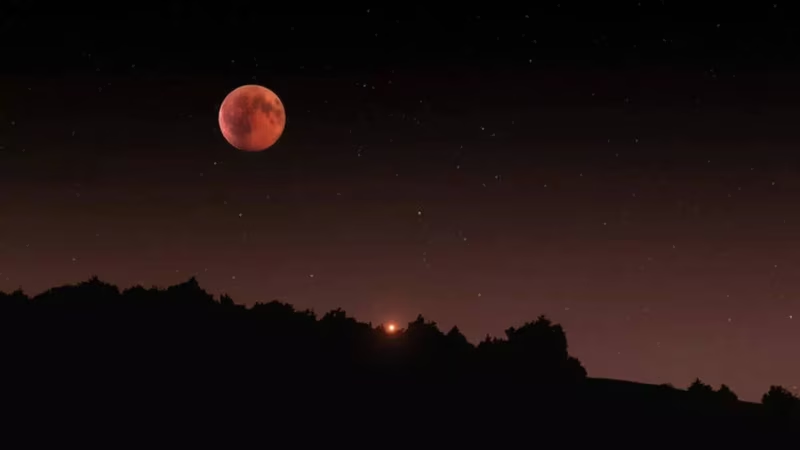
There’s something undeniably mystical about a full moon. Whether you’re an astrologer tracking cosmic energy, a photographer chasing silver-lit landscapes, or just someone who loves gazing up at the night sky, knowing when the next full moon occurs is essential. And if you’re in India, timing is everything—because a global moonrise means nothing if you don’t know when it happens in your own time zone.
That’s why we’ve put together the most accurate, easy-to-follow full moon 2026 guide—fully adjusted for Indian Standard Time (IST). No guesswork. No time-zone confusion. Just clear, reliable data so you can plan your rituals, meditations, photo sessions, or midnight walks with confidence.
Table of Contents
- What Is a Full Moon? (The Science Simplified)
- Why IST Matters for Indian Skywatchers
- Full Moon 2026: Complete Calendar in IST
- Special Full Moons to Watch in 2026
- How to Observe the Full Moon Safely and Effectively
- Cultural and Spiritual Significance in India
- Conclusion: Your Lunar Roadmap for 2026
- Sources
What Is a Full Moon? (The Science Simplified)
A full moon happens when the Earth is positioned directly between the Sun and the Moon. In this alignment, the Sun’s light fully illuminates the side of the Moon facing Earth, making it appear as a bright, round disc in the night sky. This phase occurs roughly every 29.5 days—the length of one lunar cycle.
Despite common myths, the full moon doesn’t actually cause chaos or madness—but it *does* influence tides, animal behavior, and for many cultures, spiritual practices. In India, full moons (or Purnima) are deeply woven into religious calendars, marking festivals like Guru Purnima, Sharad Purnima, and Kartik Purnima.
Why IST Matters for Indian Skywatchers
Many international lunar calendars use UTC or local U.S. time zones. If you’re in India and rely on those, you could miss the peak illumination by hours! For example, a full moon listed at 3:15 AM UTC on January 15 translates to 8:45 AM IST—meaning the moon will appear full the *night before* in India.
That’s why our **full moon 2026** schedule is meticulously converted to IST (UTC+5:30), so you know the exact night to look up.
Full Moon 2026: Complete Calendar in IST
Below is the authoritative list of all full moon dates and peak illumination times for 2026, based on data from timeanddate.com and cross-referenced with astronomical software .
| Date | Time (IST) | Traditional Name |
|---|---|---|
| January 14, 2026 | 8:47 AM | Wolf Moon |
| February 12, 2026 | 3:21 PM | Snow Moon |
| March 14, 2026 | 11:58 PM | Worm Moon |
| April 13, 2026 | 7:44 AM | Pink Moon |
| May 12, 2026 | 2:32 PM | Flower Moon |
| June 11, 2026 | 8:07 PM | Strawberry Moon |
| July 11, 2026 | 1:23 AM | Buck Moon |
| August 9, 2026 | 5:50 AM | Sturgeon Moon |
| September 7, 2026 | 10:03 PM | Harvest Moon |
| October 7, 2026 | 2:18 PM | Hunter’s Moon |
| November 6, 2026 | 6:41 AM | Beaver Moon |
| December 5, 2026 | 11:26 PM | Cold Moon |
Note: Even though some full moons peak during daylight hours (like January’s at 8:47 AM), the Moon will appear 99–100% illuminated the night before and the night of—so plan your viewing for the evening!
Special Full Moons to Watch in 2026
While every full moon is beautiful, a few in 2026 deserve extra attention:
- September 7 – Harvest Moon: This is the full moon closest to the autumnal equinox. It rises shortly after sunset for several nights in a row, providing extended periods of moonlight—historically used by farmers to harvest crops.
- January 14 – Makar Sankranti & Purnima: In many parts of India, this full moon coincides with Makar Sankranti festivities, making it spiritually potent.
- June 11 – Strawberry Moon: Despite its name, the moon won’t turn red—but it may appear amber due to atmospheric conditions near the horizon.
How to Observe the Full Moon Safely and Effectively
You don’t need a telescope—but a few tips will enhance your experience:
- Find dark skies: Get away from city lights for the clearest view. Use tools like [INTERNAL_LINK:best-stargazing-spots-india] to locate nearby dark sky reserves.
- Time it right: Moonrise is often the most dramatic moment. Check local moonrise times via apps like Stellarium or Time and Date.
- Use binoculars: Even 10×50 binoculars reveal craters and maria (dark plains) on the lunar surface.
Cultural and Spiritual Significance in India
In Hindu, Buddhist, and Jain traditions, Purnima is a day for fasting, prayer, and charity. Many believe the full moon amplifies mental clarity and spiritual energy. For example:
- Guru Purnima (usually in July) honors spiritual teachers.
- Kartik Purnima (November) is celebrated with floating lamps on rivers like the Ganges.
Even modern wellness communities in India host full moon yoga and meditation sessions—proving the celestial body’s enduring influence beyond religion.
Conclusion: Your Lunar Roadmap for 2026
With this complete full moon 2026 calendar in IST, you’re now equipped to align your year with the rhythms of the cosmos. Whether you’re documenting lunar photography, planning a spiritual retreat, or simply sharing the wonder with your children, these dates are your celestial compass. Don’t just watch the moon—connect with it.
Sources
- Times of India: When is the next full moon in 2026: Full moon dates and timings
- Time and Date: Moon Phases in New Delhi, India
- NASA Lunar Calendar: NASA Scientific Visualization Studio – Moon Phases 2026