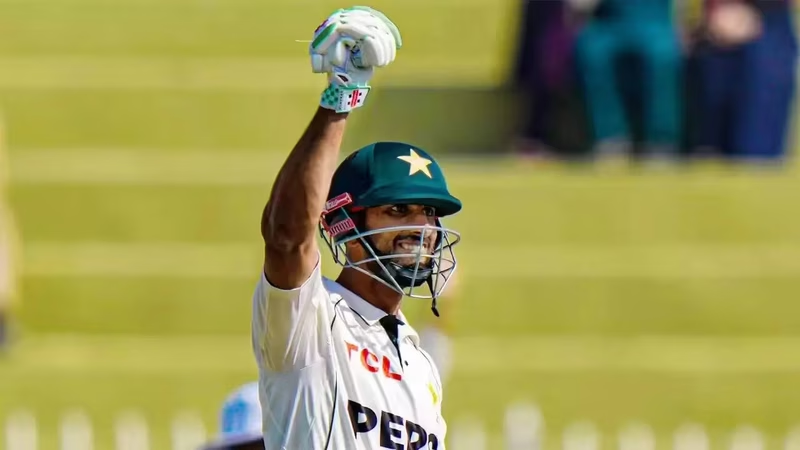
In the world of cricket, records are the bedrock of legacy. They stand as towering monuments, often untouched for decades, daring future generations to rise to the challenge. This past Sunday, Shan Masood didn’t just meet that challenge—he demolished it with a sledgehammer.
The **Shan Masood record** for the fastest double century by a Pakistani batsman is now etched in the history books, smashing a benchmark set by the legendary Inzamam-ul-Haq over three decades ago. But this isn’t just a story of a personal milestone; it’s a seismic shift in the DNA of Pakistani batting.
Table of Contents
- A Day to Remember: Masood’s Historic Knock
- Breaking Down the Shan Masood Record
- Inzamam’s Ghost and the 1992 Benchmark
- Where Does This Stand Globally?
- A New Batting Philosophy for Pakistan?
- Conclusion
- Sources
A Day to Remember: Masood’s Historic Knock
The scene was set in a domestic first-class match, a stage often overlooked on the global stage but one that has birthed countless legends. Shan Masood, the current captain of the Pakistan national side, walked in with intent. It wasn’t just about runs; it was about a statement. By the end of the day’s play, he was unbeaten on a staggering 212 from just 185 balls, a knock that included 28 fours and two massive sixes .
But the record-breaking moment came much earlier. Masood raced to his double century in a mind-blowing 177 deliveries, a feat that sent shockwaves through the cricketing community . This wasn’t a gritty, defensive masterclass. It was a brutal, calculated assault on the bowling, a display of power and precision rarely seen in the longer format from a top-order batsman of his profile.
Breaking Down the Shan Masood Record
What makes this achievement so monumental? Let’s dissect the numbers:
- Previous Record: 188 balls to a double century.
- New Record (Shan Masood): 177 balls to a double century.
- Margin of Victory: A full 11 balls faster.
- Strike Rate for the Innings: An astonishing 114.59.
This level of aggression from a player known more for his solid technique and leadership has redefined what’s possible. It signals a new confidence, a new approach that could be a blueprint for the future of Pakistani cricket in all formats.
Inzamam’s Ghost and the 1992 Benchmark
The record Masood shattered belonged to none other than Inzamam-ul-Haq, a colossus of Pakistani batting in the 90s and 2000s. Inzamam’s 188-ball double century was a tour match gem, a flash of his explosive potential against Oxford University in 1992 . For 33 years, that score stood as the gold standard for Pakistani batsmen in the first-class arena.
Inzamam, known for his unorthodox yet brutally effective style, was a pioneer of aggressive batting in his own right. For Masood, a player with a very different technical foundation, to surpass this record is a powerful testament to the evolution of the game and the adaptability of modern batsmen. It’s a passing of the torch from one generation of power-hitters to the next, but with a new, more refined weapon.
Where Does This Stand Globally?
While the Shan Masood record is a national landmark, it’s crucial to understand its place in the global context. The ultimate benchmark for speed in Test cricket is held by New Zealand’s Nathan Astle, who reached his double century in a mere 153 balls against England in 2002—a record that still stands today . Other names on that elite list include Ben Stokes and Virender Sehwag .
Masood’s 177-ball effort, while not a Test match innings, is a phenomenal first-class achievement that places him firmly among the world’s most destructive batsmen in the longer format. It’s a reminder that explosive batting isn’t confined to the T20 arena; it can, and is, reshaping first-class cricket.
A New Batting Philosophy for Pakistan?
Masood’s innings is more than just a personal triumph; it could be a catalyst for a broader strategic shift. Traditionally, Pakistan’s top order has been built on a mix of caution and counter-attack. Masood’s knock suggests a new, more proactive philosophy: seize the initiative from the very first ball, regardless of the format.
This aggressive mindset, if adopted by the wider team, could make Pakistan an even more formidable force in Test cricket, a format where they have often been their own worst enemies due to slow starts. His performance is a masterclass for the likes of Abdullah Shafique and Imam-ul-Haq, showing that solid defence and explosive stroke-play are not mutually exclusive. For more on Pakistan’s evolving batting strategy, see our deep dive on [INTERNAL_LINK:pakistan-batting-order-evolution].
Conclusion
Shan Masood’s 177-ball double century is a watershed moment. It’s a record that breaks a 33-year-old spell, a performance that blends classical technique with modern aggression, and a signal that Pakistani cricket is ready to bat on its own terms, fearlessly and with immense power. The ghost of Inzamam’s 1992 innings has been respectfully laid to rest, making way for a new era defined by Masood’s explosive brilliance. The message to the cricketing world is clear: the old records are just a starting point.
Sources
- Times of India: 177 balls to history: Pakistan’s Shan Masood breaks Inzamam-ul-Haq’s three-decade-old record
- ESPNcricinfo: Cricket Records in Pakistan in England Test Series, 1992
- International Cricket Council (ICC): Fastest Double Centuries in Test Cricket History