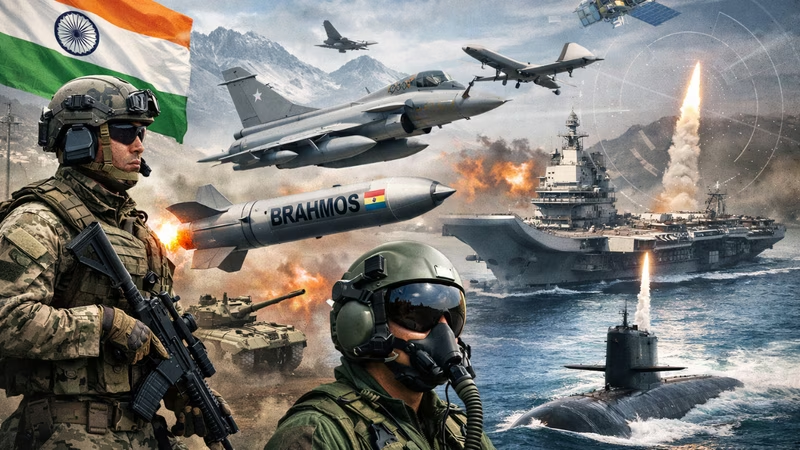
2025 wasn’t just another year for India’s armed forces—it was a turning point.
Triggered by the deadly Pahalgam attack, India’s military response—codenamed Operation Sindoor 2025—wasn’t just about retribution. It was a meticulously executed demonstration of a new kind of warfare: integrated, tech-driven, and lightning-fast. More than a counterstrike, it became the catalyst for India’s most ambitious military overhaul in a generation.
From tri-service integration to billion-dollar acquisitions and AI-enabled battlefield systems, India spent 2025 building a war machine designed not for yesterday’s threats—but for the high-intensity, multi-domain conflicts of tomorrow.
Table of Contents
- What Was Operation Sindoor 2025?
- Operation Sindoor 2025: The Strategic Response
- The Three Pillars of India’s 2025 Military Transformation
- Defence Budget and Major Acquisitions
- Exercises That Simulated Future War
- Challenges and the Road Ahead
- Summary
- Sources
What Was Operation Sindoor 2025?
Following a coordinated terrorist assault in Pahalgam in early 2025 that targeted civilians and security personnel, India’s National Security Council authorized a surgical military operation across the Line of Control (LoC). Unlike previous responses, Operation Sindoor 2025 leveraged real-time satellite intelligence, drone swarms, and precision-guided munitions launched jointly by the Army, Air Force, and Navy’s maritime strike units .
The operation was notable for its speed, accuracy, and minimal collateral damage—hallmarks of a force that had trained extensively for just such a scenario. But more importantly, it validated years of behind-the-scenes reform.
Operation Sindoor 2025: The Strategic Response
What made Operation Sindoor different wasn’t just its execution—it was the doctrine behind it.
- Jointness in Action: For the first time, all three services operated under a unified command structure, coordinated through the newly empowered Chief of Defence Staff (CDS) office.
- Network-Centric Warfare: Real-time data from Indian satellites (like the Cartosat-3 series) and airborne platforms fed directly into tactical decision nodes, enabling dynamic target updates mid-mission.
- Deterrence by Denial: The message was clear: any attack on Indian soil would be met not just with retaliation, but with a capability so precise and overwhelming that future adversaries would think twice.
The Three Pillars of India’s 2025 Military Transformation
Beyond a single operation, 2025 saw India institutionalize three core strategic pillars:
1. Integrated Theatre Commands
After years of debate, India accelerated the rollout of its Integrated Theatre Commands—a structure where geographical regions (like the Northern, Western, and Maritime theatres) are managed by unified tri-service headquarters. This eliminates inter-service rivalry and streamlines logistics, intelligence, and operations .
2. Indigenous Defence Ecosystem
The “Make in India” push in defence hit new heights. DRDO, BEL, and private players like L&T and Tata Advanced Systems delivered key systems: the SWATHI Mk-II radar, QR-SAM missiles, and indigenous loitering munitions—all tested and deployed during 2025 exercises .
3. Cyber and Space Integration
Recognizing that future wars will be won in orbit and cyberspace, India formally integrated the Defence Space Agency (DSA) and Defence Cyber Agency (DCyA) into operational planning. Electronic warfare units now train alongside infantry and air wings in every major exercise.
Defence Budget and Major Acquisitions
India’s 2025-26 defence budget crossed ₹6.5 lakh crore—a record 13% increase from the previous year . This surge funded critical capabilities:
- 31 MQ-9B SeaGuardian drones (leased and later purchased from the U.S.)
- Additional Rafale-M fighters for the Navy
- Procurement of 480 BrahMos-NG supersonic cruise missiles
- AI-powered battlefield management systems (BMS) for infantry units
These acquisitions weren’t just about hardware—they reflected a shift toward “smart lethality”: fewer platforms, but smarter, networked, and deadlier.
Exercises That Simulated Future War
2025 was packed with large-scale drills designed to stress-test the new doctrine:
- Vajra Prahar: Joint special forces exercise with the U.S., focusing on counter-terrorism in urban and mountainous terrain.
- Sindhu Sudarshan: Western Command’s massive desert war game, integrating tanks, drones, and electronic jammers in a near-peer conflict scenario.
- TROPEX 2025: The Navy’s theatre-level exercise featured aircraft carriers, submarines, and cyber-defense units simulating a two-ocean war.
These weren’t just shows of strength—they were laboratories for refining the tactics that powered Operation Sindoor.
For deeper insights, explore our coverage on [INTERNAL_LINK:india-defence-modernization] and [INTERNAL_LINK:future-of-indian-navy].
Challenges and the Road Ahead
Despite progress, hurdles remain. Legacy equipment still comprises over 60% of infantry gear. Interoperability between old Russian systems and new Western platforms is a persistent headache. And while jointness is improving, cultural resistance within service silos hasn’t vanished overnight.
Nonetheless, 2025 marked a psychological shift: India is no longer preparing for limited conflicts. It’s building a military that can fight—and win—high-intensity wars on multiple fronts.
Summary
Operation Sindoor 2025 was far more than a retaliatory strike. It was the public debut of a transformed Indian military—unified, technologically advanced, and strategically agile. Backed by record budgets, doctrinal reforms, and a clear vision for multi-domain warfare, India has not just prepared for future wars; it has redefined how it will fight them.
Sources
- Times of India: Operation Sindoor and beyond: How India prepared for future wars in 2025
- Ministry of Defence, India: Annual Report 2025
- Brookings Institution: India’s Military Modernization: Challenges and Opportunities
- Stockholm International Peace Research Institute (SIPRI): India Military Expenditure Database