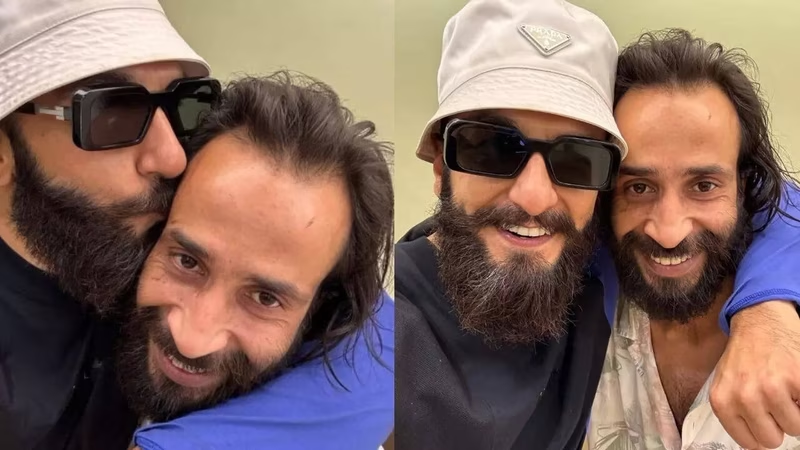
It’s the scene that’s got everyone talking—from Reddit threads to Twitter reels—and now we know the human story behind it. In the gritty crime drama Dhurandhar, a raw and intense Dhurandhar assault scene between Ranveer Singh and newcomer Naseem Mughal has gone viral, not just for its brutality but for its emotional authenticity . But what few knew is that moments before rolling cameras, Mughal—playing the bandit Lulli—was so overwhelmed he told the director, “I can’t do this.”
His reluctance wasn’t about the script’s violence. It was about the sheer psychological weight of performing a high-stakes, physically demanding sequence opposite one of Bollywood’s biggest stars. Thankfully, what could have been a production roadblock turned into a masterclass in on-set empathy—all thanks to Ranveer Singh’s approach .
Table of Contents
- Who Is Naseem Mughal: The Man Behind Lulli Dakait?
- The Dhurandhar Assault Scene That Broke the Internet
- Why Naseem Initially Refused to Shoot the Scene
- How Ranveer Singh Turned Anxiety Into Art
- The Bigger Picture: Trust in Bollywood’s New Era
- Conclusion: Why This Scene Matters Beyond the Virality
- Sources
Who Is Naseem Mughal: The Man Behind Lulli Dakait?
Before Dhurandhar, Naseem Mughal was largely unknown outside indie theatre circles in Uttar Pradesh. His casting as Lulli—a morally ambiguous dacoit entangled in a brutal power struggle—was a bold move by the filmmakers. They weren’t looking for glamour; they wanted authenticity .
Mughal, a former street performer with a background in local folk theatre, brought a grounded, almost documentary-like realism to his role. But transitioning from stage to a high-pressure film set alongside a powerhouse like Ranveer Singh? That was a different beast entirely.
The Dhurandhar Assault Scene That Broke the Internet
The now-iconic Dhurandhar assault scene unfolds in a rain-soaked forest, where Lulli is ambushed and overpowered by Singh’s character in a moment of explosive tension. Shot in a single, unbroken take, the sequence is visceral, chaotic, and emotionally draining—exactly what director Shlok Sharma envisioned .
What made it go viral wasn’t just the choreography—it was the raw fear and desperation in Mughal’s eyes, contrasted with Singh’s controlled fury. Viewers felt they weren’t watching acting; they were witnessing something real. And in a way, they were.
Why Naseem Initially Refused to Shoot the Scene
“I told them I couldn’t do it,” Mughal admitted in a recent interview. “The scene felt too real, too close to things I’ve seen in life. And facing Ranveer sir… I froze” .
His hesitation stemmed from more than stage fright. The scene required physical contact, simulated violence, and extreme emotional vulnerability—all in front of a crew of 50 people. For a newcomer, that’s terrifying. He feared he’d “mess up” or, worse, be judged as “not strong enough” for the role.
In today’s era of heightened awareness around on-set safety and consent—especially for intimate or violent scenes—Mughal’s honesty is a reminder that even fictional violence carries real emotional weight .
How Ranveer Singh Turned Anxiety Into Art
Rather than getting frustrated or moving on, Ranveer Singh did something unexpected. He pulled Mughal aside, away from the lights and cameras.
“He sat with me in silence for ten minutes,” Mughal recalled. “Then he said, ‘This scene isn’t about me dominating you. It’s about two broken men colliding. Your fear is the character’s fear. Use it’” .
According to the actor, Singh then walked him through every beat of the choreography—not as a co-star, but as a collaborator. He emphasized safety cues, gave Mughal full control over pacing, and even suggested subtle facial expressions to enhance realism without physical strain.
“He didn’t act like a star. He acted like a brother,” Mughal said. That trust allowed him to surrender to the moment—not as himself, but as Lulli.
Key Elements That Made the Scene Work:
- Psychological safety: Clear communication and mutual respect before filming.
- Actor autonomy: Mughal could call for pauses or adjustments at any time.
- Emotional anchoring: Singh helped him connect the scene to the character’s backstory, not personal trauma.
- Technical rehearsal: Multiple dry runs with stunt coordinators minimized physical risk .
The Bigger Picture: Trust in Bollywood’s New Era
This moment reflects a subtle but significant shift in Indian cinema. Where once the “star system” dictated top-down authority, newer films like Dhurandhar are embracing collaborative, actor-first environments .
Platforms like the National Film Development Corporation of India have long advocated for ethical filmmaking practices, and stories like Mughal’s show these values are finally taking root on commercial sets too .
Moreover, as audiences demand more realism—and as filmmakers tackle grittier subjects—the industry must ensure that the pursuit of authenticity never comes at the cost of an actor’s well-being. The success of the Dhurandhar assault scene proves that the two aren’t mutually exclusive.
Conclusion: Why This Scene Matters Beyond the Virality
Yes, the Dhurandhar assault scene is trending. But its true legacy lies in what it reveals about the future of filmmaking in India: one where empathy, preparation, and human connection are just as important as lighting, lenses, and box office numbers. Naseem Mughal’s journey—from refusal to revelation—shows that the most powerful performances aren’t born from pressure, but from trust. And in that, Ranveer Singh didn’t just play a role; he led by example.