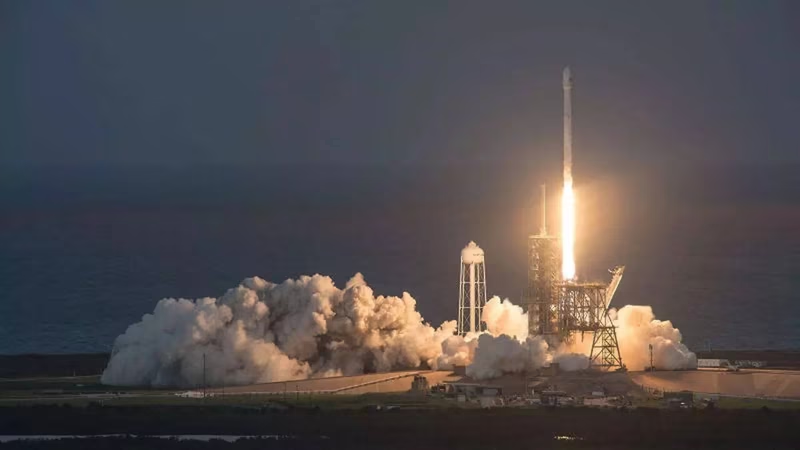
Elon Musk, take note. China isn’t just watching SpaceX; it’s building an entire financial and industrial engine to catch up—and fast. In a stunning policy shift just before the end of 2025, Chinese regulators have effectively thrown open the doors of its tech-focused STAR Market to private companies pioneering reusable rocket technology . And the old rules? They’ve been tossed out the airlock.
Table of Contents
- A Financial Springboard for China’s Space Ambitions
- The Real Goal: Challenging SpaceX’s Dominance
- Who Are the Contenders in China’s Reusable Rocket Race?
- What This Means for the Global Space Economy
- Conclusion: A New Chapter in the Space Race
- Sources
A Financial Springboard for China’s Space Ambitions
Traditionally, a company needed to prove it was profitable or had significant, stable revenue before it could even think about an Initial Public Offering (IPO) on a major exchange. China’s new rules for the Shanghai Stock Exchange’s STAR Market shatter that precedent for a very specific and critical sector: reusable rocket developers .
Under these groundbreaking guidelines, a company is no longer judged on its bottom line. Instead, its worthiness for a public listing is tied directly to its technical milestones. The key benchmark? A single, successful orbital launch using its own reusable architecture .
This pivot from financial metrics to engineering achievements is a masterstroke of industrial policy. It acknowledges the immense upfront capital required for rocket development—a field where failure is a common and necessary step on the path to success, as seen with SpaceX’s early struggles . By removing the profit barrier, China is providing its nascent commercial space sector with the financial oxygen it needs to breathe, iterate, and ultimately, compete on the world stage.
The Real Goal: Challenging SpaceX’s Dominance
Let’s be clear: this move is not happening in a vacuum. It’s a direct, calculated response to the overwhelming success of SpaceX. Elon Musk’s company has decimated launch costs and captured a massive share of the global market, primarily thanks to the reusability of its Falcon 9 rockets .
China’s state-driven space program, while highly capable, operates on a different economic model. To truly challenge SpaceX in the commercial arena—where speed, cost, and innovation are king—China needs a vibrant private sector that can mimic that agile, iterative approach .
These new IPO rules are the catalyst. They aim to create a self-sustaining ecosystem where private Chinese firms can access vast pools of public capital to fund rapid development, learn from failures without the immediate threat of bankruptcy, and build their own fleets of cost-effective, reusable launchers. The ultimate objective is clear: to break SpaceX’s stranglehold on affordable space access and establish China as an independent, dominant force in the new space economy .
Who Are the Contenders in China’s Reusable Rocket Race?
Several private Chinese companies are now in prime position to leverage this new policy. They have been working feverishly in the background, and 2025 was a pivotal year for their progress .
- Landspace: A leading contender, Landspace has been at the forefront of China’s reusable ambitions. They conducted the country’s first major orbital launch and landing attempt for a reusable rocket in 2025, a critical milestone that aligns perfectly with the new STAR Market requirements . Their efforts are explicitly inspired by SpaceX’s model .
- Space Pioneer: This firm is developing the Tianlong-3 rocket and has been actively preparing for its own reusable launch attempts . They are another prime candidate to benefit from the fast-tracked IPO process.
- Galactic Energy & iSpace: These established players in China’s commercial launch sector are also developing next-generation rockets with reusability in mind, aiming for debut flights in 2025 and 2026 .
With the IPO pathway now clear, these companies are likely to accelerate their timelines, knowing that a successful launch could be their ticket to a massive capital infusion.
What This Means for the Global Space Economy
The implications of China’s move ripple far beyond its borders. For the global space economy, this signals the intensification of a true two-horse race. We are moving from a market largely dominated by a single innovative player (SpaceX) towards a competitive duopoly between the U.S. and China .
This competition could be a powerful driver for innovation, potentially leading to even lower launch costs and more frequent access to space for everyone—satellite operators, researchers, and future space tourists. However, it also carries the risk of further bifurcating the global tech landscape into separate U.S. and Chinese spheres of influence, each with their own launch providers, satellite constellations (like a Chinese rival to Starlink ), and space standards.
For investors, a whole new asset class has just opened up in one of the world’s largest economies. The STAR Market is now a potential gateway to backing the next generation of space infrastructure, albeit with the high risks inherent in such frontier technology.
Conclusion: A New Chapter in the Space Race
China’s decision to ease IPO rules for reusable rocket companies is far more than a financial policy tweak. It’s a declaration of intent. By aligning its capital markets directly with its strategic space goals, China has created a powerful mechanism to turbocharge its commercial launch industry. The race to dominate the economics of space is now officially a head-to-head contest between American private enterprise and Chinese state-capitalism. For the rest of the world, the ensuing battle will be nothing short of historic, and its outcome will shape our access to the final frontier for decades to come. The SpaceX era may have just met its most serious challenger yet.
Sources
- Reuters: China eases IPO rules for firms developing reusable rockets
- SpaceNews: China to fast track IPOs for reusable rocket tech firms
- South China Morning Post: China eases IPO rules for private companies developing reusable commercial rockets
- Nikkei Asia: China to debut large reusable rockets in 2025 and 2026
- Nature: The new space race with China