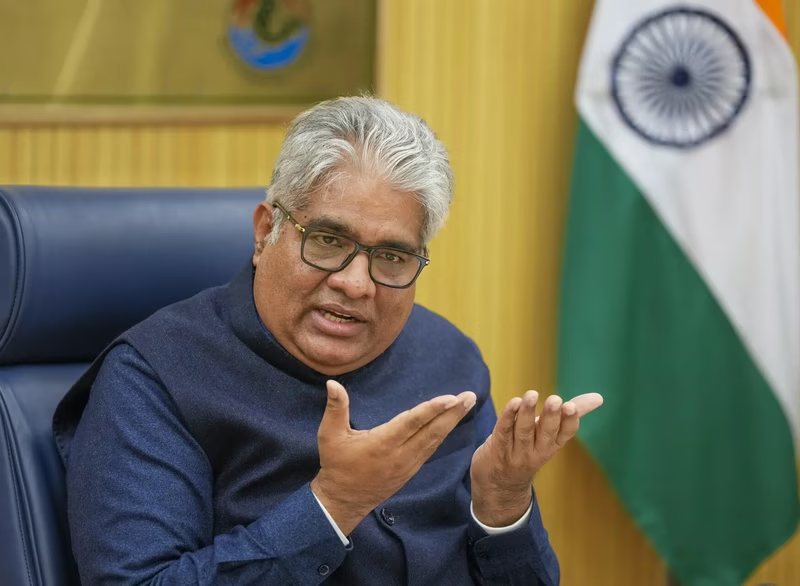
The fate of one of India’s oldest and most ecologically critical mountain ranges has taken a dramatic turn. Following widespread public outcry and environmental concerns, the Supreme Court has put a decisive pause on its previous directive to redefine the Aravalli Hills. In response, Union Environment Minister Bhupender Yadav has issued a clear and forceful message: the government’s Aravalli mining ban is not just policy—it’s a promise. “We stand committed to extending all assistance… in the protection and restoration of the Aravalli range,” Yadav declared .
This development comes as a crucial relief to activists and scientists who warned that a controversial new definition, which proposed a 100-meter height threshold for what constitutes an Aravalli hill, would have opened vast tracts of the range to destructive mining and real estate activities . Now, with a new high-powered committee tasked to re-examine the issue, the future of the Aravallis rests on a more comprehensive and ecologically sound review.
Table of Contents
- Supreme Court Stays Controversial Aravalli Redefinition
- Bhupender Yadav’s Firm Stance on the Aravalli Mining Ban
- Why the Aravalli Hills Are a National Ecological Asset
- The New Committee and the Path Forward
- Public and Expert Reaction to the Ruling
- Conclusion
- Sources
Supreme Court Stays Controversial Aravalli Redefinition
The legal saga began on November 20, 2025, when the Supreme Court accepted a new, narrower definition of the Aravalli range. This definition, which limited protected areas to hills over 100 meters in height, was met with immediate and fierce criticism from environmental groups. They argued it was a thinly veiled attempt to declassify ecologically sensitive areas and pave the way for mining and construction .
Just weeks later, in a significant reversal, the apex court “put in abeyance” its own November 20 order. The bench announced the formation of a new, high-powered committee to conduct a thorough and holistic re-examination of the ecological, geological, and legal complexities surrounding the Aravalli Hills . The stay on the previous ruling will remain in effect until this new committee completes its work .
Aravalli mining ban: Bhupender Yadav’s Firm Stance
Minister Bhupender Yadav has been unequivocal in his support for the court’s latest decision and the overarching policy to protect the Aravallis. In a series of public statements, he has sought to quell rumors and reassure the public.
“I welcome the Supreme Court directions introducing a stay on its order concerning the Aravalli range, and the formation of a new committee,” Yadav stated, adding that the government is fully aligned with the goal of conservation . He categorically dismissed claims that the initial definition change was a ploy to relax mining rules, calling such reports “false” .
Critically, Yadav has reiterated that the Aravalli mining ban is ironclad. “No new mining leases will be permitted, especially in the ecologically fragile zones,” he confirmed . He also clarified that the existing ban on mining in the National Capital Region (NCR) remains completely unchanged . This stance directly addresses the core fear of environmentalists: that the legal definition was being manipulated to benefit commercial interests.
Why the Aravalli Hills Are a National Ecological Asset
The government’s firm position is rooted in the undeniable ecological importance of the Aravalli range. Spanning over 1.44 lakh square kilometers across four states and Delhi, these ancient hills are far more than just a scenic backdrop . They are a lifeline for North India.
Here’s why their protection is non-negotiable:
- Desertification Barrier: The Aravallis act as a crucial natural barrier, preventing the eastward expansion of the Thar Desert into the densely populated plains of Haryana and Delhi .
- Air and Water Guardians: The hills play a vital role in recharging aquifers, curbing dust storms, and improving air quality in the NCR, a region notorious for its pollution .
- Biodiversity Hotspot: Uncontrolled mining has already led to deforestation, loss of natural vegetation, and contamination of water sources, posing a “great threat to the ecology of the nation” as noted by the Supreme Court itself .
For a deeper dive into India’s environmental policies, see our analysis on [INTERNAL_LINK:environment-policy-india].
The New Committee and the Path Forward
The formation of the new Supreme Court committee is now the central focus. Unlike the previous process, this panel is expected to adopt a multidisciplinary approach, consulting geologists, ecologists, and urban planners to draft a definition that prioritizes long-term environmental health over short-term economic gains .
The Centre has pledged its “full cooperation” with this committee, signaling a willingness to be guided by scientific evidence rather than political or commercial pressure . The outcome of this review will set the legal and ecological framework for the Aravalli Hills for decades to come.
Public and Expert Reaction to the Ruling
The Supreme Court’s decision to stay its own order has been widely celebrated by environmental activists and concerned citizens. Many see it as a victory for public interest and a testament to the power of collective advocacy. The move has been praised as a necessary step to correct a course that many believed would have led to an irreversible ecological disaster .
Conclusion
The recent developments surrounding the Aravalli Hills mark a critical juncture for India’s environmental governance. The Supreme Court’s decision to hit pause and the Environment Minister’s strong reaffirmation of the Aravalli mining ban demonstrate a growing recognition of the range’s irreplaceable value. The path forward, guided by the new expert committee, must be rooted in science and a genuine commitment to protecting this ancient ecological shield for future generations.
Sources
- Times of India: “‘Stand committed’: Forest min reacts to SC Aravalli ruling; what he said on mining”
- Live Law and other legal news reports on the Supreme Court’s December 2025 hearings.
- Official statements and press releases from the Ministry of Environment, Forest and Climate Change (MoEFCC).
- Scientific and ecological studies on the Aravalli Hills from institutions like the Indian Institute of Science (IISc) and the Wildlife Institute of India (WII).