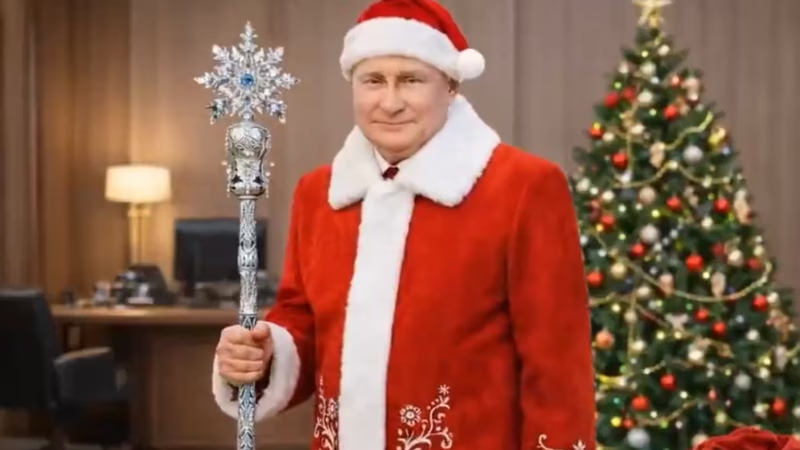
Putin’s AI Christmas Gifts: A Masterclass in Digital Geopolitics
In a year already saturated with AI breakthroughs and global tensions, an unexpected holiday video has captured the world’s attention. The Russian Embassy in Kenya, known for its provocative social media tactics, dropped an AI-generated Christmas special that’s equal parts festive and ferocious .
The video features a jolly, Santa Claus-clad Vladimir Putin delivering personalized gifts to a curated list of world leaders. But this isn’t your typical holiday cheer; it’s a stark, symbolic statement on Russia’s view of global alliances and enemies. The star recipients? Prime Minister Narendra Modi, former U.S. President Donald Trump, and Chinese leader Xi Jinping. The stark outlier? A pair of handcuffs left for Ukraine’s Volodymyr Zelenskyy .
Table of Contents
- The Viral Video Breakdown
- What Did Each Leader Receive?
- The Geopolitical Message Behind the Gifts
- Why the Russian Embassy in Kenya?
- Global Reactions and Backlash
- Conclusion
- Sources
The Viral Video Breakdown
The nearly two-minute clip, shared widely on X (formerly Twitter), uses sophisticated AI to animate a scene that feels both whimsical and deeply unsettling. Putin, as “Santa Claus,” is seen walking through a lavishly decorated hall, carefully selecting gifts from under a Christmas tree . The animation quality is high, blurring the line between satire and a serious political communication tool.
This isn’t just a random PR stunt. The timing is crucial, released just days before a potential meeting between Donald Trump and Russian officials, and during a period of heightened Russian-Ukrainian conflict . It’s a piece of digital diplomacy—or digital warfare—crafted for the social media age.
What Did Each Leader Receive?
The gifts in the Putin AI Christmas gifts video are not random. They are carefully chosen to send a direct message.
- PM Narendra Modi: Modi is shown receiving a rolled-up yoga mat. This is a clear nod to India’s soft power and its globally recognized association with yoga, a symbol of peace and wellness that aligns with Russia’s view of India as a strategic, non-confrontational partner . It’s a flattering, if somewhat simplistic, portrayal.
- Donald Trump: The former U.S. President is depicted receiving a golf bag. This is a direct, albeit cheeky, reference to Trump’s well-known love for the sport. Some analysts interpret this as Russia attempting to portray Trump as a figure of leisure and deal-making, possibly in anticipation of his potential return to the White House and his expressed desire to negotiate an end to the Ukraine war .
- Xi Jinping: The Chinese President is gifted what appears to be a traditional Chinese porcelain vase. This symbolizes the deep, strategic partnership between Moscow and Beijing, often described as being “without limits.” The gift reinforces the image of a strong, mutual alliance built on shared interests .
- Volodymyr Zelenskyy: In the video’s most controversial moment, Putin leaves a pair of handcuffs at Zelenskyy’s door . This is a brutal and unambiguous message, portraying the Ukrainian leader not as a head of state but as a criminal who should be arrested. It’s a piece of wartime propaganda designed to dehumanize the enemy.
The Geopolitical Message Behind the Gifts
At its core, this AI video is a map of Russia’s current geopolitical worldview. The “Putin AI Christmas gifts” are a stark visual representation of who Moscow sees as its friends and its foes.
The inclusion of allies like Modi, Trump (as a key political figure), Xi, and even North Korea’s Kim Jong Un , creates a club of nations that, from Russia’s perspective, are either supportive of its actions or are valuable strategic partners. Conversely, the exclusion of Western leaders like Joe Biden or Emmanuel Macron, and the direct mockery of Zelenskyy, solidifies the East-West divide that has deepened since the invasion of Ukraine.
This is a prime example of how AI is being weaponized for modern information warfare, blending entertainment with a hard-edged political agenda. For a deeper dive into the ethics of AI in media, [INTERNAL_LINK:ai-ethics-in-modern-journalism] provides a comprehensive overview.
Why the Russian Embassy in Kenya?
The choice of the Russian Embassy in Kenya as the publisher is a deliberate tactic in Russia’s global media strategy. Embassies in non-Western, Global South nations often serve as a megaphone for Russian narratives, allowing them to bypass Western media scrutiny and speak directly to a different audience . This approach aims to build sympathy and support in regions that may be more skeptical of the mainstream Western narrative on the Ukraine conflict.
Global Reactions and Backlash
The video has sparked intense debate online, with many condemning it as a tasteless and dangerous piece of propaganda, especially the depiction of Zelenskyy . Critics argue it crosses a line by using AI to spread disinformation and incite hostility.
Others see it as a darkly humorous, if cynical, reflection of current global power dynamics. Regardless of the interpretation, the video has successfully achieved its primary goal: to dominate the news cycle and force a conversation on Russia’s terms.
Conclusion
The viral “Putin AI Christmas gifts” video is far more than a holiday novelty. It’s a sophisticated, if disturbing, piece of political communication that reveals Russia’s strategic alliances and its adversarial stance toward Ukraine and the West. By gifting a yoga mat to Modi and a golf bag to Trump while leaving handcuffs for Zelenskyy, the Kremlin has used AI to deliver a Christmas message that is both personal and profoundly political. In the new age of digital diplomacy, the line between a festive greeting and a geopolitical declaration has never been blurrier.
Sources
- Times of India: Watch: Santa Putin’s Christmas gifts for world leaders
- Russia’s Sputnik News Agency Releases Controversial ‘Putin Claus’ Video
- Russian Embassy in Kenya X Post on AI Christmas Video
- Analysis of Russia’s AI Propaganda Tactics by Council on Foreign Relations https://www.cfr.org/