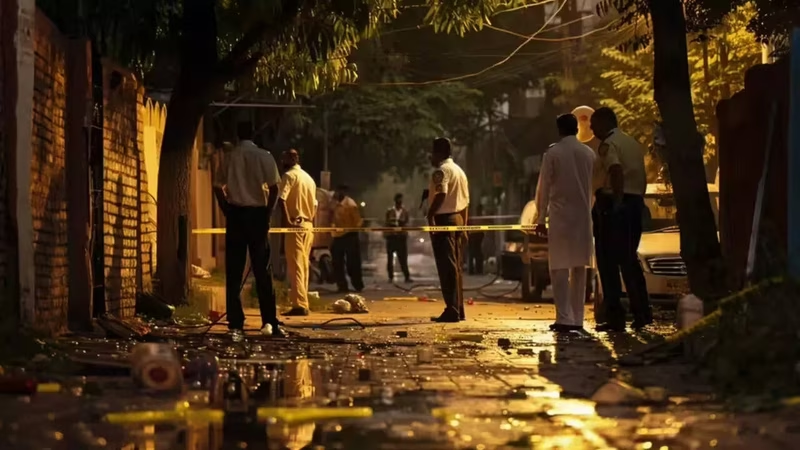
Dowry Dispute Turns Deadly: Woman Beaten to Death in Maharashtra Sparks National Outrage
In a horrifying reminder of how deeply entrenched dowry culture remains in parts of India, 35-year-old Kalpana Soni was allegedly beaten to death by her own husband and sister-in-law in Virar West, Palghar district, Maharashtra. The motive? A simple but fearless request: she wanted to leave the marriage and demanded the return of her dowry. What followed wasn’t a peaceful separation—but a brutal, fatal assault that has shocked the nation and thrust the issue of dowry death back into the spotlight.
Initial attempts to pass off her injuries as an “accident” quickly unraveled when autopsy reports confirmed she had been attacked with a sharp weapon. Both Mahesh Soni (her husband) and Deepali Soni (her sister-in-law) have since been arrested. But beyond the headlines lies a tragic pattern—one that repeats itself far too often across Indian households.
Table of Contents
- The Chilling Details of the Case
- What Is a Dowry Death Under Indian Law?
- How Common Are Dowry Deaths in India?
- Warning Signs of Dowry Harassment
- What to Do If You or Someone You Know Is at Risk
- Conclusion: Breaking the Cycle of Violence
- Sources
The Chilling Details of the Case
According to police reports, Kalpana Soni had recently expressed her desire to end her marriage. Frustrated by ongoing demands for more dowry and emotional abuse, she asked her husband to return the valuables and cash given during the wedding—a move that reportedly enraged Mahesh and his sister, Deepali.
On the day of the incident, a heated argument escalated into physical violence. Neighbors later reported hearing screams, but by the time help arrived, Kalpana was unresponsive. The family initially claimed she had “fallen” at home, but doctors at the hospital grew suspicious due to multiple deep lacerations and blunt-force trauma.
A subsequent post-mortem examination by the Maharashtra Forensic Department confirmed homicide. “The injuries were consistent with assault using a sharp and heavy object,” stated the medico-legal report. Within 48 hours, both accused were taken into custody under Sections 302 (murder) and 498A (cruelty by husband or his relatives) of the Indian Penal Code.
What Is a Dowry Death Under Indian Law?
Legally, a dowry death is defined under Section 304B of the Indian Penal Code (IPC). It applies when:
- A woman dies of “unnatural causes” within seven years of marriage.
- It’s shown that she was subjected to cruelty or harassment by her husband or his relatives.
- The cruelty was “in connection with any demand for dowry.”
If convicted under this section, the punishment is a minimum of seven years’ imprisonment—extendable to life. Additionally, Section 498A criminalizes emotional and physical abuse linked to dowry demands, though critics argue enforcement remains weak.
For more on legal protections, the National Commission for Women provides detailed guidelines at [EXTERNAL_LINK: https://ncw.nic.in], a government-backed authority on gender justice.
How Common Are Dowry Deaths in India?
Despite being illegal since 1961 under the Dowry Prohibition Act, dowry-related violence persists. According to the latest National Crime Records Bureau (NCRB) data:
- Over 6,500 dowry deaths were reported in India in 2022 alone.
- Maharashtra, the state where Kalpana’s murder occurred, ranks among the top five states for such crimes.
- Only about 35% of dowry death cases result in convictions—highlighting systemic failures in investigation and prosecution.
These aren’t just statistics—they represent thousands of women like Kalpana, whose lives are cut short over material demands that should have no place in modern society.
Warning Signs of Dowry Harassment
Many dowry-related tragedies could be prevented if families and communities recognize early red flags. Common indicators include:
- Repeated demands for cash, jewelry, vehicles, or property after marriage.
- Public or private humiliation of the bride for “inadequate” dowry.
- Isolation from friends, family, or support networks.
- Threats of abandonment or divorce unless more dowry is paid.
- Sudden changes in behavior—depression, anxiety, or fearfulness in the woman.
If you notice these signs in a friend or relative, it’s crucial to intervene—not with judgment, but with support and resources.
What to Do If You or Someone You Know Is at Risk
No one should suffer in silence. Here’s how to act:
- Call the Women’s Helpline: Dial 181 (toll-free across India) for immediate assistance.
- File an FIR: Police are mandated to register a complaint under Section 498A upon request.
- Reach out to NGOs: Organizations like Majlis Legal Centre or Snehalaya offer free legal and shelter support.
- Document everything: Save texts, voice notes, medical reports—evidence matters.
For more on legal rights, explore our guide on [INTERNAL_LINK:know-your-rights-against-domestic-violence].
Conclusion: Breaking the Cycle of Violence
The murder of Kalpana Soni is not just a crime—it’s a symptom of a deeper societal disease. While laws exist, their impact is limited without cultural change, community vigilance, and stronger institutional accountability. Every dowry death is preventable. By speaking up, supporting survivors, and rejecting dowry in all its forms—whether as givers, receivers, or silent bystanders—we can honor Kalpana’s memory and protect countless others from the same fate.
Sources
[1] Times of India: Woman beaten to death by husband, sister-in-law in Maharashtra
[2] Indian Penal Code, Sections 304B and 498A
[3] National Crime Records Bureau (NCRB) Crime in India Report, 2022
[4] National Commission for Women (NCW) Guidelines on Dowry Harassment
[5] Maharashtra Police Public Statement on Kalpana Soni Case (December 2025)