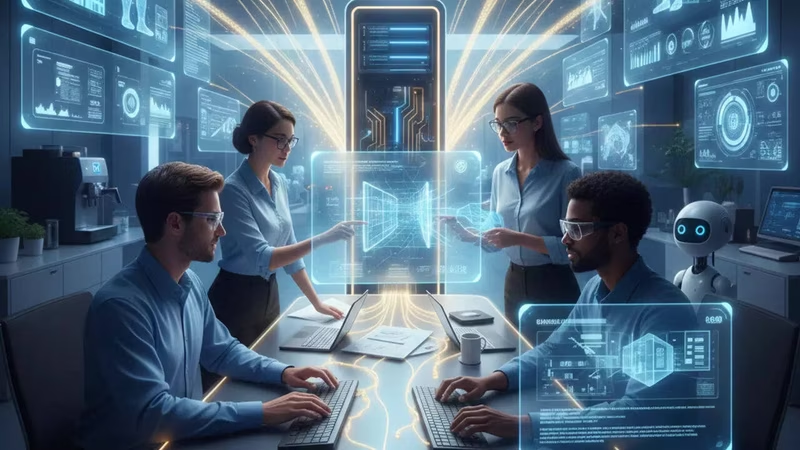
Imagine this: It’s Monday morning. Instead of sifting through 87 unread emails, your AI coworker has already prioritized them, drafted responses to routine queries, and scheduled your week based on project deadlines. It didn’t just follow orders—it anticipated your needs, collaborated with other AI agents across departments, and flagged a potential supply chain delay before your human team even noticed.
This isn’t science fiction. According to industry forecasts, 2026 marks the tipping point where artificial intelligence evolves from a passive tool into an active, autonomous partner in the workplace. The era of the AI coworker has officially begun—and it’s set to transform how we work, lead, and innovate.
Table of Contents
- What Exactly Is an AI Coworker?
- Why 2026 Is the Breakthrough Year for AI Coworkers
- India’s Bold Bet on AI Public Infrastructure
- Real-World Applications Across Industries
- The Ethical and Human Challenges Ahead
- Conclusion: Preparing for Your New Digital Colleague
- Sources
What Exactly Is an AI Coworker?
An AI coworker isn’t just another chatbot or virtual assistant. Unlike today’s AI tools—which require explicit prompts—a true AI coworker operates with agency. It can independently manage multi-step workflows, make context-aware decisions, learn from outcomes, and even coordinate with other AI systems without constant human oversight.
Think of it as a digital employee with a specialty: it might handle customer onboarding, run financial forecasts, or optimize logistics in real time. The key shift? From reactive to proactive intelligence.
Why 2026 Is the Breakthrough Year for AI Coworkers
While AI has been advancing for years, 2026 represents a convergence of three critical factors:
- Compute Power & Cloud Maturity: Cloud infrastructure has become robust, affordable, and globally accessible—essential for running complex, real-time AI agents.
- Agent Architecture Advances: Breakthroughs in agentic AI frameworks now allow systems to plan, execute, and self-correct tasks autonomously.
- Enterprise Readiness: Companies are moving beyond experimentation to integrate AI into core business processes, demanding measurable ROI.
This perfect storm means AI won’t just assist—it will own outcomes. As one tech executive recently noted, “We’re not just automating tasks; we’re delegating responsibilities.”
India’s Bold Bet on AI Public Infrastructure
Perhaps the most exciting development is India’s strategic positioning as a global leader in what experts are calling “AI public infrastructure.” The country is investing heavily in sovereign cloud platforms, AI-ready data centers, and open digital frameworks that allow startups and enterprises alike to build and deploy AI solutions at scale .
Initiatives like the IndiaAI mission and partnerships between government bodies and tech giants are creating a fertile ecosystem. This isn’t just about competing with Silicon Valley—it’s about democratizing access to connected intelligence so even small businesses in Tier-2 cities can leverage AI coworkers.
For more on India’s tech policy, check out our deep dive on how India’s DPI stack is powering the next decade of innovation.
Real-World Applications Across Industries
The impact of AI coworkers will be felt everywhere. Here’s how different sectors are preparing:
- Healthcare: An AI agent monitors patient vitals, coordinates with pharmacy bots for prescriptions, and alerts human doctors only when anomalies exceed thresholds.
- Finance: Autonomous AI reconciles accounts, detects fraud in milliseconds, and generates regulatory reports—freeing analysts for strategic work.
- Manufacturing: AI coworkers manage predictive maintenance schedules, negotiate with supply chain bots, and optimize energy use across smart factories.
- Education: Personalized AI tutors adapt lessons in real time, track student progress, and alert teachers to learning gaps before they widen.
The common thread? These aren’t replacements—they’re force multipliers that handle the mundane so humans can focus on creativity, empathy, and complex problem-solving.
The Ethical and Human Challenges Ahead
Of course, the rise of the AI coworker isn’t without risks. Key concerns include:
- Accountability: If an AI makes a costly error, who’s responsible—the developer, the user, or the algorithm itself?
- Job Displacement Fears: While AI may enhance jobs, certain roles (especially repetitive ones) will inevitably shrink.
- Bias & Transparency: Autonomous systems must be auditable and fair, especially when making decisions that affect people’s lives.
That’s why experts at the Google AI Principles and other leading institutions stress the need for “human-in-the-loop” design—even as AI grows more independent.
Conclusion: Preparing for Your New Digital Colleague
The AI coworker of 2026 isn’t coming to take your job—it’s coming to take your tasks. The future belongs to professionals who can collaborate with intelligent systems, ask better questions, and lead with emotional intelligence in an increasingly automated world.
India’s push toward AI public infrastructure means this future isn’t just for tech giants—it’s for every entrepreneur, teacher, doctor, and engineer ready to embrace connected intelligence. The question isn’t whether you’ll work with an AI coworker. It’s whether you’ll be ready to lead one.
Sources
- Times of India: Tech in 2026: The era of AI coworker and Connected Intelligence beckons
- Google AI Principles: Responsible AI Practices
- Ministry of Electronics and IT (India): IndiaAI Mission Overview
- McKinsey & Company: The Economic Potential of Generative AI