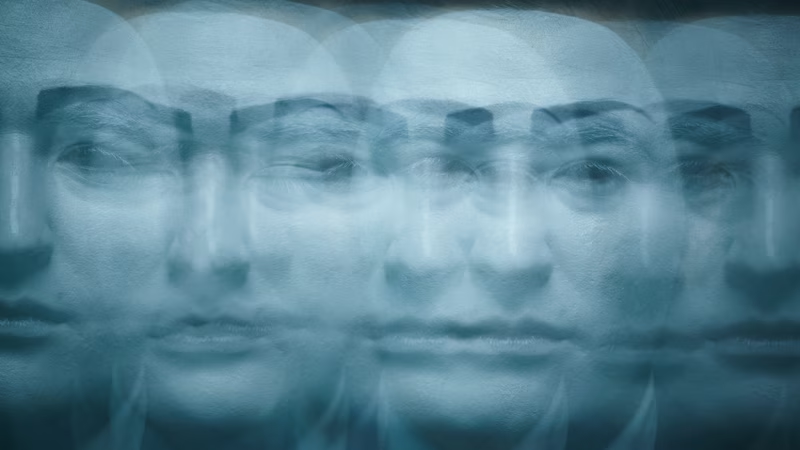
Imagine looking at a power outlet and seeing a surprised face, or glancing at a slice of toast and being convinced it’s staring back at you. For most of us, this is a fleeting, quirky illusion called pareidolia. But for people with visual snow syndrome, this experience isn’t just occasional—it’s amplified, frequent, and often overwhelming.
A groundbreaking study published in late 2025 in the journal Perception has uncovered a direct link between visual snow syndrome and a heightened susceptibility to face pareidolia . This discovery isn’t just a curious footnote; it offers a profound window into how a hyperactive brain can fundamentally reshape our perception of reality.
Table of Contents
- What is Visual Snow Syndrome?
- The Science of Seeing Faces Everywhere (Pareidolia)
- The Visual Snow Syndrome & Pareidolia Connection
- Why Migraines Make the Illusions Worse
- Living With It: Coping Strategies for Visual Snow Syndrome
- Summary: A Brain Wired for Over-Perception
- Sources
What is Visual Snow Syndrome?
Visual snow syndrome is a rare and often misunderstood neurological disorder. Its hallmark symptom is a persistent, TV-static-like flicker of tiny black, white, or transparent dots that occupy the entire visual field, 24/7 . It’s not a problem with the eyes; it’s a misfire in the brain’s visual processing centers.
Beyond the static, VSS is a complex condition that often comes with a host of other visual disturbances, including:
- Palinopsia: Seeing afterimages or trailing images of moving objects.
- Photophobia: Extreme sensitivity to light.
- <Entopsias: Seeing floaters, flashes, or other shapes within the visual field .
For years, many patients were dismissed or misdiagnosed, but growing research is finally validating their experiences as a legitimate neurological condition . If you’ve been experiencing these symptoms, it’s crucial to consult a neurologist familiar with the condition [INTERNAL_LINK:neurological-disorders-overview].
The Science of Seeing Faces Everywhere (Pareidolia)
Pareidolia is a universal human trait. It’s the brain’s remarkable, if sometimes overzealous, ability to find familiar patterns—especially faces—in random or ambiguous stimuli . Think of the “Man in the Moon” or seeing a grumpy face in a coiled garden hose.
From an evolutionary perspective, this makes perfect sense. It was far safer for our ancestors to mistake a shadowy rock for a predator’s face (a false positive) than to miss a real predator (a fatal error). Our brains are hardwired with a specialized network, often called the “face area,” that is constantly on the lookout for this critical social signal .
This network is so powerful that it can be triggered by the most minimal cues—a pair of dots above a curve can be enough to create the compelling illusion of a face .
The Visual Snow Syndrome & Pareidolia Connection
This is where the new research becomes truly fascinating. The 2025 study led by Blake W. Saurels and colleagues found that individuals with visual snow syndrome are significantly more susceptible to the face pareidolia illusion than those without the condition .
The leading theory is that the constant neural “noise” or hyperactivity in the visual cortex of VSS patients creates a fertile ground for pareidolia. The brain, already in a state of heightened visual excitement from the static, is more prone to grabbing onto any fleeting pattern and interpreting it as meaningful—in this case, as a face. This suggests that face pareidolia could potentially be a useful clinical marker for identifying or understanding the severity of visual snow syndrome .
Why Migraines Make the Illusions Worse
There’s a strong and well-documented link between visual snow syndrome and migraines. Studies show that up to 72% of VSS patients also suffer from migraines, with or without aura . This comorbidity isn’t just a coincidence; it points to a shared underlying neurological hyper-excitability.
During a migraine attack, the brain’s sensory processing goes into overdrive. This state of cortical hyperexcitability can directly intensify the symptoms of VSS, including the amplified pareidolia. The visual static may become more dense, and the brain’s pattern-seeking machinery may work even more frantically, making the illusory faces appear more vivid, frequent, or even distressing .
Living With It: Coping Strategies for Visual Snow Syndrome
While there is currently no cure for VSS, a combination of strategies can help manage its symptoms and improve quality of life .
Lifestyle and Environmental Adjustments
- FL-41 Tinted Lenses: These specialized glasses can significantly reduce photophobia and may help calm the visual system .
- Stress Management: Since stress is a major trigger, practices like mindfulness, deep breathing, and regular exercise are essential [[41], [47]].
- Sleep Hygiene: Prioritizing consistent, high-quality sleep is a cornerstone of symptom management .
Therapeutic Approaches
- Cognitive Behavioral Therapy (CBT):strong> CBT can help patients develop coping mechanisms for the anxiety and distress that often accompany chronic visual disturbances .
- Medication: In some cases, medications like lamotrigine (an anticonvulsant) or certain benzodiazepines have shown promise in managing symptoms, though their effectiveness varies greatly from person to person .
It’s important to work with a healthcare provider to develop a personalized plan, as what works for one person may not work for another.
Summary: A Brain Wired for Over-Perception
The discovery that visual snow syndrome amplifies face pareidolia is more than just a scientific curiosity. It provides compelling evidence that VSS is a disorder of brain hyperactivity, where the constant internal “static” creates a state of visual over-perception. This not only validates the real and challenging experiences of VSS patients but also opens new avenues for research and potential diagnostic tools. For those living with this condition, understanding this link can be a powerful first step toward finding effective coping strategies and managing a world that often feels far too visually noisy.
Sources
- Saurels, Blake W., Robinson, Amanda K. and Taubert, Jessica (2025). Increased susceptibility to the face pareidolia illusion in Visual Snow syndrome. Perception.
- Healthline: Visual Snow Syndrome (Static Vision): Symptoms & Causes
- Encyclopædia Britannica: Pareidolia
- Silva, E.M. et al. (2023). Visual snow syndrome and migraine: a review. Eye.
- Ayesha, A. (2025). Diagnostic and Management Strategies of Visual Snow Syndrome.