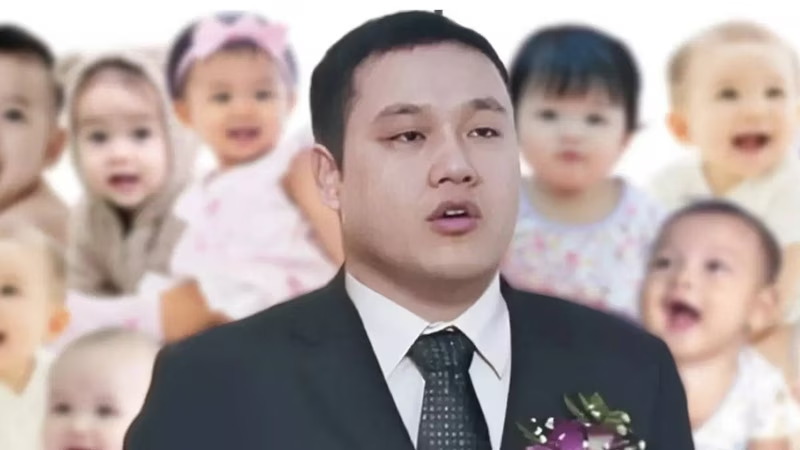
In a world where wealth, legacy, and global citizenship increasingly intersect, one Chinese tech tycoon is pushing the boundaries of traditional succession planning to a whole new level. Xu Bo, founder of the $1.1 billion gaming company Youzu Interactive, has reportedly embarked on an audacious mission: to father at least 20 children born in the United States through surrogacy, specifically so they can one day inherit and run his business empire. While the company denies claims he has over 100 children, it has confirmed that 12 of his offspring were indeed born on U.S. soil—a move that blends corporate strategy, international law, and bioethics in unprecedented ways .
Table of Contents
- Who Is Xu Bo? The Gaming Billionaire Behind the Headlines
- Chinese Billionaire Succession Plan: What We Know
- Why the U.S.? The Strategic Value of American Citizenship
- Ethical and Legal Quagmires of Global Surrogacy
- A Growing Trend Among Tech Elites?
- What This Means for the Future of Corporate Legacy
- Conclusion: Legacy Reimagined or Reckless Experiment?
- Sources
Who Is Xu Bo? The Gaming Billionaire Behind the Headlines
Xu Bo isn’t a household name like Elon Musk or Mark Zuckerberg, but in China’s gaming world, he’s a force. As the founder of Youzu Interactive, he built a company known for popular titles like League of Angels and strategic investments in global IPs. Youzu went public in 2014 and at its peak was valued at over $1 billion .
But in recent years, the company has faced regulatory headwinds in China, where the government has cracked down on gaming hours, content, and data security. Against this backdrop, Xu’s focus appears to be shifting—not just on product innovation, but on securing his legacy beyond China’s borders.
Chinese Billionaire Succession Plan: What We Know
According to reports from Chinese media and later covered by international outlets, Xu Bo has allegedly fathered more than 100 children—a claim his company strongly disputes. However, in an unusual corporate statement, Youzu Interactive did confirm that Xu has 12 children born in the U.S., all via surrogacy arrangements .
The Chinese billionaire succession plan reportedly aims to reach 20 U.S.-born heirs. Why 20? The number appears strategic—large enough to ensure redundancy (in case some heirs opt out of business) yet manageable for grooming, education, and legal oversight. These children automatically gain U.S. citizenship under the 14th Amendment, granting them rights to live, work, and—critically—own and operate businesses in the world’s largest economy without visa restrictions .
Why the U.S.? The Strategic Value of American Citizenship
For wealthy Chinese nationals, U.S. citizenship offers more than just a passport. It provides:
- Asset Protection: Shielding wealth from domestic regulatory shifts or political uncertainty in China.
- Business Flexibility: Easier access to U.S. capital markets, tech partnerships, and intellectual property frameworks.
- Educational Advantage: Direct admission pathways to elite U.S. universities without international student quotas.
- Global Mobility: Visa-free or visa-on-arrival access to over 180 countries.
In Xu’s case, raising a generation of American-citizen heirs could be a long-term hedge against China’s tightening controls on outbound investment and data flows—critical for a gaming firm that relies on global user bases and cloud infrastructure.
Ethical and Legal Quagmires of Global Surrogacy
While surrogacy is legal in certain U.S. states like California and Nevada, the practice remains ethically contentious—especially when scaled to this degree. Critics argue that commercial surrogacy can exploit vulnerable women and commodify human life .
Moreover, China bans surrogacy outright. Although Xu’s arrangements occur overseas, they raise questions about circumventing domestic laws. The U.S. State Department notes that while birthright citizenship is granted regardless of parental status, cases involving mass surrogacy by foreign nationals could attract scrutiny under immigration fraud statutes .
For more on the legal landscape, see our explainer on [INTERNAL_LINK:international-surrogacy-laws].
A Growing Trend Among Tech Elites?
Xu Bo isn’t entirely alone in rethinking legacy through biology and geography. Telegram founder Pavel Durov has spoken about wanting “many children” to carry forward his vision, while Elon Musk—father to at least 11 children—has mused publicly about population collapse and the need for more humans to sustain civilization .
What sets Xu apart is the explicit corporate linkage: his children aren’t just personal legacies—they’re intended successors with legal and financial infrastructure already in motion. This blurs the line between family and corporate governance in ways modern business law is unprepared to regulate.
What This Means for the Future of Corporate Legacy
If Xu’s plan succeeds, it could inspire other ultra-wealthy founders—especially in restrictive or volatile regions—to adopt similar models. Imagine a future where:
- Tech dynasties are built through “citizenship-by-design.”
- Corporate boards include heirs selected not just for merit, but for passport.
- Nations compete to attract bio-strategic investors via reproductive tourism policies.
Yet, it also risks deepening inequality and normalizing the idea that human life can be strategically deployed as corporate assets—a notion that challenges fundamental ethical norms.
Conclusion: Legacy Reimagined or Reckless Experiment?
The Chinese billionaire succession plan spearheaded by Xu Bo is equal parts visionary and unsettling. On one hand, it reflects a pragmatic response to geopolitical and regulatory uncertainty. On the other, it commodifies reproduction and citizenship in ways that could set dangerous precedents. As global wealth concentrates in fewer hands, how we define legacy—and who gets to shape it—will become one of the defining questions of the 21st century.
Sources
- Times of India: “Chinese billionaire who has fathered more than 100 children wants 20 US-born children to run his video game business”
- South China Morning Post: “Youzu Interactive: The rise and challenges of China’s gaming giant”
- U.S. Constitution, 14th Amendment – Citizenship Clause
- World Health Organization (WHO): “Ethical considerations in surrogacy arrangements” (https://www.who.int)
- U.S. Department of State: “Acquisition of U.S. Citizenship by Birth in the United States”
- The Guardian: “Elon Musk on having more children and saving humanity”