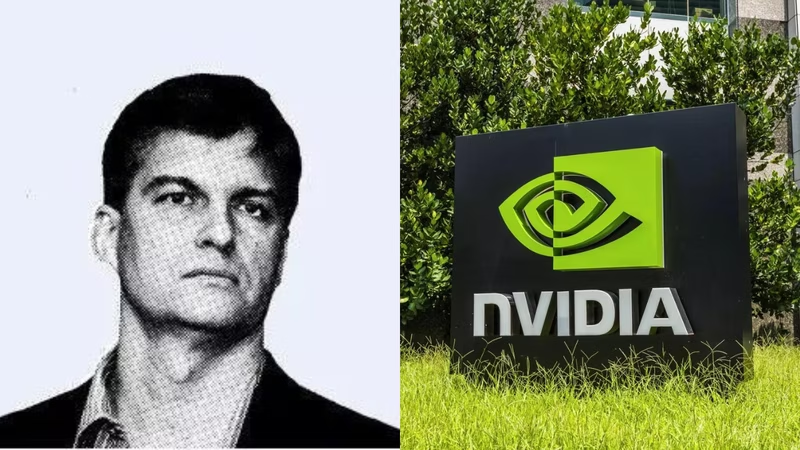
When Michael Burry speaks, markets listen. The investor who famously predicted the 2008 housing crash is now sounding the alarm on a different kind of bubble—one that could cost America its technological supremacy. In a recent, pointed warning, Burry declared that the United States is dangerously close to losing the global AI race to China. And the reason isn’t a lack of innovation or brainpower—it’s a critical shortfall in something far more basic: energy.
Table of Contents
- Michael Burry’s Audacious Claim on the AI Race
- The Nvidia Problem: Power-Hungry Chips and a Fragile Foundation
- China’s Energy Advantage: Building the Future at Pace
- Why US Energy Infrastructure Is Stalling
- What a Lost AI Race Could Mean for the World
- Conclusion: Is There Still Time for a US Course Correction?
- Sources
Michael Burry’s Audacious Claim on the AI Race
Burry’s warning, shared with his followers, cuts through the usual tech hype. He argues that while the US is betting its entire AI future on companies like Nvidia and their incredibly powerful—but massively energy-intensive—graphics processing units (GPUs), China is playing a longer, more strategic game .
“Nvidia will make you lose the AI race to China,” Burry bluntly stated. His point is that the current US model is unsustainable. The explosive growth of AI data centers is creating an unprecedented demand for electricity, a demand the American grid is ill-equipped to handle .
The Nvidia Problem: Power-Hungry Chips and a Fragile Foundation
Nvidia’s H100 and upcoming Blackwell chips are the undisputed engines of modern AI. However, they come with a massive power bill. A single AI server rack can consume as much power as dozens of homes . As AI scales, so does its thirst for energy.
The US strategy appears to be: build more data centers, buy more Nvidia chips, and hope the power grid catches up. Burry sees this as a fundamental flaw. “You can’t out-compete on a platform that is fundamentally constrained by your own energy policy,” he implies. The overreliance on one company’s hardware creates both a strategic and logistical bottleneck.
China’s Energy Advantage: Building the Future at Pace
While the US is bogged down in a complex web of environmental reviews, zoning laws, and permitting delays—a process Burry calls “deceleration”—China is executing with a top-down efficiency that is hard to match .
China is not just building power plants; it’s building an entire energy ecosystem tailored for the AI age. This includes massive investments in nuclear, hydro, and renewable energy, all coordinated with national AI ambitions . Their ability to rapidly deploy new power generation and transmission infrastructure gives them a decisive edge in hosting the vast computational farms that future AI models will require.
Key Differences in Approach
- US: Decentralized, market-driven, hampered by regulatory hurdles and NIMBYism (Not In My Backyard).
- China: Centralized, state-directed, with expedited permitting and a clear link between energy policy and national tech strategy .
Why US Energy Infrastructure Is Stalling
The core of Burry’s argument lies in the US permitting process. Building a new high-voltage transmission line can take a decade or more in America . In contrast, China can complete similar projects in a fraction of that time. This isn’t just an inconvenience; it’s a strategic vulnerability.
AI companies are already feeling the pinch. Major players like Microsoft and Amazon are reporting that a lack of available power is their biggest constraint to building new data centers . This bottleneck could slow down innovation and deployment, giving China the room it needs to catch up and potentially surpass the US in AI development and application.
What a Lost AI Race Could Mean for the World
The stakes of the AI race extend far beyond economic competitiveness. AI is poised to reshape every facet of society—healthcare, finance, defense, and governance. A world where the dominant AI framework is built in a nation with a fundamentally different set of values and governance models presents immense geopolitical and ethical challenges .
Burry’s warning is a call to look beyond the stock price of Nvidia and consider the foundational resources that will determine who truly controls the future. For a deeper dive into the geopolitical implications of AI, see our feature on [INTERNAL_LINK:geopolitics-of-ai].
Conclusion: Is There Still Time for a US Course Correction?
Michael Burry’s warning is not a prophecy of doom, but a stark call for strategic reassessment. The US still has immense advantages in research, talent, and private capital. However, to win the AI race, it must address its energy Achilles’ heel. This requires a national effort to modernize the grid, streamline permitting for critical infrastructure, and diversify its approach to AI hardware, moving away from a single, power-hungry dependency. The time for action, Burry suggests, is now—before the race is irrevocably lost.
Sources
- Times of India: Michael Burry warns America: Nvidia will make you lose AI race to China
- MIT Technology Review: Reports on AI’s growing energy demands
- BloombergNEF: Analysis of global energy infrastructure trends [[6], [11]]
- International Energy Agency (IEA): Data on electricity demand from data centers and AI