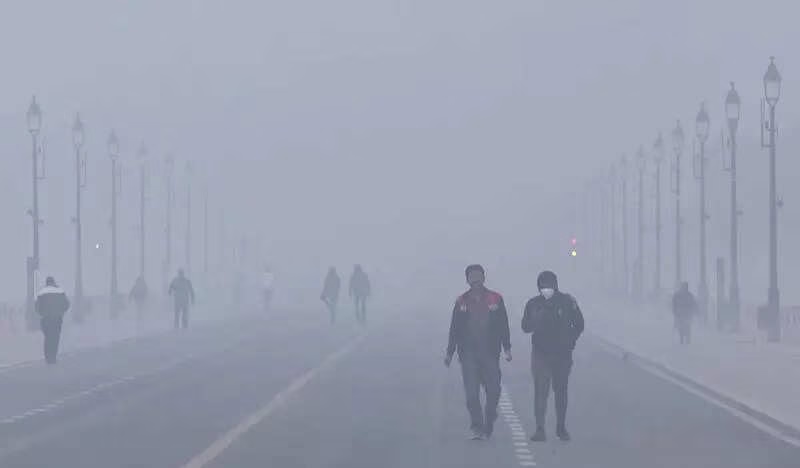
Imagine loving your job, your team, and your company, but being forced to walk away because the very air you breathe is poisoning you and your family. This is no longer a hypothetical scenario in India’s capital. In a bold and telling move, a senior corporate leader has officially declared Delhi air pollution as his reason for resignation, shining a harsh light on an environmental and public health emergency that’s now directly impacting the city’s economic and human capital.
Table of Contents
- The Resignation That Shocked the Corporate World
- Delhi’s Air Quality: A Chronic Public Health Emergency
- From ‘Pollution Leave’ to ‘Pollution Resignation’: A Growing Trend
- The Human and Economic Toll of Toxic Air
- What Companies and the Government Are Doing
- Conclusion: Is Delhi Becoming Unlivable for Professionals?
- Sources
The Resignation That Shocked the Corporate World
Rajkumar Bafna, the President of Finance at Akums Drugs and Pharmaceuticals—a company with a turnover of over ₹7,000 crores—sent a resignation email that has since gone viral in corporate circles. His message was direct and heartbreakingly simple: “Due to Delhi pollution, I am resigning from my position as president of finance” .
According to reports, Bafna, who had only been in the role for about four months, was deeply concerned about the severe health implications of the capital’s smog for himself and his family . His departure is not just a personal decision; it’s a stark business signal. If a high-ranking executive in a critical role is willing to leave a prestigious position over Delhi air pollution, it raises serious questions about the city’s ability to retain top talent .
Delhi’s Air Quality: A Chronic Public Health Emergency
Bafna’s fears are far from unfounded. Delhi’s air quality has reached a point of no return for many. In 2025, the city recorded a horrifying statistic: zero days of “Good” air quality . On December 28, 2025, the Air Quality Index (AQI) in Delhi stood at a perilous 390, categorized as “Very Poor” .
The health consequences are severe and well-documented. Exposure to this level of pollution is linked to a terrifying array of illnesses, including Chronic Obstructive Pulmonary Disease (COPD), asthma, heart disease, and even chronic kidney disease . Perhaps the most chilling statistic is that, as of 2023, one in seven deaths in Delhi is linked to air pollution . When the environment itself becomes a primary cause of mortality, it’s no longer just an inconvenience—it’s a life-threatening crisis.
From ‘Pollution Leave’ to ‘Pollution Resignation’: A Growing Trend
Bafna’s resignation is an extreme but logical endpoint of a growing trend. Companies in the National Capital Region (NCR) have already been grappling with the “pollution problem” for years. Many have been forced to reinstate work-from-home policies during severe air quality episodes to protect their employees .
There’s even an informal but widely recognized term for it: “Pollution Leave.” Employees, especially those with young children or elderly family members, are increasingly requesting time off or remote work arrangements during the winter smog season . Now, this is evolving into a more permanent solution: relocation. Skilled professionals are actively trading Delhi for cities with cleaner air, a phenomenon some are calling the rise of “smog refugees” . This brain drain poses a significant long-term risk to Delhi’s status as a corporate and financial hub .
The Human and Economic Toll of Toxic Air
The impact of this crisis is twofold. On a human level, it’s about families making impossible choices between career opportunities and their children’s health. Parents report their kids suffering from constant coughs, wheezing, and eye irritation, leading to sleepless nights and missed school days .
Economically, the cost is just as staggering. A recent analysis suggests that cleaner air could boost a city’s GDP by about 6.7% and increase incomes by over 12% . Conversely, the persistent smog is driving away the very talent that fuels economic growth. Employers are finding it increasingly difficult to retain top-level executives, who are now prioritizing their family’s well-being over a Delhi posting .
What Companies and the Government Are Doing
In response, some forward-thinking companies are taking matters into their own hands. Beyond offering work-from-home options, they are investing in high-grade air purifiers for offices, providing N95 masks, and even subsidizing employee relocations to satellite offices in less polluted areas .
However, these are band-aids on a gaping wound. A lasting solution requires a coordinated, aggressive, and sustained effort from the government to tackle the root causes of pollution—vehicular emissions, industrial discharge, construction dust, and the annual farm stubble burning. Without this, corporate adaptation will only go so far.
Conclusion: Is Delhi Becoming Unlivable for Professionals?
Rajkumar Bafna’s resignation is a watershed moment. It’s a personal story that echoes a collective sentiment felt by millions. His simple act of quitting over Delhi air pollution has given a voice to a silent exodus that has been building for years. It’s a clear message to policymakers and business leaders alike: a city that cannot provide its residents with clean air is a city that is failing its most basic duty.
For professionals across India, this incident may serve as a crucial case study in evaluating job offers in the capital. For more on how environmental factors are reshaping career decisions, see our analysis on [INTERNAL_LINK:climate-and-career-choices]. The question is no longer just about salary and position, but about the very quality and longevity of life.
Sources
- Times of India: ‘Kindly relieve me asap’: Pharma company finance president resigns over Delhi’s toxic air
- AQI.in: Delhi Air Quality Index Data [[1], [4]]
- Health & Environment Reports: The Lancet Planetary Health – Health impacts of air pollution in India [[7], [14]]
- Economic Times: Reports on corporate response to Delhi pollution [[12], [14]]