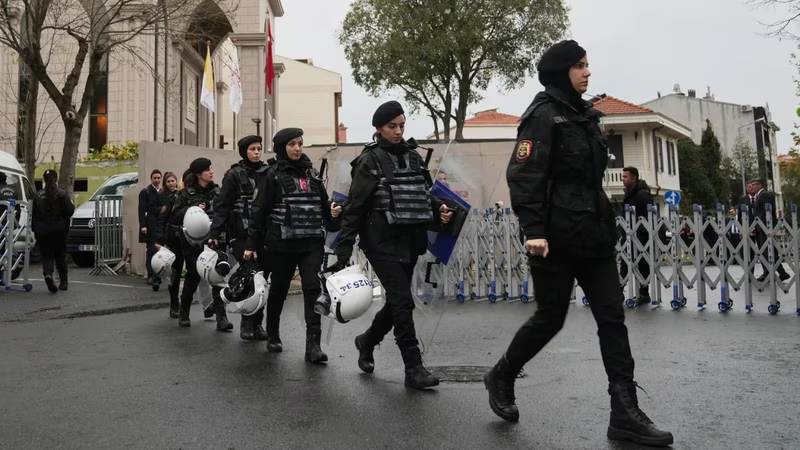
In the quiet province of Yalova, just a stone’s throw from Istanbul, a routine counter-terrorism operation exploded into a deadly firefight on Monday, December 29, 2025. The target: a suspected cell of ISIS militants. The outcome: seven Turkish police officers injured and a nation on high alert [[1], [3]].
This intense Turkey ISIS clash is a stark reminder that despite years of global efforts to dismantle the so-called caliphate, the threat of ISIS remains potent and deeply embedded, ready to erupt in the most unexpected places. But what happened in Yalova, and what does it signal about the current state of terrorism in Turkey and the wider region?
Table of Contents
- The Yalova Operation: What We Know
- Is ISIS Making a Comeback in Turkey?
- Turkey’s Counter-Terrorism Strategy: An Overview
- Why Yalova? The Strategic Significance
- The Role of Special Forces in Modern Counter-Terrorism
- Conclusion: A Fragile Peace
- Sources
The Yalova Operation: What We Know
According to Turkish security sources, the operation was a targeted raid on a known hideout of suspected ISIS militants in Yalova province, a region in northwestern Turkey adjacent to Istanbul [[2], [4]]. The police team was met with heavy resistance, leading to a prolonged gunfight. Seven officers sustained injuries, though thankfully, there have been no reported fatalities among the security forces as of now [[3], [8]].
The situation was serious enough to warrant the immediate deployment of elite special forces to secure the area and support the ongoing operation . This rapid escalation to a higher tier of military response underscores the perceived threat level and the determination of Turkish authorities to neutralize the cell completely.
Is ISIS Making a Comeback in Turkey?
The Turkey ISIS clash in Yalova isn’t an isolated incident. Security analysts have noted a worrying uptick in ISIS-related activities in the country in recent months . While the group lost its territorial stronghold years ago, its networks have proven resilient, shifting to clandestine cells that focus on planning attacks and recruitment.
Turkey has long been a key battleground in the fight against ISIS, both as a target for attacks and as a critical partner in regional security. The group has a history of carrying out devastating bombings on Turkish soil, including the 2015 Ankara bombing that killed over 100 people . The Yalova raid suggests that these sleeper cells are still active and dangerous, capable of inflicting significant harm on security personnel.
Turkey’s Counter-Terrorism Strategy: An Overview
Turkey operates under a robust and multi-faceted counter-terrorism strategy. Its approach typically involves:
- Intelligence-led operations: Using signals intelligence and human sources to identify and track terror cells before they can act.
- Rapid response units: Highly trained police and gendarmerie units capable of executing complex raids.
- Special forces escalation: The deployment of the military’s elite units, like the ones sent to Yalova, for high-risk scenarios involving heavily armed militants .
- International cooperation, particularly with NATO and regional partners, to share intelligence and coordinate efforts.
This layered defense has been largely successful in preventing large-scale attacks in recent years, but the Yalova incident is a sobering reminder that the threat is never fully extinguished.
Why Yalova? The Strategic Significance
Yalova’s location is key to understanding its appeal to militant groups. Situated on the eastern coast of the Sea of Marmara and directly across from Istanbul, it offers several strategic advantages:
- Proximity to a Megacity: Being so close to Istanbul provides access to a massive population center for potential attacks or logistical support.
- Transportation Hub: The province is well-connected by road and sea, making it easy for militants to move people and materials.
- Lower Security Profile: Compared to Istanbul itself, smaller provinces like Yalova may be perceived as having a less intense security presence, making them ideal for hiding in plain sight.
This makes Yalova a prime location for establishing a clandestine cell, which is precisely what Turkish authorities appear to have disrupted.
The Role of Special Forces in Modern Counter-Terrorism
The immediate deployment of special forces in the Turkey ISIS clash highlights their critical role in modern counter-terrorism. These elite units are not just soldiers; they are specialists trained in hostage rescue, close-quarters battle, and intelligence gathering under fire.
Their involvement shifts the mission’s objective from a standard police arrest to a military-style neutralization of a high-threat target. Their presence ensures that the operation has the firepower, tactical expertise, and command structure needed to end the threat decisively and with minimal collateral damage. Their deployment is a clear signal from Ankara that it will use its most powerful tools to protect its citizens.
For more on global special forces operations, see our analysis on [INTERNAL_LINK:special-forces-global-counter-terrorism].
Conclusion: A Fragile Peace
The gunfight in Yalova is a potent symbol of the ongoing, hidden war against terrorism. While the seven injured officers are a testament to the dangers our security forces face daily, the successful containment of the threat by Turkey’s elite units is a story of resilience and preparedness. The Turkey ISIS clash serves as a crucial wake-up call: the fight against groups like ISIS is far from over, and constant vigilance, robust intelligence, and a willingness to deploy overwhelming force are the only guarantees of a fragile peace.
Sources
- Times of India: Turkey: Seven officers injured in clash with suspected ISIS militants; special forces deployed
- Various Security Reports on the Yalova Operation [[2], [3], [4], [8]]
- U.S. Department of State – Turkey Country Report: https://www.state.gov/countries-areas/turkey/
- Historical Context on ISIS Attacks in Turkey