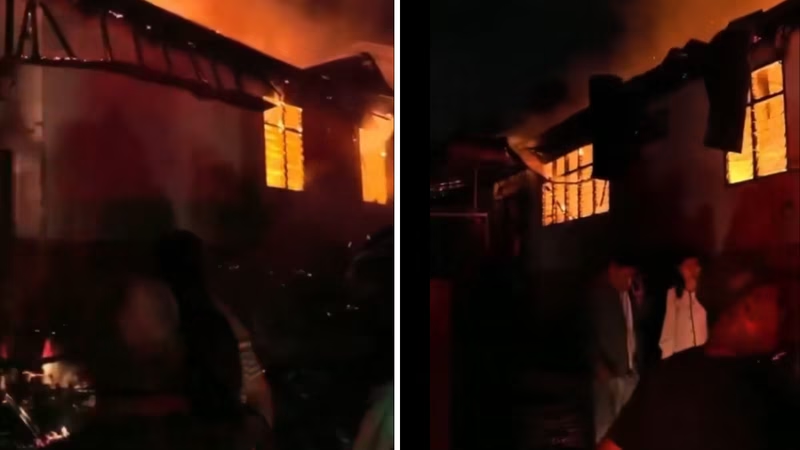
A quiet Sunday evening in Manado, Indonesia, was shattered by a horrific and all-too-common tragedy in the modern built environment: fire. The Werdha Damai retirement home, a place meant for sanctuary and care in one’s later years, became a death trap as flames engulfed the building on December 28, 2025. The final, grim toll stands at 16 elderly lives lost, with three others suffering burn injuries .
This isn’t just a local disaster; it’s a stark, global warning about the critical and often overlooked issue of fire safety for our most vulnerable populations. In this deep-dive, we’ll unpack the events of the Indonesia retirement home fire, explore the potential systemic failures, and examine what the rest of the world can learn from this heartbreaking incident.
Table of Contents
- The Manado Tragedy: What Happened?
- A Global Perspective on Nursing Home Fires
- Fire Safety Regulations in Indonesia: Are They Enough?
- Why Elderly Residents Are So Vulnerable to Fire
- Key Lessons and a Call for Action
- Conclusion
- Sources
The Manado Tragedy: What Happened?
On the evening of December 28, a fire broke out at the Werdha Damai retirement home in Manado, the capital of North Sulawesi province. The building was quickly consumed by flames, and many of its elderly residents, with limited mobility and potentially cognitive impairments, were unable to escape . Local residents bravely joined the rescue efforts, pulling some survivors from the inferno, a testament to community spirit in the face of horror [[2], [4]].
Emergency services responded, but the speed and intensity of the fire proved overwhelming. The blaze was finally extinguished late that night, leaving behind a scene of utter devastation and heartbreak . The official death count is 16, with three other individuals hospitalized for burn injuries . Authorities have launched an investigation to determine the cause, a crucial step towards preventing future catastrophes.
A Global Perspective on Nursing Home Fires
While the Indonesia retirement home fire is a local event, the problem of fire in elder care facilities is a global one. Data from the National Fire Protection Association (NFPA) in the United States is somewhat reassuring, with no recorded multiple-death fires (three or more fatalities) in nursing homes in recent years, thanks to stringent federal regulations .
However, history shows us the potential for mass casualties. In 2003, fires in nursing homes in Hartford, Connecticut, and Nashville, Tennessee, claimed 31 lives combined . Furthermore, reports have indicated that more than half of U.S. nursing homes have been found in violation of federally established fire safety standards, highlighting a persistent gap between regulation and real-world compliance .
Globally, fire is a massive public health issue, causing an estimated 200,000 deaths annually, with a disproportionate impact on the poor and vulnerable .
Fire Safety Regulations in Indonesia: Are They Enough?
Indonesia does have a framework for fire safety, rooted in its Building Law of 2002 and a hierarchy of subsequent regulations . The system requires a Fire Risk Assessment (FRA) for most building types to ensure compliance .
Yet, a critical question remains: are these regulations specific and robust enough for high-risk, high-occupancy facilities like nursing homes that house immobile residents? A 2023 study on Jakarta’s nursing homes pointed to a significant gap, noting a lack of specific regulations regarding the environmental and safety standards for public elderly care facilities .
Without mandatory, facility-specific codes that address evacuation plans for non-ambulatory residents, adequate staffing for emergencies, and the latest in fire suppression and detection technology, regulations may exist only on paper. This incident in Manado forces us to ask if a simple FRA is sufficient to prevent such a tragedy.
Why Elderly Residents Are So Vulnerable to Fire
The elderly are at a uniquely high risk during a fire for several interconnected reasons:
- Physical Mobility: Many residents rely on walkers, wheelchairs, or are bedridden. A standard evacuation plan that assumes everyone can walk quickly is a death sentence for them.
- Sensory Impairment: Hearing loss can prevent residents from hearing a fire alarm. Poor eyesight can make it difficult to find exits in a smoke-filled room.
- Cognitive Conditions: Residents with dementia or Alzheimer’s may not understand the danger, may hide, or may even wander towards the fire out of confusion.
- Slower Reaction Time: The natural aging process slows physical and mental reflexes, leaving less time to react in a fast-moving emergency.
Because of these factors, a retirement home isn’t just a building; it’s a high-dependency environment that demands a specialized, gold-standard approach to fire safety, far beyond what is expected for a standard residential building.
Key Lessons and a Call for Action
The Manado fire is a grim reminder that our systems for protecting the elderly can fail spectacularly. Here are the key takeaways:
- Specialized Regulations are Non-Negotiable: Governments must create and enforce fire safety codes specifically designed for elder care facilities, not just generic building codes.
- Investment in Technology is Critical: Facilities need modern, interconnected fire alarm systems, sprinklers in every room, and emergency lighting that guides residents to safety.
- Staff Training is Paramount: Regular, realistic fire drills that involve moving non-ambulatory residents are essential. Staff must be trained in evacuation chairs and emergency protocols.
- Global Awareness: This isn’t just Indonesia’s problem. It’s a moment for every nation to audit its own elderly care facilities. For more on this, see our deep dive on [INTERNAL_LINK:global-elderly-care-standards].
For a perspective on best practices, the U.S. Fire Administration’s guidelines on fire safety for older adults provide a valuable benchmark for global standards .
Conclusion
The loss of 16 lives in the Indonesia retirement home fire is an unspeakable tragedy. While the investigation into its cause is ongoing, the broader lesson is clear: we cannot afford to be complacent about the safety of our aging population. Their vulnerability demands a proactive, not reactive, approach to fire safety. The Werdha Damai retirement home should become a catalyst for sweeping reforms, not just in Indonesia, but across the world, to ensure that a place of care never again becomes a place of tragedy.
Sources
- Times of India: Elderly residents trapped: Indonesia’s Manado retirement home catches fire; 16 killed
- Various News Reports on the Manado Fire: [[1], [2], [3], [4], [5], [6], [7], [8]]
- Indonesian Fire Safety Regulations: [[9], [10], [12], [13], [16]]
- Global Fire Safety Statistics and Guidelines: [[17], [19], [20], [21]]
- US Fire Administration: Fire and the Older Adult