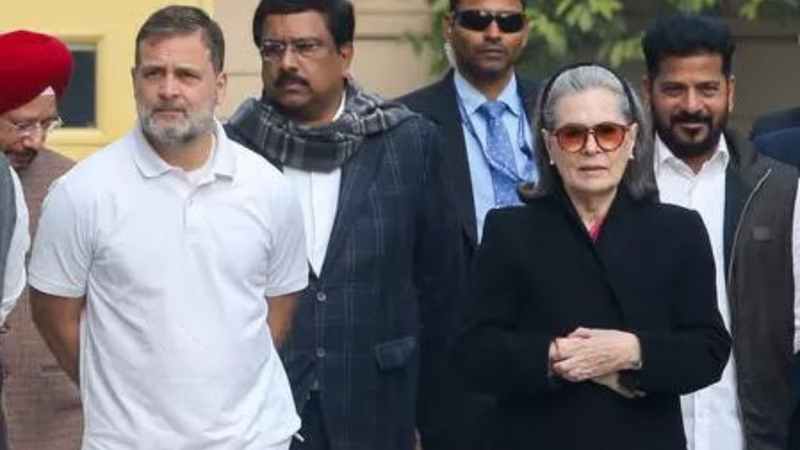
The gloves are off. In one of the sharpest political broadsides of 2025, the BJP vs Congress rivalry has escalated dramatically, with the ruling party accusing the opposition of being little more than a private asset of “fake” Gandhis—and its president, Mallikarjun Kharge, a puppet on a string .
Speaking to the media on Sunday, BJP national spokesperson Gaurav Bhatia didn’t hold back. He accused the Indian National Congress of abandoning ideology, embracing corruption, and reducing democracy to a dynastic fiefdom. The blistering critique comes amid heightened political tension ahead of key state elections and growing public scrutiny over leadership legitimacy in both parties.
But what’s behind this explosive language? And why now? Let’s unpack the charges, the context, and what this means for India’s political future.
Table of Contents
- The BJP Attack: Accusations and Allegations
- What Are the ‘Fake Gandhis’? BJP’s Controversial Claim
- Kharge as ‘Remote-Controlled’: A Symbolic Slam
- Congress Legacy Under Fire: Emergency & Anti-Sikh Riots
- Political Dynasties in India: A Broader Debate
- Congress Response and Public Reaction
- Conclusion: The Rhetoric Escalates—But What Changes?
- Sources
The BJP Attack: Accusations and Allegations
At a press briefing in New Delhi, BJP spokesperson Gaurav Bhatia laid out a scathing indictment of the Congress party. His core argument? That the party no longer represents the people—but functions as a corporate shell controlled by unelected members of the Gandhi family .
“The Congress has become the private property of the so-called ‘Gandhis’—who have no electoral mandate, no public office, yet dictate every decision,” Bhatia stated. He added that under this arrangement, even an elected president like Mallikarjun Kharge is reduced to a “remote-controlled politician” who “presses buttons on command.”
Beyond personal jabs, Bhatia also invoked historical controversies, specifically citing the 1975–77 Emergency and the 1984 anti-Sikh riots as stains on Congress’s legacy—accusing the party of whitewashing these events while claiming to champion secularism and democracy .
What Are the ‘Fake Gandhis’? BJP’s Controversial Claim
The term “fake Gandhis” is a deliberate provocation. While the Gandhi family (Nehru-Gandhi dynasty) has led the Congress for most of India’s post-independence history, the BJP’s phrasing aims to delegitimize their political lineage by suggesting it’s adopted, not authentic.
Though Feroze Gandhi—Indira Gandhi’s husband—was from a Parsi background and unrelated to Mahatma Gandhi, the family has long been publicly associated with the Mahatma’s legacy. The BJP’s use of “fake” is thus a strategic attempt to sever that symbolic connection and paint the family as opportunistic interlopers.
This isn’t the first time the BJP has used this tactic. In previous elections, Prime Minister Narendra Modi himself questioned, “Who voted for the Gandhis?”—highlighting that Rahul and Priyanka Gandhi hold no official government posts despite wielding immense influence .
Kharge as ‘Remote-Controlled’: A Symbolic Slam
Calling Mallikarjun Kharge “remote-controlled” is more than just an insult—it’s a narrative weapon. Kharge, 82, is the first non-Gandhi president of the Congress in over two decades. His election in 2022 was hailed as a step toward internal democracy.
But the BJP argues this is a facade. According to them, key decisions—from candidate selection to alliance formations—are still made by Rahul Gandhi from behind the scenes. As evidence, they point to Kharge’s rare public deviations from the Gandhi line and the continued centrality of Rahul in campaign rallies and strategy sessions.
Political analysts note that while Kharge brings regional credibility (as a Dalit leader from Karnataka), his authority within the party remains circumscribed by the Gandhi family’s historical dominance .
Congress Legacy Under Fire: Emergency & Anti-Sikh Riots
Bhatia’s invocation of the Emergency and anti-Sikh riots isn’t random—it’s designed to counter Congress’s moral posturing. During the Emergency, civil liberties were suspended, and political opponents jailed. In 1984, thousands of Sikhs were killed in state-sanctioned violence following Indira Gandhi’s assassination.
Though the Congress has issued apologies for both events, critics argue these have been performative. By dredging them up now, the BJP aims to undermine Congress’s claim to be the “custodian of democracy”—a central pillar of its 2024–25 opposition narrative.
Political Dynasties in India: A Broader Debate
It’s worth noting the irony: the BJP itself isn’t immune to dynastic politics (think of Jayant Chaudhary in RLD or even Modi’s protégés being positioned as heirs). Yet the scale of Congress’s reliance on one family is unmatched.
According to a 2023 study by the Centre for the Study of Developing Societies (CSDS), over 38% of Congress MPs come from political families—compared to 27% for the BJP . The Nehru-Gandhi dynasty has produced three prime ministers and led the party for over 60 of its 138 years.
This concentration of power fuels the BJP’s “private asset” narrative—and resonates with voters frustrated by a lack of internal democracy.
Congress Response and Public Reaction
As of Monday, the Congress has not issued an official rebuttal, though party sources told The Hindu that they view the attack as “desperate deflection” ahead of upcoming by-elections .
On social media, reactions are split. BJP supporters applaud the “truth-telling,” while Congress loyalists accuse the BJP of hypocrisy—pointing to its own leadership centralization around PM Modi. Still, independent observers note that the BJP’s messaging is effectively framing the Congress as outdated and undemocratic.
Conclusion: The Rhetoric Escalates—But What Changes?
The BJP vs Congress war of words is heating up, but the real battle is for India’s political soul. By branding the Congress as a “dynastic asset” and Kharge as a figurehead, the BJP isn’t just attacking opponents—it’s offering a vision of merit-based, centralized leadership under Modi.
Whether this narrative sticks will depend on Congress’s ability to demonstrate genuine internal reform and Kharge’s willingness to assert independent authority. Until then, expect more fiery speeches—and fewer handshakes.
For deeper insights into India’s political dynasties, explore our analysis on [INTERNAL_LINK:future-of-dynastic-politics-in-india].
Sources
- Times of India. (2025). BJP: Congress has become asset of ‘fake’ Gandhis; Kharge a ‘remote-controlled’ politician. Retrieved from https://timesofindia.indiatimes.com/india/bjp-congress-has-become-asset-of-fake-gandhis-kharge-a-remote-controlled-politician/articleshow/126221997.cms
- Centre for the Study of Developing Societies (CSDS). (2023). Dynastic Politics in India: Trends and Impacts. https://www.csds.in
- The Hindu. (2025, December 29). Congress Silent on BJP’s ‘Remote-Controlled’ Jibe.
- Election Commission of India. (2024). Political Party Leadership Structures Report.